Posts Tagged ‘Internet Advertising’

How Huffington Post and Obama Killed the New York Times Online

Wednesday, October 22nd, 2008

AdAge revealed recently that the New York Times reported a steep 17.9% decline in ad revenues for July. Not unexpected, as many print behemoths are getting pummeled in this economy. (See related post “Is Digital Marketing Killing Magazine Ads”) However, NYTimes.com and the company’s other online efforts grew only .9% in July, compared to double digit increases throughout most of the past year. 

My initial thought was along the lines of “what’s the big deal? they still grew .9% which is 10.8% annualized and that’s not bad.” 

But, once I started to look more deeply at the data, I found two revealing patterns that explain the sudden stop in NYTimes.com ad growth.

Obama - the King of Web Traffic

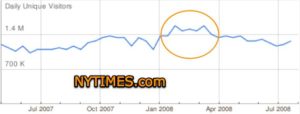
Looking at NYTimes.com data from Google Ad Planner I found that NYTimes.com, WashingtonPost.com and other print-based portals showed significant growth in average daily visits from January through March of this year. While of course there were other national and world events during the first quarter of this year, the rise of Obama and his unexpected (to many) vigorous challenge of Hillary Clinton was a recurring and dominant news story. 

NYTimes.com traffic past 12 months:

WashingtonPost.com traffic past 12 months:

To see an even more pointed display of the Obama Effect on Web traffic, here’s the Google Insights search volume graph for “Barack Obama” for this year. Note the huge spike in searches in the first quarter.

“Barack Obama” search volume - 2008

Now that Obama has the nomination and we don’t have daily Barack v. Hillary drama, search volume has cooled (although a recent spike (convention-related?) is evident). This no doubt is a bellweather for overall public interest, and examining the more recent traffic for NYTimes.com and WashingtonPost.com demonstrates this effect. While Google doesn’t provide exact figures, I estimate a total daily audience erosion of 25% for NYTimes.com and 45% for WashingtonPost.com from Obama-mania to today. 

Expecting NYTimes.com to continue growing ad revenue when traffic dips considerably is unrealistic. The bigger question is whether they can hold on to the ad revenue they have, now that the Obama effect on traffic is waning.

Blogs Are Beating Traditional Media Powers at Internet Publishing

The Obama effect is not limited only to traditional media portals. Spikes were seen for all the major political-oriented blogs (most of whose readers also read NYTimes.com, according to Google Ad Planner). Dailykos.com, Huffingtonpost.com, Thepolitico.com, Realclearpolitics.com, et al all showed spikes that looked like this:

HuffingtonPost.com traffic past 12 months:

Notice that even though HuffingtonPost.com and the rest of its blog-based brethren were helped by the Obama effect in the first quarter, their traffic today is HIGHER than it was at the beginning of the year pre-Obama. 

DailyKos.com traffic past 12 months:

I interpret this as Obama mania driving significant number of Web visitors to sample sites that they may not have used much (if at all) previously, most notably the high profile, opinionated, and hyper-current political blogs. These sites have been able to hold on to substantially greater portion of their increased audience than have the traditional media portals. 

To me, these findings call into question the ability for traditional portals to continue growing significantly. It appears that as media continues to fragment and consumers have more and more choices, blog-based journalism seems to resonate with a greater percentage of the population. 

Obviously, traditional media portals aren’t going away. After all, NYTimes.com does have 6X the audience of the Huffington Post. However, given that it costs peanuts to produce the Huff compared to NYTimes.com, and given the traffic trends examined here, over the long-term I see the uber blogs becoming more and more dominant, provided they don’t lose their opinionated appeal as they grow.

It’s increasingly clear that consumers want a dash of opinion with their news, regardless of medium, and their journalistic credo and huge overhead is going to make it a difficult future for the newspaper-based Web sites. Ultimately, it spells a slow death for NYTimes.com and other traditional media entities.

Related: Why the Murder of Old Media is PR’s Best Chance


Get my blog posts in your email>>

Similar Posts That You Might Enjoy

Welcome. If you liked that, there's plenty more. Please subscribe to my RSS feed. You can also find me on Twitter @jaybaer

Jason Baer

Why PPC is about to skyrocket - and then CRASH

Tuesday, October 14th, 2008

Times are tough.

But one area that is ready to soar is pay-per-click search marketing (PPC). That most measurable and controllable of digital marketing opportunities, PPC looks like a no-brainer in this economy.

Have you called a newspaper lately and asked them if they’ll charge you per phone call generated? Even with ad sales down 14% year over year, they won’t do it. 

Thus, with the holiday season approaching and a flinty consumer base not exactly killing themselves to buy the latest electronics or must-have toy (it’s Foreclosure Elmo), PPC looks like a no-lose proposition for retailers and e-tailers.

PPC - The Rich are Going to Get Richer

With PPC spend already up 52% in Q1 2008 versus 2007, the number of PPC advertisers and the money they’re going to throw at clicks is about to get insane. The competition for clicks, leads and sales in the 4th Quarter is going to be fierce, and I suspect there will be some “make us #1 no matter what” money in the game as casual PPC advertisers pull money from TV and print. 

It’s going to require exceptionally smart bidding (think day-parting) and a serious commitment to landing page testing to succeed. 

The problem is, this huge thirst for clicks is going to drive average cost per click through the ceiling. Google is already substantially most expensive on a per click basis than is Yahoo or MSN. Further, according to Efficient Frontier and their excellent Q2 search engine report (PDF) Google is getting $1.10 of each new dollar of PPC spend (Yahoo is minus 9 cents, and Microsoft is minus 1 cent). 

PPC - The Rich Are Then Going to Get Poor

The price of a click on Google is going to go WAAAY up over the holidays. So much so that ROI on those clicks will inevitably diminish, especially with consumers in “I think I’ll go to the Hickory Farms store in the mall and have 11 free samples and call it lunch” mode. 

At the end of January, hundreds of thousands of PPC advertisers will look at their reports (especially Google) and say “this isn’t worth it anymore.” 

February 1 will be the day the music died for PPC, and a long period of very modest growth will ensue as newcomers adopt a “we tried that back in 2008 and it almost broke us” mentality. 

Get yourself a killer test plan, a shot of Jim Beam (hat tip to Jason Falls) and manage client (and your own) PPC expectations. It’s going to be quite a ride. 


 Similar Posts That You Might Enjoy

Jason Baer

The 10 Strengths of the Agency of the Future

Tuesday, September 16th, 2008

Web services giant Sapient recently fielded a national online digital marketing survey of more than 200 chief marketing officers (CMOs) and senior marketers responsible for managing digital budgets (among other things).

Survey respondents were asked about the top qualities they sought in their advertising and marketing agencies in the coming year.

Sapient’s Top 10 Wish List for Agencies of the Future…and My Comments

1. Greater knowledge of the digital space. With more than a third of marketers surveyed revealing that they are not confident that their current agency is well-positioned to take their brand through the unchartered waters of online digital marketing and interactive advertising, it’s clear that agencies need to have a greater knowledge of the digital space in order to thrive. In fact, nearly half (45 percent) of the respondents have switched agencies (or plan to switch in the next 12 months) for one with greater digital knowledge or have hired an additional digital specialist to handle their interactive campaigns.

This is another in a series of warnings from me that traditional agencies NEED to get uber-competent at digital marketing now. Clients are switching agencies based on digital marketing knowledge. See my post “Wake Up Agencies - Digital Shops = Trojan Horse” for more.

2. More use of “pull interactions.” When trying to engage consumers with their brand, 90 percent of respondents agree that it is becoming increasingly important that their agency uses ‘pull interactions’ such as social media and online communities rather than traditional ‘push’ campaigns.

No question this is true, and it will be even more acute in 2010 when Millennials (who prefer organic sources of information and recommendations) become a larger demographic cohort than Boomers or Gen X. 

3. Leverage virtual communities. An overwhelming 94 percent of respondents expressed interest in leveraging virtual communities (public and private) to understand more about their target audience.

This one is a little fuzzy for me. It sounds like market research using social networks. That can work, but if this list is in order, no way is this #3 for the future of agencies. On a related note, check out Rapleaf. They take a database (your client’s email list, for example) and cross-reference it against all the social networks so you can figure out if you should emphasize MySpace, Facebook, LinkedIn, or something else. Cool, and potentially massively useful. 

4. Agency executives using the technology they are recommending. Ninety-two percent of respondents said it was ‘somewhat’ or ‘very’ important that agency employees use the technologies that they are recommending. For example, it is important that agency executives regularly use Facebook, Flickr, wikis, blogs, etc. in their personal social media mix.

The fact that this even made the list is an indictment of the advertising profession. If you’re going to pitch a social media campaign to a major client, you might want to have a Twitter account (among other things). It’s like SEO firms that aren’t ranked anywhere on Google for their own services. The Emperor has no clothes.

5. Chief Digital Officers make agencies more appealing. Forty-three percent of marketers surveyed said that agencies with chief digital officers are more appealing than those without.

I agree that having somebody in charge of digital strategy in an agency can be beneficial (disclosure: I had this role at Off Madison Ave for nearly 3 years). However, that approach only works if the agency has many digital experts, and just needs someone to steer the ship. Too many small and mid-sized agencies far prey to the “guru syndrom” and hire one Internet guy to handle all digital marketing for their agency. Big mistake. If that guy leaves (and he will), you’re screwed. And, centralizing digital expertise gives the rest of your staff an excuse to not get better at digital marketing. Don’t do this. See my series of training workshops for agencies on how to not get your whole agency competent at digital marketing. 

6. Web 2.0 and social media savvy. Sixty three percent of marketers surveyed said that an agency’s Web 2.0 and social media capabilities are ‘important/very important’ when it comes to agency selection.

Yes. Related to a couple of the points above. However, it’s critical for agencies to have a social media strategy for their clients, not just a random collection of social media tactics. Building a wikipedia page is not a strategy.

7. Agencies that understand consumer behavior. Seventy-six percent of respondents deemed this as an ‘important/very important’ aspect of their agency’s online digital marketing and interactive advertising area of expertise.

Isn’t this what agencies are supposed to be doing now (never mind the future)? This will be a huge determinant on agency winners and losers in the future, because Google and others will take away agencies’ revenue streams that are procedural rather than strategy and creative-driven. See my post about Google looking to crush agencies for scary details. 

8. Demonstrate strategic thinking. Seventy-seven percent of marketers surveyed ranked strategy/brain trust capabilities at the top of their agency wish list.

Yes. See #7. Same thing in my book. 

9. Branding and creative capabilities. Sixty-seven percent of respondents ranked branding at the top of their agency wish list while seventy-six percent ranked creative capabilities as ‘important/very important.’

This one is definitely more future looking than some of the others. At present, especially for the mid market, digital marketing can sometimes be very successful without great branding. But that will change, and agencies MUST get their creative teams comfortable with digital. How do creative directors get away with “I don’t really understand online, so I have our junior art director do that stuff”? Would that work for radio? For outdoor? For magazine? Well guess what, Internet advertising is larger than all three of these media types (U.S. annual spend).

10. Ability to measure success. It’s no surprise that marketers want an agency that can report on where campaigns succeeded, fell short and where they should be fine-tuned. Sixty-five percent ranked analytics at the top of their agency wish list.

This is the secret weapon of digital marketing and what makes it superior to traditional in some ways. Agencies that aren’t using the inherent measurability of interactive marketing to their advantage are missing the boat. The reason digital marketing will thrive in the recession is its targeting and tracking components. 


What do you think? Are there other attributes the agency of the future must have? Jetsons-style flying car? Extreme Wii proficiency? Please leave a comment with your ideas.

Perhaps you’d like to receive these blog posts via email?


Similar Posts That You Might Enjoy

Jason Baer

Customized Internet Marketing Training for Agencies

Thursday, September 11th, 2008

Convince & Convert launches new training program series to help agencies improve their digital capabilities

Addressing the needs of ad agencies and PR firms to improve their digital marketing competency, Convince & Convert is now providing a series of customizable, in-person training programs.

We are offering 5 intensive, all-day sessions to train ad agencies and PR firms on a wide variety of critically important digital marketing services including:

Digital Marketing Audits & Action Plans
2 days on site interviewing staff and reviewing interactive marketing work samples, followed by creation of a detailed 90 day action plan.

Winning Search Engine Optimization & PPC Techniques
Includes training exercises on SEO copywriting, link building, PPC ad creation, bid management, and reporting.

Relevant Email Marketing That Works
Learn how to segment recipient lists, boost click through rates, and deliver killer email ROI to your clients.

Internet Advertising Tactics and Targeting
Learn how to craft solid online media plans, how to maximize effective targeting, and the 4 rules for effective Internet creative.

Social Media - The Roar of the Crowd
Learn how to create layered social media programs that get measurable results for your clients, and how to monetize social media efforts.

Better Than Conferences

“Sure agency staff can go to conferences, but they typically are full of theory and case studies,” said Jason Baer, President of Convince & Convert. “We deliver training that’s hands-on, tactical, and relevant. After our sessions, agencies can begin implementing the next morning,” he said.

All Convince & Convert training programs are conducted at the agency’s location, eliminating travel time and expense for attendees.

Programs are customized for each agency, and all attendees receive personalized workbooks and implementation materials, including checklists, vendor recommendations, and step by step procedures for digital marketing success.

After the training sessions, we conduct follow up Webinars with all attendees to answer questions and oversee implementation.

“Too many agencies are trying to handle advanced digital marketing for their clients, without the expertise to do so,” said Baer. “These new training programs will give agencies the serious know-how necessary to compete with digital specialists.”

>>Call or email to discuss setting up customized training at your agency

 Similar Posts That You Might Enjoy

Jason Baer

The Alarming Truth About Digital Marketing’s Imperfections

Monday, September 8th, 2008

A One Legged Stool

My Job, Pre InternetThere’s no question the Internet has been good to me. The last two jobs I had before getting involved in Internet marketing in 1994 were spokesman for the Arizona Department of Juvenile Corrections (prison tours), and marketing director for Waste Management (landfill tours). I prefer this gig as it is smell and horror-free.

I’ve been doing the Internet thing long enough, however, that my hype detector is finely honed (when I hear the words “designer dog” my nose runs). And lately, the more I read about this new online boom, the more Kleenex I grab.

No question, online marketing has many enticing characteristics like trackability, ease of implementation, and targeting (all of which I’ve chronicled in these pages). But I’ve witnessed more than a handful of conversations recently where clients and even agencies have pondered “maybe we should only do online?”

The Internet Isn’t Magic

That chalk mark on the ground? That’s the line between enthusiasm and crazy, and you just crossed it. People are being lured into an illusory sense that just because it’s digital, it defies the laws of marketing. That just because a trial campaign was boffo, a 400% increase in budget should yield a commensurate increase in results.

There are a few, highly targeted businesses – especially those that operate only online – that can succeed with a purely digital marketing approach. But for most real world companies, online-only (or even online dominant) marketing will not succeed.

The Difference Between Demand Creation, and Demand Fulfillment

Why? Because at its very core, digital marketing fulfills demand much better than it creates it. The digital tactics that work best (email to current customers, search marketing, highly targeted banners, social media) work because they reach an audience that is either already aware of your company, or susceptible to your charms based on their needs and lifestyle.

At any moment in time, there are a finite number of prospective customers that are aware of your service, interested in your service, and online. Thus, there is a ceiling on the effectiveness and size of any winning digital campaign. Approximately 100 people will search today for “RV rentals.” And not much can be done online to increase that number. You can do everything possible to maximize your exposure to those 100 searchers, but that’s the size of the potential customer pool via search at present.

To grow the pool of people who are clearly interested in RV rentals (as evidenced by their search query), you have to use the much maligned and uncool world of traditional marketing. By using print, broadcast, direct mail, event sponsorship, and public relations you can grow the awareness and demand for your product or service, and PRESTO that demand will show up online.

Learn From Cupcakes

For example, an examination of historical search volume for “cupcakes” shows a consistent, slightly increasing number of daily searches from 2004 through 2006. Beginning in 2007, when the media began running frequent stories about the new gourmet cupcake trend (no doubt prodded by professional PR practitioners), search volume for “cupcakes” spiked, with a 300% increase.

….While you’re here, sign up to get my blog posts in your email

1+1=3

At Off Madison Ave, (where I handle strategic planning) we often engage in a tactic called “Media Isolation” to measure this effect and produce efficient media plans. Try it for yourself.

Take a two to four week period and run only PPC and SEO. No other outbound efforts. Then, keep the search campaign up, and add offline tactics. Reexamine results of the search program. Then, take down the traditional campaign, and continue running the search campaign.

What you’ll find in essentially every case is that the initial online campaign produces results that increase by 50-100% when traditional media is added. But most interestingly, the search campaign continues to perform better than it did initially, even when traditional media ceases. Why? Because the traditional program increased demand, and then the online tactics fulfill that demand.

This concept that offline marketing improves online marketing is powerful, but it can sometimes take a while to prove, when you consider that search latency (the time lag between when a consumer first searches for you and when they buy) can be as long as 90 days. Look at your reports in three and six month increments, not just monthly intervals, to help identify these relationships and trends.

From a marketing strategy standpoint, maximizing the effectiveness of your online efforts is a great first step, as the available data and feedback immediacy produce ROI faster than other tactics. But if you want to seriously grow your customer base, you have to put down the black turtleneck and Red Bull and employ a true mix of marketing approaches that work together to increase the number of people that care enough about your product to bother looking for it.

What do you think? Am I being too hard on Internet marketing? Leave a comment

More posts about using a true media mix>>

My digital marketing training workshops for agencies>>

Get my blog posts in your email>>

Similar Posts That You Might Enjoy

Jason Baer

Wake Up Agencies - Digital Shops = Trojan Horse

Tuesday, September 2nd, 2008

It was bound to happen, and now it has. A big-time digital agency (R/GA) has opened up a full-fledged brand development arm.

And whom do you think they will be competing against with this new branding department? Other digital agencies? Nope. They are aiming for traditional agencies and the branding, media placement, and creative budgets they enjoy. The division is headed up by an ex Wieden & Kennedy executive.

To quote from AdAge:

Branding is a logical progression for R/GA, an agency that focuses on digital design for clients — for example, its Nike Plus work. It’s also another example of R/GA’s aggressive expansion into other marketing disciplines; the shop was originally known for its web work but has added TV production and media planning in the past few years. 

Digital marketing is going to grow. That’s unquestioned (see blog post about growth rate). But the smart digital agencies aren’t satisfied with consuming that piece of the marketing pie. They figure that if they can master the digital component - widely recognized as the most complicated aspect of marketing - surely they can handle traditional branding and advertising. I see a horse. His name is Trojan.

As social media (see blog post on social media’s role) becomes a more important part of public relations, this argument becomes more valid. It’s further supported by the increasing ties between online and offline media, with traditional media tactics driving traffic to landing pages (see blog post about landing page testing) and campaign microsites.

This is not just a national, big agency trend. In every market in the country, digital agencies are adding PR 2.0 divisions to specialize in social media, and are trying to deliver traditional services. With the digital marketing DNA being firmly rooted in measurement and analytics, digital shops are using tracking reports and low cost new media tactics to convince advertisers that they know a better way.

Forty Agency in Chandler, Arizona is a good example. Formerly a Web design and application development firm, they have branched out into branding and social media PR. They’re not doing broadcast production or traditional media buying, but that’s a logical next step. 
 

Agencies, the time is now

This is the official call to arms. Traditional agencies have to get serious about digital marketing now (see blog post about how to embrace digital). Not only are you not tapping into your clients’ digital budget, but you run the risk of those clients beginning to think that their beloved advertising and PR agencies just haven’t kept up with the times.

Agencies that want to do the “easy” digital stuff like building Web sites, but don’t want to get their hands dirty with SEO, analytics, or other numbers and process intensive services just perpetuate clients’ thinking that digital shops understand the future better than traditional firms.

It’s not too late. Is digital marketing complicated? Absolutely. Is it out of reach for advertising and PR firms that want to commit to it? Absolutely not. But you have to take the plunge pretty soon, or the curve to catch up will be exceedingly steep.


Comments? Any digital agencies want to admit to their master plan? Any traditional shops feeling threatened and ready to do something about it?


How I help ad agencies & PR firms get better at digital marketing>>
Get my blog posts in your email>>

Similar Posts That You Might Enjoy

Jason Baer

Internet Advertising to Grow 20% in 2008

Wednesday, August 13th, 2008

A new report from Bernstein Research says online advertising in the U.S. will grow by 20% in 2008, despite weakness in travel, auto, and financials.

Top categories for online advertising spend include:

  • Finance, insurance, real estate - 29.6% of overall spend
  • Media and entertainment - 25.2%
  • Retail - 13.8%
  • Other - 12.9%
  • Auto - 8.6%
Despite big cuts in auto marketing in broadcast and print, online ads for automakers were actually up 3.8% in the first quarter. (see my blog post about auto advertising online, and why it works)

According to Bernstein’s forecast, even a significant worsening in overall economic conditions wouldn’t deter Internet advertising growth much. In a full-blown recession scenario, they predict online ads would still grow by 17%. (See my blog post on “Why Digital Marketing Will Thrive in a Recession” for more on this topic).

The Question for Agencies…

This research begs an obvious question for agencies? Are there other elements of your business that are likely to grow by 20% this year? If not, is it time to ramp up your digital capabilities?

Any agency readers of Convince & Convert care to comment about their digital progress in 2008?

How I help ad agencies & PR firms get better at digital marketing>>
Get my blog posts in your email>>
 

Similar Posts That You Might Enjoy

Jason Baer

Ad Networks Are a House of Cards - But a Great Deal

Tuesday, August 12th, 2008

A groundbreaking study by the Interactive Advertising Bureau (IAB) and Bain & Company shows that ad networks’ share of display ad sales soared from 5% to 30% from 2006-2007. (Read the excellent full report here)

It seems the rise in Internet advertising (~20% per year, according to eMarketer) is creating a flurry of new sites, and a scenario where established sites keep adding more content, and thus more ad inventory.

For agencies, the opportunity is tremendous because ad networks charge $2-$3 per one thousand ad impressions, while buying ads direct from a site can run $20 or more. Certainly, sites often hold back premier ad placements for direct sales, giving ad networks less attractive, run of site inventory. However, if one ad buy is at a $2 CPM, and the other ad buy is at a $20 CPM, it is extremely unlikely that the premium inventory will perform 10 TIMES better than the non-premium placements.

There are literally dozens of ad networks now, each willing to place ads for your clients on Web sites, including highly targeted behavioral and retargeting opportunities. (Decent list of reputable ad networks here) Given that you can buy solid inventory at a fraction of the cost, why wouldn’t you use ad networks almost exclusively, especially for test campaigns when you’re trying to optimize creative and call to action? (my blog post on how to optimize online ads)

From 2006 to 2007, sell out rate (the percentage of overall ad inventory sold) by premium publishers covered in the IAB study actually went UP from 55% to 72%, but that was due almost entirely to the huge increase in ad network placements. Thus, sites are turning more and more of their ad inventory over to networks that are paying them a pittance for it, figuring “some dollars are better than no dollars.” This of course is true in the short-term, but eventually this house of cards will fall.

Sites cannot continue to sell an increasing share of their ads at a couple bucks per thousand, unless their content creation overhead is extremely low. And even ad networks that are booming at present with a 600% annual growth rate, cannot sustain it. As more ad networks come online, downward price pressure will only increase, making it difficult for ad networks to make much margin on their arbitrage. Failures and consolidation will occur quickly.

Advice for Agencies

Consequently, my advice for agencies is to use ad networks as much as possible for your online media purchases, especially in the testing phase. However, use first-tier networks at all times, and use multiple networks.

Realize that your preferred network may not be around very long, and when the consolidation begins, it will happen FAST, so make sure your in-house team (either media or account executives) legitimately know enough to be dangerous about Internet advertising placement to keep you in the game if the precarious ad network situation blows up in your face.


How I help ad agencies & PR firms get better at digital marketing>>
Get my blog posts in your email>>

Similar Posts That You Might Enjoy

Jason Baer

3 New Features for Google’s Ad Planner

Tuesday, August 5th, 2008

Google announced on Friday via one of their blogs that they have added 3 new features to Ad Planner. 

(note: for more about Ad Planner, and Google’s long-term plan to totally change the ad agency business, read this post from Convince & Convert’s greatest hits)

Impressive that Google has made pretty significant upgrades to Ad Planner only a month after launch, and the new features make it an even more useful tool for ad agency Internet advertising buyers.

  • They’ve added more detail on sites, including a lot of stickiness metrics like time spent, total views, and average visits per visitor. This really helps understanding the potential engagement level of sie visitors.
  • If you already have sites that you know you need to include in your plan (either they’re must buys, or you’re already running them, etc.) you can just type them in, rather than having to search for them in the Ad Planner interface. 
  • Visual indicator that the site is in the plan. This is a helpful step, as it displays an icon next to sites you’ve already included so that you don’t add the same site multiple times. Nice usability touch.
If you haven’t tried Ad Planner yet, you can request an account here

I’ll review Ad Planner in-depth in a future edition of the Convince & Convert Agency Advantage Tools

Have you tried Ad Planner? Leave a comment and let me know what you think. 

How I help ad agencies & PR firms get better at digital marketing>>
Get my blog posts in your email>>

Similar Posts That You Might Enjoy

Jason Baer

Agency Advantage Tools #2 - Yureekah

Friday, August 1st, 2008

The variety and quality of banner ads online is truly staggering. From the infamous X10 Camera pop-up, to Punch the Monkey, to today’s highly engaging rich media video ads, turning out great banner creative is a universal challenge.
PUnch the monkey banner ad

For nearly every facet of the creative process, there are libraries that can be used for inspiration. Font collection. Stock photography. Creative annuals. But until now, thinking through a banner ad design consisted of going to a few Web sites you like and hoping to find an ad that actually looked decent.

Not anymore.

Finally, a Banner Ad Search Engine

Yureekah is a free Web site that enables you to search banners ads by country (currently, U.S. U.K., India, and somewhat unexpectedly the United Arab Emirates), brand, or keyword. The site then returns a collection of banner ads matching your query, including where those ads are running.

For example, a global brand search for “Ford” returns 31 results, including banners for at least 20 different campaigns.
Yureekah - Online Ad Search Engine

You can click a check box next to banners you particularly like and save them for future inspiration.

3 Ways To Use Yureekah

Yureekah is theoretically highly useful to ad agencies, interactive shops, and client-side marketers. Three primary uses for Yureekah include:

- Creative inspiration. If you’re challenged with making a great banner for a new sweater, type “apparel” or “sweater” into Yureekah and get some instant ideas

- Competitor campaign monitoring. If you’re JCrew (if so, please send discount code) and you want to know what Eddie Bauer is doing with their online creative, type “eddie bauer” into Yureekah to find out.

- Competitor media monitoring. Find our where Eddie Bauer is placing their online media.

The Reality

In fairness to Yureekah, the system is still in alpha (in fact you’ll need to request a log-in to get to the site). Consequently, we shouldn’t expect it to be perfect. However, there are definitely some gaps in the system.

- The overall amount of ads in the search engine is pretty paltry.

- The brand search is nearly useless. Except for Top 50 or so brands, don’t bother. Even my nifty Eddie Bauer example above came up with zero results.

- Inability to search for ads by format. If I need to create a Leaderboard ad, it would be nice to only see Leaderboard-sized search results.

- The email someone an ad system is very sketchy. It comes through as junk mail, and has no formatting or context at all.

If it continues to evolve and expand, Yureekah could be a useful site for many in the agency community. However, their original alpha launch was in late April and no changes appear to have been made since then.

Let’s hope it comes out of experimental phase and becomes the robust research tool it could be.Similar Posts That You Might Enjoy

Jason Baer