Posts Tagged ‘triggered email’

Mobile Opt-in Flies at US Airways

Thursday, November 20th, 2008

A recent study by ExactTarget and Ball State University showed that consumers 24 years old and younger prefer text messages to email. For consumers 25+, email still reigns supreme. Does that put text/mobile/SMS out of reach for most brands? Not at all. In fact, using mobile to drive email subscriptions is an emerging best practice.

Mobile opt-in is instant, exceptionally easy for the subscriber, and the brand gets both an email address AND a mobile number for use when text messaging is more prevalent in the U.S.

Mobile Opt-in Done Right

I should have joined US Airways’ points program long ago. I fly the airline often, but haven’t signed up for the program because I didn’t want to take the time to fill out a long, online form, etc.

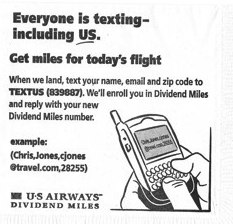
But, on a recent flight I glanced at my cocktail napkin to see this compelling and easy sign-up offer:

Other than the fact that US Airways was practically daring me to violate the in-flight ban on cell phone usage, I was enthralled. One text message with your name and email address, and you’re enrolled. Very slick.

Follow Up Good, but Unfocused

Almost immediately after signing up via text, I received a nifty email confirmation that included a digital membership card, and two offers for bonus mile via credit card offer. While the creative on the offers wasn’t spectacular, the use of transactional email to drive additional action is on the mark.

But then the next day, I received another email that mentioned something called TEXTUS (evidently the system that runs the mobile opt-in program), and asks for me to provide additional info to activate my account. I understand the need/desire for more info from me, but shouldn’t they have asked for that before I got my nifty digital membership card? I wasn’t offended, but I was confused. And that could have been easily avoided. And why was that sent a whole day later?

Then, once I did in fact log-in to provide additional information, I received another confirmation with another digital membership card, and related offers (more this time). Again not bad, but a bit puzzling.

Overall, a great program. Fills a need. Makes it easy. Confirmation and follow up is a little wacky, but extra effort for being an airline (not typically the most nimble marketers) and pulling off a mobile program.

I anticipate mobile opt-in will be big in 2009. The prevalence of SMS capable phones make it a natural for point of sale e-mail subscriptions for newsletters, special offers, and other programs.

Could you use mobile opt-in effectively? What’s your plan?

Sphere: Related Content

Welcome. If you like the content here, consider susbscribing to my RSS feed. You can also find me on Twitter @jaybaer

Jason Baer

A Conversation, Not a Monologue - Digital Marketing for Colleges

Friday, September 26th, 2008

I just finished giving a speech at the western region meeting of the National Council for Marketing & Public Relations in Sedona, Arizona. 

NCMPR is the association of community and technical college marketers. A really interesting group that needs to harness social media and work with prospective students on an individual, relevant, highly personal basis. 

While this presentation was specifically for NCMPR, there is a lot of material that will be valuable to anyone looking to launch and maintain a social media and digital marketing program for a mid-sized business or organization. 

Key points in this presentation:

- Media outlets have exploded, causing audience fragmentation

- You have to communicate to audiences individually, because they don’t herd together like the old days

- Using the power of audience segmentation

- Digital marketing is critical in this new hyper-targeted marketing world, because online users identify themselves through their search queries and site usage

- Ways to find prospective community college students (Twitter, Facebook, Blog search, Flickr)

- Web site is the key to translating awareness of your college (or any brand) to action

- Web content needs to be transparent, real, and multi-modal

- Lead acquisition is critical for colleges. Give users multiple call to action options. 

- Secrets to good form design

- Web site testing and optimization basics

- Lead nurturing via personalized follow up and triggered communications


Comments are very much appreciated. Enjoy. 


Sphere: Related Content

Jason Baer

The Future of Email Marketing - Think Holistically, Send Individually

Wednesday, September 24th, 2008

The demise of email has been greatly exaggerated.

While Jupiter says that overall email volume has dropped from 41 messages per day per U.S. user to 24, the email marketing universe is very much alive and well. The Direct Marketing Association (DMA) projects that $600 million will be spent on email in 2008, driving an astonishing $27 billion in sales. That’s $45.65 in revenue for every dollar spent on email marketing, an ROI figure that’s nearly impossible to match outside of the bottled water and pharmaceutical industries.

But, the increasingly vigorous expectations and demands of email recipients are changing the game. An electrifying survey by Marketing Sherpa in August, 2008 showed that 41% of subscribers believe an email to be spam if it is not of interest - even if it’s email they requested. There’s a Saturday Night Live skit in there somewhere. You meet someone at a party and they end up being boring and irrelevant, so you can click a spam button and they disappear forever.

Targeted = Relevant = Wanted = Successful

Consumer demand for email that meets their specific needs mirrors the surging desire for authentic, 1:1 conversations with brands via social media outlets. Regardless of medium, today’s consumers want to be talked with, not talked at.

This is troublesome for many email marketers who continue to adhere to the longstanding practices of sending an email “blast” or “campaign” to a “list” and hoping that 5% of the recipients take action. This is the definition of surgery with a dull knife, and the patients are starting to revolt.

Further, in many circumstances email may not even be the optimal message delivery mechanism. Text messages, voice mails, good old direct mail, Twitter, and other outlets can be more appropriate and more engaging for consumers at times.

The promise of a hyper-targeted and relevant message, delivered at the right time, to the right person, using the right medium is holy grail marketing, and its the new focus of ExactTarget, the leading email service provider that’s morphed into a robust, centralized messaging system.

(disclosure: I’m an ExactTarget customer and was a speaker at their Connections user conference this week in Indianapolis)

ExactTarget is trumpeting this new era of multi-modal, targeted messaging under the mantra “Subscribers Rule.” Essentially, it’s an umbrella position for “give people what they want, even if it’s a text message in Portuguese at 3 a.m. featuring coupon codes for mittens.”

This notion of 1:1 marketing has of course been the rallying cry for digital marketing since its inception. Historically, the problem has been gathering enough information and insight about your customer base to be able to fashion customized, truly relevant messaging. In the past, you’d have to mine e-commerce data or implement a sweeping audience segmentation study to do it right, and then you’d build an e-mail campaign around it.

Now however, ExactTarget and its burgeoning network of partners are enabling email itself to be used as a segmentation tool. Advanced link tracking, integrations with Web analytics software like Omniture, and a new user-controlled engagement score feature (whereby you assign a numerical weight to subscriber activities like email opens, clicks, purchases) allow the sophisticated marketer to learn a tremendous amount about their audience based on their email-driven behavior, and then use that feedback loop to create and send ever more relevant and timely messages.

Additionally, a thorough program of triggered messages (sent individually based on Web site behavior) can provide tremendous information about a subscriber while simultaneously delivering hyper-relevant and timely information.

I Get Sign Ups With a Little Help From My Friends

A second very interesting opportunity presented by the centralized messaging platform concept is the cross pollination of message delivery vehicles. The most buzz-worthy example is “email opt-in via text” whereby consumers can use short code text messaging to sign up for highly targeted offers and other communication from a brand at point of sale. This could render the physical email opt-in form moot at retailers and restaurants, and would make opt-in immediate (enabling instant couponing, etc.).

Imagine you’re in a check out line at Petsmart and you see a prominent sign that says “for $5 off Iams dog food, text “Iamsdog” to 23907. For $5 off Iams cat food, text “Iamscat” to 23907.” Instantly, the brand knows whether you have a dog, cat or both, has added you to its database, and you get a valuable and relevant coupon immediately. Slick - and not terribly difficult to execute.

Lions vs. Lambs

As this multi-modal, 1:1 marketing gets more prevalent, the software needed to run it and the expertise needed to strategize and manage it are becoming commensurately larger and more complex. Interesting then that ExactTarget is rolling out a formalized partner program (similar to Microsoft, Oracle and other enterprise software companies) that will features specific partner tiers, certifications and other “badges” to distinguish among specific expertise. This should assist clients in selecting the most appropriate agency partner for their 1:1 marketing efforts, and agencies will have a codified program for reselling the software and providing services to augment it.


I’m on Twitter @jaybaer
Subscribe to Convince & Convert via email>>

Sphere: Related Content

Jason Baer

When The Fonz Clicked Delete: Email has jumped the shark

Wednesday, June 20th, 2007

Like Lohan trips to rehab and Cardinals’ “this is our year” chants, most of us have had it up to here with email.  Spam has gone from annoying to ridiculous. I got an insane, indecipherable missive from a German derelict this week. 417 times. It looked like he slapped a sausage on the keyboard to form random word forms, and then fired out the email.

For marketers, it’s been too easy. Email requires little technical or budget pain compared to other marketing channels, and those advantages have resulted in marketers beating the golden goose to death with a huge “Send” button.

Getting great response rates from email is tougher than ever. Email volume is massive and the technical rules of the game have changed dramatically in the past 12 months.

Here’s what you need to know to be a successful email marketer, now that doing so has gotten substantially more difficult.

Mind Your Rep

Whether or not the major ISPs delivered your email to the inboxes of your subscribers was formerly determined by the content of your email. Viagra references were lumped together with more innocuous offenses like exclamation marks, use of “click here” and “free”, and unusual font colors into a naughty list that would get your email filtered.

That’s clearly a pretty blunt instrument with which to decide email validity. Consequently, many ISPs have now switched to delivering email wholly or at least in part based on the reputation of the sender. Mercifully, it has nothing to do with high school and that night on the roof.  Instead, reputation is determined by the percentage of your subscribers that mark your email as spam. You may have heard that people rarely click “unsubscribe.” That’s true. Instead, nearly all consumer ISPs (AOL, Earthlink, Cox, et al) have a “mark as spam” button prominently located. Instead of taking the time to unsubscribe, consumers click the spam button, and like Prom writ wrong, there goes your reputation.

Consequently, it is more critical than ever to not send email to anyone that hasn’t specifically requested it from you, and to only send content of value. Given the importance of reputation to the success of your email campaign, it’s better to have a small, quality list than to have a big list of dubious merit.

Your Trojan Horse Has Shipped

A proven method for increasing the frequency of your email communication without annoying your subscribers and putting your reputation at risk is to engage in transactional email.

Transactional messages are anything that gets sent out based on either a user action or relationship status change. Thank you for subscribing. Your order has shipped. Your order is delayed. Thank you for your bill payment. Your customer service request has been received.

All of these emails can be configured to include valuable promotional and informational content alongside the core transaction messaging. And it works. A study by MarketingSherpa found that consumers read transactional emails from trusted brands frequently or very often 75% of the time, compared to 55% for regular email communication.

Open Sesame

When it comes to measuring the success of your outstanding new transactional email program, give pause when using open rate as a metric. If you have Outlook (or Yahoo! mail and others) you may have noticed that images in emails don’t load unless you click “load images” in the message. Email open rates are tied directly to images. If an image (like your logo) loads in the recipient’s email program, the email has been “opened” and will be counted as such. This is true even if the email is only seen in the preview pane.

With images turned off on many browsers, however, open rates have plummeted. We have seen a decline of approximately 50% for every client over the past year.

Consider using click-through rate or total clicks as your main barometer for email success. Both are reliable and not influenced by technology or email software variations.

Also, because so many images are not loading, it is absolutely imperative that any graphics in your email are solely illustrative. You should never put an offer, headline, phone number, or any sort of important information in a graphic unless that same information is also prominently included in text.

The Name Is the Game

Everything you’ve just read is of course invalid unless you can convince people to subscribe to your email program.

As much as half of your Web site traffic may enter your site on a page other than the home page. Thus, you should include your email sign up on every page of the site. Incidentally, this is true for other key promotional elements on your site. Remember than any and every page of your site could be a visitor’s entry point and that page needs to be clear and persuasive.

While you’re at it, include the actual sign-up form on every page. Don’t make people click to another page to sign-up, we have found it to reduce response rates.

Lastly, make sure people know what they’re going to get from you. Again, it’s like high school. Set clear expectations at the beginning, and nobody will be disappointed. Add a link to a sample email newsletter above your sign-up form. Your response rate will increase, your spam complaints will decrease, or both.

Is email the bright and shiny new toy it once was? Sadly, no. But by following the evolving rules for email success, you can continue to outflank your competition and create valuable online relationships with your customers.

Sphere: Related Content

Jason Baer

Nothing Personal: SWM 35 seeks email marketing that’s relevant

Sunday, January 30th, 2005

Once upon a time you could send and receive email without incident. Like leaving your doors unlocked or eating medium-rare hamburgers, the glory days of email were blissfully free of hassle and worry.

Email has literally transformed the way we communicate. 31 billion emails are sent every day in North America, according to research firm IDC. But despite its speed and a Paris Hilton-esque ubiquity, email is under siege.

IDC says spam now accounts for 38 percent of all email, up from 24 percent in 2002, and the smorgasbord of increasingly crafty email viruses and frauds is causing a great deal of agitation among the populace.

“People are getting fed up with all this spam nonsense, and when you’re scared to click on something for fear of getting scammed, that’s not good,” says Kevin Maxwell, Product Manager for Scottsdale-based anti-spam service SpamElimination.com.

Millions of Americans now use some sort of spam blocker, whether personally purchased or installed on their behalf by their ISP or the company IT guys in the basement. These spam blockers can be very effective by “reading” email content and other technical attributes and then filtering presumed spam to a special folder or refusing to deliver it altogether.

The trouble is, spam blockers don’t have a lot of nuance to them. Like civil war medicine, it’s very much an “if in doubt, cut it off” mentality. This results in up to 20 percent of legitimate, permission-based email being undelivered, according to Michelle Eichner, who heads the Scottsdale office of Pivotal Veracity, an email deliverability management company.

Between the spam filters and the fact that people aren’t as intrigued by email as they used to be (I want to “check this box for information and special offers from us and our partners” about as much as I want a case of monkey pox), true email marketing success can be as unlikely as an Emmy for “The Swan.”

So what’s a marketer to do? First, pay attention to the deliverability of your email program. If you don’t know what your open rate and click through rates are, find out. It’s possible that your well-crafted email is falling on deaf inboxes, because your URL has been blocklisted (bad) or blacklisted (really bad), or that the text or graphics in your emails are getting them filtered out, especially by big ISPs like AOL.

Second, and perhaps most importantly, send emails about which people give a damn. The days of “batch and blast” are ending. All the spam filters and Pivotal Veracity research in the world won’t save you if nobody cares whether they get your email or not.

Today’s best email marketers are taking the time to learn about their customers’ habits and desires, and sending targeted, personalized email that matches those attributes. Most companies are still sending the same email newsletter to their entire list, and whether the recipient is a 55 year-old woman who smokes a pipe and plays foosball, or a 23 year-old male needlepoint whiz, the contents of the email are exactly the same. It’s a shotgun approach that necessitates generic messages and offers, and generates results that can be good, but rarely great.

The best emails, the ones you actually look forward to receiving, are those that are designed especially for you. My wife raves about the monthly email from babycenter.com that talks about what your 36 month-old should be doing developmentally (eating dirt, evidently), and I’m especially fond of my “your fantasy football team is losing again” messages from cbssportsline.com.

We’re using new technology from Exact Target, to help clients easily create simple profiles of their customers by importing attributes like name, gender, zip code, and other data, and then broadening the profile by inserting survey questions into each email newsletter. Each month, we know more and more about who has subscribed to this email and what they want from it, and can then tailor the content of the email accordingly.

Like paint-by-numbers for Internet geeks, Exact Target enables us to create multiple versions of copy and photos and automatically inserts the right one when the email gets sent. So, at the same time, one subscriber gets the coupon for pipe tobacco, and another gets a free trial offer for Cat Fancy magazine. Remember how impressed you were when you got your first Amazon email with that famous “people who bought this also enjoy that”? This is the evolution of that idea..

Called “dynamic content” this personalized approach to email marketing is likely to be the norm before long, especially for online retailers and other ROI-driven emailers. But it has applications far beyond e-commerce. We’re working on a pilot program for the Phoenix Convention & Visitors Bureau where people interested in visiting Phoenix check boxes that match their interests (dining, horseback riding, pro sports, art galleries, etc.) and within seconds receive a dynamic content email brochure that includes information and special offers matching their interests.

This targeted approach requires some effort, but is the email equivalent of a one-to-one conversation, rather than the yelling through a megaphone at a crowd method previously utilized. And if it forces companies to send increasingly relevant and personal email, maybe there’s a silver lining to the spam craze (beyond the wide availability of body part enhancing patches, of course).

Sphere: Related Content

Jason Baer