
Starting SEO for a new site is overwhelming, especially if you haven’t done it dozens of times already.
In fact, the process can be quite intimidating, as there are so many technical tasks involved.
SEO for a new site is one of those most intimidating tasks new site owners tend to shy away from and set aside.
Here’s a guide that will make it doable for you:
1. Don’t Take Your Domain Name Lightly
Spend some time on this step: Your domain name will hardly have any direct impact on your organic search visibility but it will be important for your brand name recognizability.
What doesn’t matter for SEO:
- Domain age (when it was registered)
- Exact-match keywords in the domain name
- Top-level domain (as long as it is not a regional / localized TLD), i.e. don’t stress if you cannot find a .com domain.
What does matter for SEO:
- Domain meaning: Its topical associations. A good domain can get more people click your snippet when they search
- Domain length: Too long or hyphenated domains may look spammy and hurt your brand.
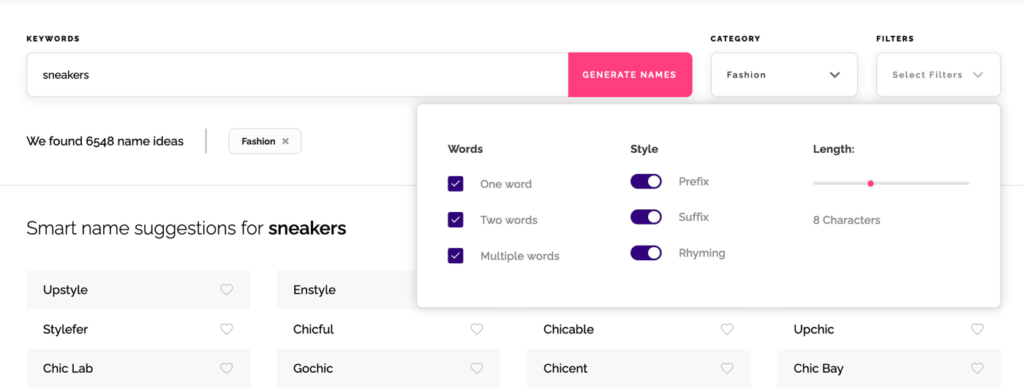
With all of that in mind, take your time. Picking a domain is a huge decision. Use this business name generator that discovers some snappy names with meaning. You can also set how long your name should be and which category it should fall under:
Once you have your domain, search Google for your name to make sure there are no existing brands in your niche that you’ll have a problem overcoming in branded search.
2. Use WordPress
WordPress is the easiest platform to set up a site. And it is also incredibly SEO friendly and flexible.
No other content management platform has so many years of fine-tuning and such a rich directory of plugins. You can do just about anything with WordPress without having to code anything.
WordPress is free, most plugins are free or freemium, and all it takes is a few-click installation on most hosting providers.
WordPress also doesn’t require a lot of optimizing, especially at the beginning. All it takes:
- Choose a theme. Unlike your domain name, this will be easy to change down the road, so focus on the theme being lightweight rather than pretty. Here are a few fastest themes out there
- Enable HTTPS: Here’s a detailed guide on doing that on WordPress
- Set your permalinks to “Post name” and choose your time zone in “General Settings”
- Publish some fundamental content to give search engines something to crawl. More on this below:
3. Set up Your E-A-T Right Away
The first thing you can do when launching a new site is to start with Lorem ipsum text on your fundamental pages: About us, Contact, Privacy Policy, etc.
Those types of pages convince your fist visitors that you are a trusted business to deal with and send quality signals to Google.
Make sure your E-A-T is set up well:
- Your foundation pages (About us, Terms of Service, Contact us, etc.)
- Your website security information (how is your visitors’ privacy protected?)
- Basic facts about your business
- Some social proof from beta testers or first product buyers
- Your author bylines detailing why they have expertise on a topic
- Links to your social media profiles
- More importantly, your service or product pages. What is it you are selling?
Ensure your service pages are as descriptive as possible. In order to achieve that, try adding not just text but also some videos that demonstrate the key benefits of your products or services.
Also, since the majority of visitors prefer watching videos with sound off, make it convenient for them by adding subtitles, so that they can get to the meat of the matter even without having to listen to them.
You want your first visitors as well as search engines to know right away!
4. Start with the Least Competitive Search Queries
One of the biggest challenges of optimizing SEO for a new site is that you have no unique data to rely on.
Any data that you are going to use at this point is public, so you have zero competitive advantage, unless you get really smart and creative.
When launching SEO for a brand new site, you need at least This content targeting definitive search queries at minimum:
- Pages describing your services / products: These will target high-intent queries
- Initial content putting your products in the educational courses: What are those problems your products help solve? These could also be use cases.
#2 is where you can focus on less competitive search queries to start generating some organic search traffic earlier and send those visitors to your key “money” pages.
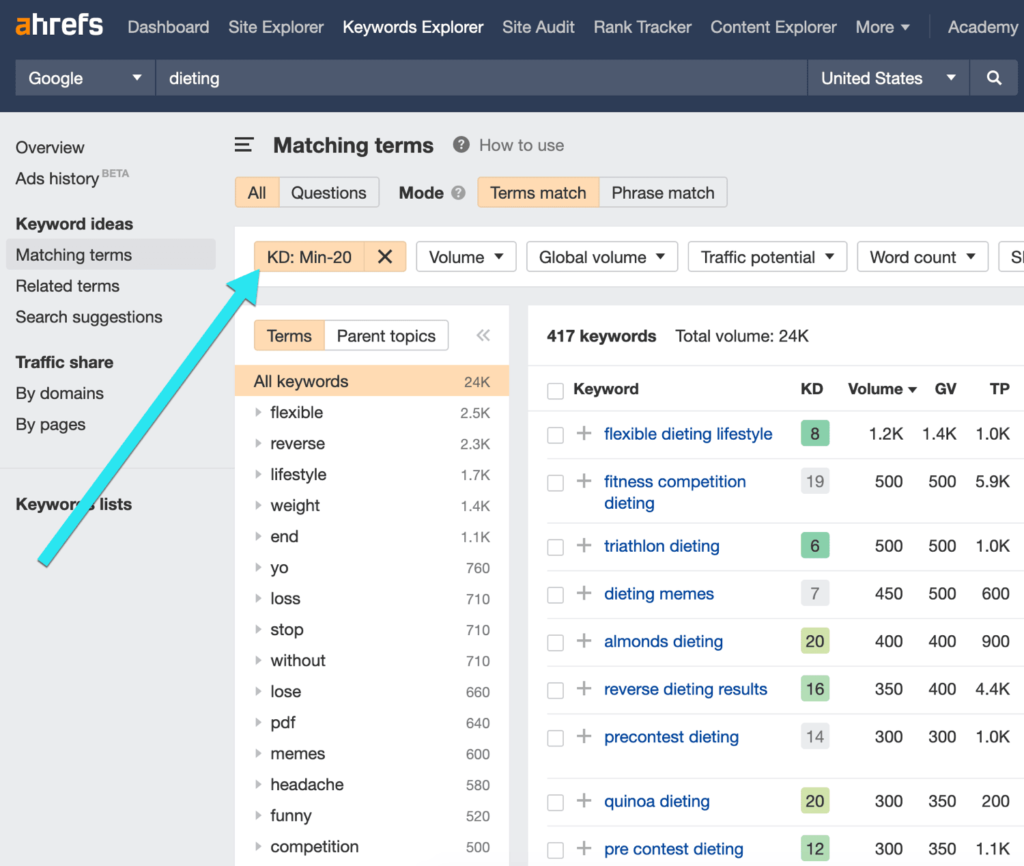
Ahrefs is a great tool to find those low-hanging-fruit keywords to target when starting a new site. The platform offers a “Difficulty” metric that shows how difficult it will be to rank for each keyword on page 1.
For a brand new site you may want your keyword “difficulty” to be no higher than 20. For that you will need to create a filter inside the Keyword Explorer:
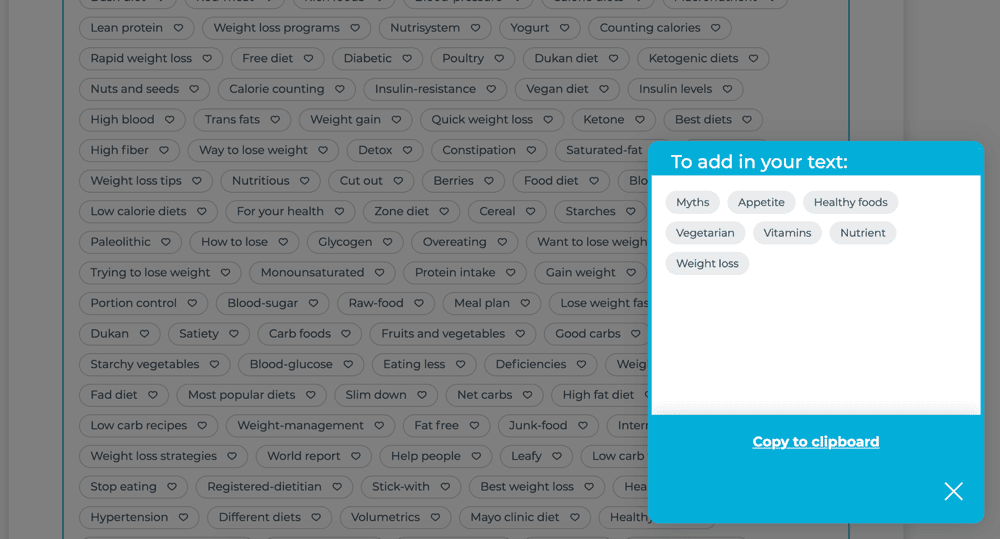
When creating your content, use Text Optimizer to build semantically relevant context and include related concepts:
5. Start Monitoring Your Progress
You want to start collecting your site’s data as early as possible. This will help you get ahead of your competition by utilizing your own data and making more informed decisions. You don’t have to do lots of web tracking systems. These three will be enough:
- Google Analytics
- Facebook Pixel (especially if you are starting an ecommerce site and planning to use retargeting ads down the road)
- Google Search Console: Google will start collecting data about you as soon as they discover you but things like sitemaps may speed things up.
6. Focus on Content-to-Content Links
Links will help your site get discovered by Google as well as start growing its credibility. No site should be launched without a smart link acquisition strategy.
Links are still key to organic search visibility, so there’s no search engine optimization strategy without links.
Self-serving link building is a risky tactic that can bury your website in penalties and filters, and the risk even higher for new sites that have no good record with Google.
With that in mind, don’t be in a hurry and try to avoid any link acquisition tactics where you can control the anchor text of the link.
There are a few powerful and safe link building tactics, and most of them come down to one process:
- You create useful and truly unique content asset (e.g. an original study)
- You reach out to media publications for them to consider covering it.
It takes time and effort but you just cannot put a price on contacts you’ll be building underway. Make sure you build strong relationships with all the publishers that chose to link to your content. Every further outreach campaign will be easier from there.
Your New Site Is On Its Way to Ranking
SEO for a new site is mostly about building a foundation. You don’t have to do everything perfect when starting a site. You just need to lay a good foundation to start collecting data and expanding.
SEO takes time, so whatever you do, don’t expect fast results. Google needs to start crawling your site and forming your opinion about your content before they know it is worth showing up for its users.