Posts Tagged ‘agency self-promotion’

And They’re Off…Palin PPC Finalists Selected…Ads Live on Google

Monday, September 1st, 2008

Thanks to everyone who participated in the Palin PPC contest (see post below).

It was difficult to select 4 ads to test live on Google, but ultimately I choose these:

Sarah Palin’s Secrets
What the GOP doesn’t want you to
know about McCain’s running mate

from James Archer (@jamesarcher)
I like this one because it’s a solid tease with a lefty slant.

Sarah Palin Revealed
What makes her so special
and why the Democrats should worry

from Johnny M (@thesoop)
This is a great counterbalance to the first one. Similar approach with a righty slant.

Who is Sarah Palin?
Exclusive stories, photos and more
on the Vice Presidential candidate

from Russ Hollmann (@hollmann)
This one is very plausible as an actual ad. I’m interested to see the CPC of this more factual approach.

Lastly, but not leastly….

McCain is 72 Years Old
Avg US life expectancy is 78 years.
Is Palin qualified? Read this.

From Tony Sirois (@tbonemalone)
Solid. I love that this effort hits right at the core issue of Palin and does it in 15 words.

Get my blog posts in your email>>

What? No Nudity?

Certainly, there were some entries that probably would have generated a higher CTR than those above. However, since I have to actually build an ad group and run these ads - and link them to a landing page - I wanted to stay away from anything along the “Palin: Naked and covered in Skippy peanut butter” vein.

All good interactive marketers know that it’s not about clicks, it’s about qualified clicks, so I selected the 4 finalists in that spirit.

I’m running the same display URL for all ads www.thesarahstory.com since it fits all of the ads. I scoured the Web and found different news coverage and blog posts about Palin to fit each of the ads, in an effort to keep Quality Score high enough to keep the ads live.

Cheaters Never Win

Finalists, please don’t recruit an army of friends to click on your entry so you can win my $200. Hopefully, you value the scientific and social media nature of this experiment enough to not do that. I reserve the right to not pay you if I think you gamed the system.

Ads should be live until Thursday night - again assuming the CTR stays high enough for them to keep running. Results will be announced on Friday. Thanks for playing!

Who Do You Think Will Win? Make Your Prediction In The Comments

5 Great Workshops to Train Agencies on Digital Marketing>>


Similar Posts That You Might Enjoy

Welcome. If you liked that, there's plenty more. Please subscribe to my RSS feed. You can also find me on Twitter @jaybaer

Jason Baer

Ad Agency New Business Survey - Take It

Thursday, August 21st, 2008

My friend Michael Gass, who writes the excellent Fueling Ad Agency New Business blog, has launched a survey of small and mid-sized ad agencies and the current state of their business development program. 

With the economy getting as ugly as pre-surgery Joan Rivers, figuring out how to keep your agency in front of key prospects is more important than ever. (If you haven’t read my post on “5 Reasons Why Digital Marketing Will Thrive in the Recession” you can find it here)

The survey takes literally 2 minutes to complete. 3 if you’re checking email simultaneously. 

The best part is, if you send Michael an email (michael at michael gass dot com) he’ll send you a copy of the results when analysis is completed. 

Take the ad agency new business and promotion survey here


How I help ad agencies & PR firms get better at digital marketing>>
Get my blog posts in your email>>

Similar Posts That You Might Enjoy

Jason Baer

PitchEngine Takes the Mystery out of Social Media Releases

Friday, August 15th, 2008

Agency Advantage Tools - #3 In a Series

Since it’s invention by Todd Defren at Shift Communications in 2006, the social media press release has taken root.

Combining short paragraphs and bullet points with Web-friendly links, tags, and multi-media content, the SM release aims to give reporters and bloggers the key ingredients for a story in an immediately scannable and digestible fashion.

The SM release has been successful because it capitalizes on three converging trends:
1. The emerging use of multi-media content due to increasing bandwidth and ease of content creation.

2. The increasing emphasis on search engine optimization of media releases. After all, isn’t Google just the world’s most powerful reporter?

3. Email has created a deluge of pitches and writers can’t read 1,000 narrative pitches per day. The social media release format enables them to skin and assess what’s newsworthy.

Strategically Brilliant, but Tactically Sketchy - Until Now

The hang-up with social media releases has been actually getting them built. Most PR folks are not Web programmers, and the very nature of what makes a social media release useful (tags, links, multi-media) makes it tricky to execute if your definition of high tech is inserting a footer in Microsoft Word.

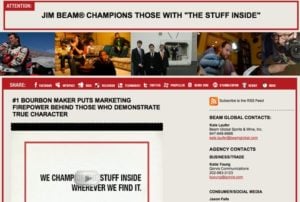
Historically, the best social media releases have essentially been customized landing pages, like this genius effort for Jim Beam from Jason Fall at Doe Anderson and Jason Swartz at PSB.

So, unless you have a Jim Beam budget and a Web programmer hanging around, making a killer SM release has been tricky, despite efforts from PRXBuilder (Wordpress and Microsoft Word plug-in) to make it easier. (note, I use PRXBuilder’s SimpleSMPR on this blog).

Enter PitchEngine

Newly launched - still in Alpha release - PitchEngine is out to change all that. Their slick, exceptionally easy online social media release creation engine is by far the best I’ve seen. Literally, if I took the time to explain what a “tag” was to my 9 year-old, she could make a release (it would probably be about ice skating or the dresses on The Titanic).

Here’s how easy it is:

- Request an account
- Log-in
- Add your boilerplate info, logo, contact info (don’t forget your Twitter account)!
- Click “create new release” and you get the screen above
- Type headline
- Type short pitch (Twitter pitch)
- Type rest of release
- Upload photos and videos
- Add links back to your Web site
- Add tags

DONE! Click a button and you have a beautifully formatted, all linked up social media release ready for distribution.

Distribution Included

In addition to enabling you to create your social media release, PitchEngine lets you easily distribute it too, by typing in whom you want to send it to (via email, Twitter, FriendFeed, Facebook). All releases created in the system automatically appear in the PitchFeed, a stream of current pitches that can be accessed by reporters and bloggers on site or via RSS.

All This, And It’s Free

For now, PitchEngine is 100% free, which is of course a ridiculously good deal. I suspect they’ll be going to a Freemium model at some point, with advanced features costing a few dollars here and there.

For all PR firms and client-side PR 2.0 and social media managers, PitchEngine is the new social media release champion, and an indispensable tool in the new media arsenal. Check it out.


More about social media>>

More tools I recommend for agencies>>

How I help ad agencies & PR firms get better at digital marketing>>
Get my blog posts in your email>>

Similar Posts That You Might Enjoy

Jason Baer

The Truth About Publicis Buying Performics

Wednesday, August 6th, 2008

In a sign that major advertising agencies are continuing to recognize the long-term profitability of search marketing, Publicis Groupe bought Performics from Google today.

One of the largest search marketing agencies, Performics will join Digitas and other Publicis entities as part of VivaKi Nerve Center (no, I am not making this up) the new strategic collective cobbled together to serve Publicis clients world-wide.

3 Reasons Why Publicis Bought Performics

1. Search marketing is entirely mainstream now, and represents a “must do” tactic for essentially every Publicis client

2. Search marketing is projected to grow (by JupiterMedia) at a minimum of 12% annually through 2012, and there’s not many other marketing tactics (maybe social media and mobile) that are likely to achieve that level of compound growth

3. Search marketing is a “forever” tactic. Once you start, you can’t just stop doing it, because all that hard work will be washed away quickly. Thus, search marketing for major brands can be a $1-3 million per year, every year service fee, with extraordinarily high profit margins of 25% plus.

Note that Publicis has stated that they want 25% of their overall revenue to come from digital by 2012, and this acquisition will help make that a reality. There’s not that many serious search marketing agencies that have the scale necessary to fit in with Publicis, it’s still a very fragmented market, so the Performics acquisition makes sense.

Plus, Google and Publicis have a long-standing cross-functional relationship, including sharing of executives and intellectual property. 

Interesting that many smaller, traditional agencies totally eschew search marketing as “too complex” and “not worth it”. I wonder if this acquisition will change some minds in that regard?

Why Google Sold Performics

It always seemed a bit strange for Google to own a search marketing services company. Performics was acquired as part of Google’s purchase of display ad network pioneer DoubleClick. The DoubleClick purchase was strategically imperative to close the gap between Google and Yahoo! in the display ad business, but the Performics search and affiliate program unit was always an extra appendage. 

Rumors about Google selling off the search marketing component of Performics were confirmed on the Google Blog in April of this year. 

Certainly, it’s a conflict of interest to have Google own a huge search marketing company, when they are the dominant vendor/partner of that company, and their ownership of Performics surely made iCrossing, Did-It, and other large search firms nervous. 

But ultimately, Google got rid of Performics because they learned what they needed to learn about how search firms work, and they got out. I predict that you’ll see a whole new suite of paid search tools from Google, based on their learnings from Performics. That’s the Google way. They bought Urchin, looked inside its guts, and PRESTO you get Google Analytics. 


What do you think about this deal? Does it portend a new round of acquisitions by traditional agencies, scooping up search marketers? Is iCrossing the next to sell? Or is it just one company trying to make a splash to drive awareness of the VivaKi Nerve Center? Also, if you can coherently describe what a VivaKi Nerve Center is, please leave a comment! 


How I help ad agencies & PR firms get better at digital marketing>>
Get my blog posts in your email>>


 Similar Posts That You Might Enjoy

Jason Baer

Agencies Need to Embrace Digital Even If It’s Uncomfortable

Monday, August 4th, 2008

Excellent post by Bart Cleveland on the AdAge Small Agency blog recently about Comfort Zones.

Bart made the point that if you get too careful and comfortable in your agency, you won’t attract clients that are looking for innovative work. There’s no question this is true. His post used “risky” or groundbreaking creative as the benchmark, but I’d say what services an agency provides is perhaps an even better measure of its Comfort Zone.

Digital marketing is NOT comfortable for most “traditional” advertising and PR firms. I get that. I’ve lived it. But, given the fact that digital marketing is growing extremely fast at the expense of other tactics, and given the fact that this will be even more acute in a down economy, agencies’ resistance to fully embrace digital is confusing.

The vast majority of agency principals are very smart folks. I know this to be true. They are good businesspeople, and great marketers. They clearly recognize that digital is taking a larger and larger share of the pie every year, and that digital-only shops are a growing threat.

Thus, if the awareness is there, I conclude that fear and uncertainty is the obstacle for most agencies to really get going on digital.

Digital Marketing is Like Learning French

In my experience, many agency leaders are immediately overwhelmed by the dizzying array of numbers, vendors, acronyms and general craziness inherent in digital marketing. I absolutely understand that coming at digital head on can be frustrating and baffling.

But, there’s an awful lot of jargon and insider knowledge in traditional advertising and PR too, and agency principals managed to pick that up somewhere.

True, digital marketing has a lot of specific terms. But if you can learn a foreign language, or learn how to write up a media plan, you certainly can figure out digital marketing basics.

It’s Not Different. It’s The Same.

The number one mistake that I see agencies make is to treat digital totally differently than other elements of their organization. In a lot of shops, it’s like Area 51. The digital guys are separated, quarantined and viewed with a mix of reverence and curiosity.

This causes two huge problems.

- Your digital guys have almost no oversight because nobody can speak their language
- You never really integrate digital into the fabric of the agency or even at a campaign level, because your “traditional” teams don’t understand or work closely with the digital teams.

There’s no other marketing tactic that gets treated this way. Would you hire a single radio expert and put them in a corner of the office and only deal with them when necessary and then say “okay radio guy, I don’t understand this very well, but do your stuff.” Of course not.

Ultimately, digital marketing is just that…..marketing. The same rules apply. Figure out the characteristics of prospective customers. Figure out how to most efficiently reach them. Craft messages that matter to them. Deliver those message. The main difference between traditional and digital marketing is the ability to measure success definitively, and that’s an advantage that should be embraced by agencies.

Many agencies are beginning to implement digital marketing tactics on their own behalf, using themselves as guinea pigs to develop greater digital prowess and confidence. This is an approach advocated by Michael Gass at Fueling Ad Agency New Business who works with agencies to set up their own blogs.

If you’re not fully embracing digital, why not? Leave a comment.

How I help ad agencies & PR firms get better at digital marketing>>
Get my blog posts in your email>>

Similar Posts That You Might Enjoy

Jason Baer

Agency Advantage Tools #1 - Website Grader

Wednesday, July 23rd, 2008

Welcome to Agency Advantage Tools, a regular blog series at Convince & Convert that spotlights inexpensive or free digital marketing tools.

There are literally thousands of different Web sites, applications, plug-ins, widgets and more devoted to helping digital marketers do their jobs better or faster. Most advertising agencies and PR firms are too busy doing actual marketing to keep up on this flood of innovation.

So, here at Convince & Convert, we’ll do the work for you. We’ll scour the Web to find the tools that are worth adoption at agencies.

Website Grader - Search Optimization Success Snapshot

Today’s tool is Website Grader. This exceptionally easy-to-use Web site shows you in an instant how your site, your clients’ sites, and/or your competitors are doing with regard to search engine optimization.

Website Grader is owned by Hubspot, an integrated, Web-based suite of tools for search, blogging, social media, content management, and competitor analysis. We’ll review the full Hubspot offering in a future edition of Tools You Can Use.

Website Grader takes information that has been in demand for years (number of links, page rank, metadata, etc.) and presents it in a very clean, easy-to-understand format. There have been a number of sites that provide portions of this data, but none with the savvy interface and non-SEO-professional tone.

You just enter your Web site’s URL, enter the address of competitors if desired, provide an email address (if you want a printable report), and click “Generate Report”. That’s it.

Analysis take about 30 seconds.

The resulting report provides information on 23 data points across four categories:


  • On-Page SEO
  • Off-Page SEO
  • Blogosphere
  • Social MediaSphere
  • Conversion
  • Competitive Intelligence
All of the data presented is interesting, with some of it quite useful. For example, inbound link count, alt image tag assessment, and keyword grader are useful measures. Being alerted to the fact that this site doesn’t have a contact form is less useful. Clearly, we are already aware that we (purposefully) don’t have a form on Convince & Convert. 

While the scoring system is no doubt arbitrary and subjective, Website Grader does provide a summary score (on a 100 point scale) of how each site is doing. Convince & Convert gets just a 59 for now, as the newness of the site and subsequent lack of Google Page Rank and other key metrics no doubt hurts our score. 

While Website Grader might provide data that is mostly already known by studious professional SEO types, for agencies that are analyzing their own sites or client sites, it’s an extremely powerful tool that we wholeheartedly endorse. The fact that Website Grader provides recommended improvements for almost every data point is a real plus, making this a key Agency Advantage Tool and one that deserves an immediate bookmark (you can actually bookmark your specific report, so you can check back on your progress every couple weeks).

Leave a comment and let us know your Website Grader score. 


 Similar Posts That You Might Enjoy

Jason Baer

UPDATE: GoDaddy and the .Me Domain Disaster

Thursday, July 17th, 2008

UPDATE:

Well, the .me registration was a complete and utter fiasco. Speaking from personal experience, and reporting from Mashable (soon to be joined by a lot of other reporting, I predict) - this was one of the worst examples of customer experience in my 15 years online. 

It took one full hour to check out. After having to reload every step in their byzantine shopping cart at least 3 times, I finally was able to pay. 

Then, 2 hours later (after already charging my credit card of course) I get an email saying that the domain they sold me was in fact not available. That’s like a guy from Safeway coming over to your house and taking back the sweet corn you bought in the morning because somebody else had apparently bought it too. I’ve received “out of stock” emails from e-commerce companies after checkout (which is also annoying - how about tying your online inventory to your offline inventory?), but to have that happen with a purely virtual item like a domain name is unfathomable.

Insert Conspiracy Theory

There were reports in recent months that GoDaddy was registering domains that people researched on their site (you see if a name is available, if it is and you don’t register it immediately, SURPRISE it’s taken the next day). Also, they were squatting on domains in the renewal grace period and dramatically increasing the renewal prices.

Based on that anti-customer behavior (if true), I wouldn’t be at all shocked if GoDaddy was selling .me domains, and then reviewing checkouts to find ones with aftermarket value, and keeping them for themselves. 

GoDaddy needs to spend less money on TV commercials, and a lot more on servers and a Chief Customer Experience Officer. Seems to me like their long-term plan is to achieve true market dominance (they are pretty close already) and then really start turning the screws on customers. Nice.

__________________________________________________________________________________

Tomorrow - July 17 - marks the first open registration period for the new top level domain (TLD) .me

Intended for use in personal branding, no doubt many other creative ideas for .me addresses are being hatched, perhaps similar to del.icio.us 

For PR firms and publicists, covering the .me base for clients that have existing or emerging personal brands (especially speakers and authors) is a must. 

.me domains are $19.98/year on a two-year minimum and are available most readily from GoDaddy. Domains go on sale at 8am on July 17. Use code BTPS7 and you should receive 20% off your purchase. 

More information is available from GoDaddy here.

We do not recommend moving your Web site content over to your .me address unless you have consulted a search marketing specialist, as doing so could severely curtail your inbound links and search rankings.Similar Posts That You Might Enjoy

Jason Baer

Flash Now Readable by Search - Usability Experts Panic

Monday, July 7th, 2008

After a LONG waite, Adobe announced this week that Flash files are soon to be readable by search engines. This removes a major impediment to using Flash for Web sites, as previously all files created in Flash were essentially invisible to Google, Yahoo! and the rest.

So, we now have the classic good news/bad news scenario unfolding. Making Flash readable takes away the biggest technical knock against Flash usage. However, the biggest common sense knock against Flash remains, which is the fact that Flash is misused in most cases.

Unless you’re a cartoonist, film editor or other such business, the point of creating an all-Flash Web site is dubious at best. The fact is, people come to your Web site to get questions answered about your business. And in most cases, using motion and animation to answer those questions gets in the way of the users’ needs. Certainly, the much-maligned “Flash Intro” is maligned for good reason as more than 75% of all users immediately click “skip intro”.

My biggest fear is that search-friendly Flash will spawn a new generation of all-Flash sites that do a lot more showing off than information conveyance. This is already an issue for a lot of agency Web sites, and I hope they don’t take this new technological advance as an opportunity to layer on even more Flash (and music) on sites that are already overburdened with cheekiness.Similar Posts That You Might Enjoy

Jason Baer

91% of Top Digital Agencies Not Buying Their Own Brands on PPC

Tuesday, July 1st, 2008

In a shocking (and embarassing) revelation today, AdWeek uncovered that of the 56 world-class digital marketing agencies featured in their Annual Report Card, just 5 are purchasing their own brand names in PPC.

In fairness to the firms, most of them appear at or near the top of organic search results for their own brand names, but several studies have shown that click through rates (and conversion rates) typically increase when your brand is at the top of BOTH organic and paid search results. Incidentally, this is why the notion of dropping your paid search when you achieve organic search success is a bit of fallacy.

Also of note are smaller firms that are purchasing competitors’ brand names in PPC and showing up in paid search results. A crafty tactic, to be sure. Note that current case law says that you can in fact purchase competitors’ names and trademarks as a search term, but you cannot use those trademarks in your actual PPC ad copy.

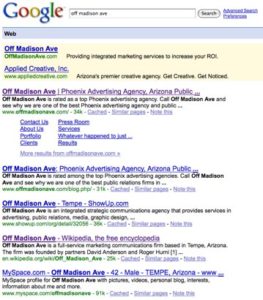
If you’re an agency, why would you NOT cover as many bases as possible with your organic and paid search marketing efforts? The costs are minuscule and the results can be significant. In fact, at Off Madison Ave and Mighty Interactive (where I handle strategy and ideas), search marketing has long been a primary driver of serious new business leads.

If even the big digital shops aren’t buying their own brands in paid search, how many traditional agencies are doing so? If you’re not playing in this sandbox, get on it. You could literally have a campaign up by the end of the day. Similar Posts That You Might Enjoy

Jason Baer