Posts Tagged ‘forrester research’

7 Critical Elements of Your Social Media Strategy

Tuesday, December 30th, 2008

(Originally written for MarketingProfs Daily Fix)

It’s fantastic that interest in social media is so high, but I’m alarmed at the number of brands and agencies that are ready to jump into social media to take “advantage” of audience concentration in Facebook, Twitter, and other fast-growth outposts. What’s lacking in most social media programs is an actual strategy. If you don’t know precisely why you’re in social media, with whom you want to engage, and how you’re going to measure success, you’re not ready to start.

I use a 7-step Social Media Strategy Worksheet to create a framework that governs what the initiative aims to accomplish. (You can download the Social Media Strategy Workshop as a PDF here, and use it as much as you like, with attribution).

Step One: Describe the Business
Sounds basic, but if you can’t describe the precise value proposition of the brand in a sentence (without a bunch of mission statement crap-ola), you need to figure that out first.

Step Two: Business Goal
Trying to do too much in social media muddles your message and confuses your fans. You can focus on one goal for a while, and then change objectives later, but don’t try to tackle multiple goals simultaneously. There are only 3 realistic business goals for a social media effort. So pick one of these.

  • Brand Ethusiasm. Turning customers into fans, driving repeat purchases.
  • Sales. Using social media to create first-time customers or to introduce your brand.
  • Loyalty. Decreasing customer churn, improving customer service.
  • Step Three: Where Is the Audience Cyclically?
    Huge segments of your customers and prospects have wholly different relationships with your brand. Some have never heard of you. Others are raving fans. Which are you trying to reach in this program? You need to be specific here because what your target audience already knows about you dictates what you can credibly have a conversation about in social media. Pick no more than two of these:

  • Awareness. They’ve maybe heard of you, vaguely.
  • Interest. They’ve heard of you and maybe have visited a Web site. No purchases.
  • Action. They’ve made a single purchase.
  • Advocacy. They are fans of the brand. Frequent purchases, tell their friends, etc.
  • Step 4: How Does the Audience Use Social Media?
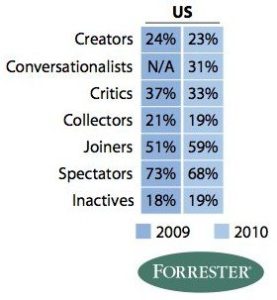
    Rolling out a social media program that features a customer photo contest is going to fail spectacularly if your audience isn’t prone to content creation. Using the Forrester Social Technographics Ladder, determine how your audience behaves within social media. You may have to guess on this one a bit, but better yet how about surveying your customers via email and ASKING THEM how they use social media? Pick one or two from among these: Creators, Critics, Collectors, Joiners, Spectators

    Step 5: The One Thing
    To be successful in social media, you need to distill your brand into the one thing that’s truly interesting, and in most cases it’s not product related. Figure out your one thing, and bring it to life in social media. Social media may be word of mouth on steroids (says Gary Vaynerchuk), but if you don’t give people something intriguing to talk about, they’ll never open their mouths.

    Step 6: How Will You Humanize the Brand
    Why do consumers love social media? Because it puts them on a more equal footing with brands that have been historically shrouded, impersonal and aloof. If your social media strategy doesn’t put a literal or figurative face on your brand in one or many ways, you’re missing the point.

    Step 7: How Will You Measure Success?
    Pick three metrics that matter to your company, and measure them consistently and well. Ideally, establish a baseline before your social media program starts. If your business goal is loyalty, you can measure true ROI by focusing on churn metrics. For brand enthusiasm, you can focus on repeat purchases. If you want to get more granular, there are dozens of potential success metrics like share of voice in social media, blog posts and tweets, comments, fans/friends in your social media outposts, etc. I’ll leave those details for another post or experts like KD Paine, but please pick only 3 success metrics. Nobody wants a 27-item results report or dashboard.

    Download Social Media Strategy Worksheet

    (photo by The Pug Father)

     Similar Posts That You Might Enjoy

    Welcome. If you liked that, there's plenty more. Please subscribe to my RSS feed. You can also find me on Twitter @jaybaer

    Jason Baer

    9 Ways to Humanize Your Brand (with real humans)

    Tuesday, November 18th, 2008

    Humanize your brand with real humansMany companies are reluctant to fully dive in to social media, either because they are afraid of losing control, or because they believe their customers aren’t using social media. The latter is especially prevalent among B2B companies, and when viewed from a purely numerical perspective they may be right. (photo by The Dana Files)

    An agency client of mine - Bliss PR - works with many large financial services companies whose customers are established CFOs. Are there 50-something CFOs using social media? Of course. Do most of them congregate in typical social media outposts? Probably not.

    Consequently, my advice in these circumstances is to abandon an outpost strategy in favor of a humanization strategy. Find a thought leader in the organization, and make them the star, instead of the company itself. Chris Brogan calls these folks Trust Agents, and cites Frank Eliason from Comcast, Scott Monty from Ford and others as examples.

    Related: Twitter interview of Scott Monty about social media at Ford.

    I mostly concur, and I think for many brands it’s smart marketing (even beyond the huge potential customer service benefits).

    9 Ingredients of a Humanization Campaign

    For agencies, your role in a humanization campaign is almost like a publicist. Find ways to make the designated star a thought leader:

    • 1. Build and optimize a blog
    • 2. Reach out to other bloggers in the category for guest posts
    • 3. Syndicate content to vertical aggregation sites
    • 4. Publish white papers and ebooks, and/or conduct Webinars
    • 5. Create a few killer presentations and get them on SlideShare
    • 6. Do at least a little video blogging to make him/her three dimensional
    • 7. Hustle for speaking engagements
    • 8. Get on Twitter and make sure he/she sets aside time to really engage people
    • 9. Make sure current company customers know all about the initiative and are invited to partipate

    By making a real person in a company the social media outreach vehicle, you can at times bypass potentially thorny legal and corporate confidence hurdles, and give the organization plausible deniability if it for some reason goes horribly wrong. “He went rogue!” they can cry.

    Simultaneously, you get almost all of the benefits of a corporate-branded social media program. Honesty. Transparency. Engagement with customers.

    Forrester is the king of this strategy. When was the last time you went to the Forrester Web site? Contrast that with the last time you went to Jeremiah Owyang’s site (or Peter Kim or Charlene Li before they left). See what I mean?

    Does this humanization strategy work? Do you have other examples? 

    Similar Posts That You Might Enjoy

    Jason Baer

    How Google Plans to Control TV Advertising and Crush Agencies

    Thursday, August 28th, 2008

    AdWeek ran an interesting story a few days ago about Google’s foray into television advertising. As I’ve been saying for years, Google’s ultimate plan is to be the middle-man for all advertising, everywhere. 

    There are clearly inefficiencies in the buying and selling of traditional media. It requires multiple phone calls and emails and spread sheets. Why? Because sellers of media will not make their inventory and their pricing transparent, believing (perhaps correctly) that to do so will result in lower prices.

    The Internet Puts People Out of Business

    Let’s see if there are other industries that were based in large measure on a slow, inefficient buying process with a lack of transparency. How about travel agents, financial agents, and insurance agents?

    The Web does a lot of things well, but its long-term legacies will be instant knowledge and the creation of efficient markets in either broad (amazon, ebay) or targeted (expedia, eTrade, Geico) categories.

    Google Has Chosen Advertising as Its Market

    To me, the agency community seems frighteningly slow to realize that Google is looking to take away all agency services that are not strategic and creative, and replace them with Google-owned software. Google Ad Planner. Google Analytics. Google Web Optimizer. And now Google Radio, Print, and TV ad insertions. ALL of these are services that agencies could charge for as recently as 30 days ago in some cases. 

    TV is the Final Frontier for Google

    There are 2 components to Google’s TV strategy that if successful, will put a ton of broadcast media reps (buyers and sellers) on the street.

    First, Google wants to deliver their menagerie of hundreds of thousands of advertisers directly to TV networks - and especially local stations. Imagine if your local CBS affiliate only needed 1 salesperson instead of 7 because most ads were bought direct through a Google interface. That’s the plan. 

    Second, Google wants to deliver precise, real-time results tracking for television. They want to do away with Nielsen and all forms of panel and meter measurement. Already, Google is serving ads in the EchoStar satellite network, and providing second by second data on which ads are watched, skipped, paused, etc. They then combine data from online marketing and print and radio campaigns to provide advertisers with a comprehensive report on which media tactics and which creative executions are driving sales. 

    Are there any clients out there that might want to know precisely how their TV fares versus their radio and print? Ummm, yes. 

    Old Media is Denying Their Own Peril

    What’s equally amazing and aggravating in the AdWeek article are the quotes from all manner of old guard TV folks and their hand maidens. They point to the newish effort by cable companies to join forces to provide the type of online marketplace and measurability for TV that Google is offering. The problem is, it doesn’t matter how great Project Canoe is (which is literally what it is code named - so much for futuristic nomenclature) - they have a grand total of zero advertisers on board. Whereas, Google has hundreds of thousands of marketers logging into their system every day. 

    Ultimately, efficient markets will win. It’s as inexorable as water flowing to a point of least resistance. Even Forrester is ignoring the eventuality of Google getting a major foothold in the traditional media buying space, as analyst David Graves was quoted “It seems that the television establishment, both buyers and sellers, are likely to want to buy it person to person.” Not for long, and when Google opens up the billions of dollars in spot TV revenue pent up in the mouse clicks of their PPC user base, watch how fast those “face to face” advocates start learning how to buy and sell remotely.


    Other posts about Google and its plan to squeeze out agencies>>


    5 Great Workshops to Train Agencies on Digital Marketing>>

    Get my blog posts in your email>> 

    Similar Posts That You Might Enjoy

    Jason Baer

    A New Weapon for Agencies in the Fight Against Digital Marketing Specialists

    Monday, July 7th, 2008

    Convince & Convert launches consultancy to help agencies figure out a digital marketing game plan

    (July 8, 2008 — Flagstaff, Ariz.)
    Thousands of advertising and public relations firms find themselves under siege as new tactics and digital specialty agencies chip away at their client base.

    What’s an agency to do? Outsource digital marketing? Hire an in-house expert? Merge with a digital marketing agency? Ignore the Web and hope it goes away?

    Convince & Convert, a new digital marketing consultancy, has launched to answer those questions – and more. The firm is believed to be America’s first devoted solely to helping agencies get better (and more profitable) at digital marketing. Convince & Convert improves agencies’ in-house expertise in email marketing, search marketing, Web strategy, Internet advertising, social media, and mobile marketing.

    The company specializes in Digital Marketing Audit and Actions, an intensive, 2-day analysis and examination of an agency’s digital capabilities, with a detailed roadmap for improvements. The firm also works with agencies on an ongoing basis to increase in-house digital marketing expertise and profits.

    The firm is led by Jason Baer, a 15-year Internet veteran who has worked with dozens of agencies and hundreds of major companies including: Nike, Fujitsu, Pulte Homes, Cold Stone Creamery, and RJ Reynolds. He founded the award-winning digital marketing firm Mighty Interactive, which he sold to integrated Tempe, AZ agency Off Madison Ave in 2005. He remains a senior consultant to Off Madison Ave.

    Notes

    •    To provide a true competitive advantage to its clients, Convince & Convert will work with only one agency in each U.S. market.

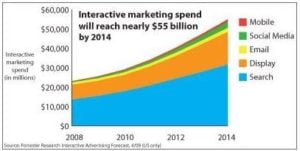
    •    Digital marketing is expected to double in the next 4 years, according to eMarketer, yet many advertising and PR agencies continue to struggle with integrating digital marketing tactics and executing them competently and profitably for their clients. A recent Forrester Research report says agencies “…must build new interactive competencies quickly in order to succeed.”

    •    Convince and Convert maintains an active blog on digital marketing issues for agencies

    Tags

    digital marketing, digital marketing consultants, ad agency consultants, interactive marketing consultants, internet business consultants, PR firm consultants, social media consultants, ad agency roundtable

    Links

    Convince & Convert digital marketing blog

    Convince & Convert digital marketing consultants services and fees

    Jason Baer Biography

    Are You Digital Ready? Quiz for Agencies

    Quotes

    (attributable to Jason Baer, President Convince & Convert)

    Advertising and PR firms have been having their lunch eaten for years by digital-only shops, and I’ve done some of that eating. Agencies must act now to dramatically improve their digital capabilities or their core business will begin to erode.

    Ultimately, there shouldn’t be a “digital” group within an agency. Every marketing tactic should have a digital component. That’s what Convince & Convert does - shows agencies how to integrate and profit from interactive marketing.

    Attributable to Forrester Research Report “Agencies Must Build Digital Skills to Survive) April, 2008

    Traditional advertising agencies face significant technical difficulties. Clients are shifting business to digital shops, and consumers have turned away from media channels that built the agency industry and toward emerging Internet media. Ad agencies must build new interactive competencies quickly in order to succeed. How? They must build digital skills with a three-tiered approach of establishing digital commitment at the executive level, retraining existing staffers, and building a pipeline of future talent.

    Multimedia

    convince and convert logo

    Get Convince & Convert Logo

    Jason Baer Headshot

    Get Jason Baer Headshot

    Get Jason Baer Bio (PDF)

    Jason Baer
    Convince & Convert
    (602) 616.1895
    jason@convinceandconvert.com
    Twitter: @jaybaerSimilar Posts That You Might Enjoy

    Jason Baer