Posts Tagged ‘keyword selection’

7 Critical Questions When Outsourcing SEO

Monday, August 11th, 2008

Many agencies without full service digital marketing departments choose to outsource any SEO work to a specialist. While I believe that the present focus on good content makes SEO easier, not harder for traditional agencies (especially PR) to handle in-house, many will continue outsourcing this critical service (or at least until I launch a “How To Do SEO At An Agency” seminar).

Howdy, Pardner


Meanwhile, finding an SEO partner is the modern day equivalent of securing someone to mine your gold claim while you go back home to Philadelphia. (feel free to insert your own Deadwood-style reference). Basically, SEO is the Wild West, with more Excel. There are no rules to speak of, very few “right” answers, and essentially no barrier to entry. There are literally hundreds (thousands?) of freelance and small firm SEO “experts,” some of whom know only slightly more than the traditional agency that hires them.

7 Critical Questions

To make sure you find a partner that understands SEO and where it’s headed, that can serve you and your clients competently, ask them these 7 questions.

1. How do you measure the success of your SEO campaigns?
You want a partner that uses metrics like leads, online sales, phone calls generated, etc. to measure success. Be wary of firms that tout their ability to get you “#1 Rankings”. Ultimately, being ranked #1 has zero direct revenue benefits. You also want to see regular reporting that focuses on those relevant metrics, not just your search position.

2. How do you determine which search terms to focus on?
Here, you’re looking for some sort of detailed search term analysis, combined with a thorough evaluation of the business model of the site to be optimized. Partners that mention testing terms to determine which will generate best results get extra credit.

3. How do you create content for search optimization?
At present, search-friendly content is the name of the game. Carefully crafting content that addresses key search terms and making sure that content is legitimately interesting to both real people and Google is the critical. Big bonus points for partners that create multi-modal content (photo galleries and videos) and partners that have dedicated search copywriters on staff. Make sure you ask for samples of their content creation.

4. How do you integrate search optimization efforts with other aspects of the marketing program?
Here, you’re looking for partners that recognize that good SEO isn’t done in a vacuum. Integrating SEO with public relations, making sure that search terms related to a new product or campaign are optimized. That’s what you want to see in this response.

5. What is your approach to getting more links?
Links are the coin of the realm in search. If you don’t have links from at least semi-popular Web sites pointing to your search-optimized content, it’s going to be an uphill battle (unless you’re emphasizing highly obscure search terms). Consequently, you want a partner that has a clearly defined process and proven expertise in finding quality links for their clients. Directories, blogs, one-to-one link requests, competitive analysis, etc. Ask to see samples of their link acquisition campaigns.

6. After the initial setup, what services do you provide month-to-month?
Some SEO firms will put real effort into getting the search program set up (pick terms, write copy, establish reports, get a few links) in the first 60 days, but then charge the client hundreds or thousands of dollars each month thereafter for essentially very little work. Find out precisely what they will do to improve the campaign on an ongoing basis. You want a partner that will create content on a regular basis, be garnering new links continuously, and be monitoring competitors.

7. What’s your best success story?
Ultimately, search optimization is about results. If a potential vendor can’t point to a series of clients for whom they dramatically increased sales, leads, etc. through measured SEO, stay away.


Any other tips you’d recommend? Reaction from the SEO community? Leave a comment.


More posts about search marketing>>

How I help ad agencies & PR firms get better at digital marketing>>
Get my blog posts in your email>>

Similar Posts That You Might Enjoy

Welcome. If you liked that, there's plenty more. Please subscribe to my RSS feed. You can also find me on Twitter @jaybaer

Jason Baer

Agency Advantage Tools #1 - Website Grader

Wednesday, July 23rd, 2008

Welcome to Agency Advantage Tools, a regular blog series at Convince & Convert that spotlights inexpensive or free digital marketing tools.

There are literally thousands of different Web sites, applications, plug-ins, widgets and more devoted to helping digital marketers do their jobs better or faster. Most advertising agencies and PR firms are too busy doing actual marketing to keep up on this flood of innovation.

So, here at Convince & Convert, we’ll do the work for you. We’ll scour the Web to find the tools that are worth adoption at agencies.

Website Grader - Search Optimization Success Snapshot

Today’s tool is Website Grader. This exceptionally easy-to-use Web site shows you in an instant how your site, your clients’ sites, and/or your competitors are doing with regard to search engine optimization.

Website Grader is owned by Hubspot, an integrated, Web-based suite of tools for search, blogging, social media, content management, and competitor analysis. We’ll review the full Hubspot offering in a future edition of Tools You Can Use.

Website Grader takes information that has been in demand for years (number of links, page rank, metadata, etc.) and presents it in a very clean, easy-to-understand format. There have been a number of sites that provide portions of this data, but none with the savvy interface and non-SEO-professional tone.

You just enter your Web site’s URL, enter the address of competitors if desired, provide an email address (if you want a printable report), and click “Generate Report”. That’s it.

Analysis take about 30 seconds.

The resulting report provides information on 23 data points across four categories:


  • On-Page SEO
  • Off-Page SEO
  • Blogosphere
  • Social MediaSphere
  • Conversion
  • Competitive Intelligence
All of the data presented is interesting, with some of it quite useful. For example, inbound link count, alt image tag assessment, and keyword grader are useful measures. Being alerted to the fact that this site doesn’t have a contact form is less useful. Clearly, we are already aware that we (purposefully) don’t have a form on Convince & Convert. 

While the scoring system is no doubt arbitrary and subjective, Website Grader does provide a summary score (on a 100 point scale) of how each site is doing. Convince & Convert gets just a 59 for now, as the newness of the site and subsequent lack of Google Page Rank and other key metrics no doubt hurts our score. 

While Website Grader might provide data that is mostly already known by studious professional SEO types, for agencies that are analyzing their own sites or client sites, it’s an extremely powerful tool that we wholeheartedly endorse. The fact that Website Grader provides recommended improvements for almost every data point is a real plus, making this a key Agency Advantage Tool and one that deserves an immediate bookmark (you can actually bookmark your specific report, so you can check back on your progress every couple weeks).

Leave a comment and let us know your Website Grader score. 


 Similar Posts That You Might Enjoy

Jason Baer

Google to Show Search Volume - Another Blow to Agencies

Tuesday, July 15th, 2008

In a LOOOOONG overdue move that provides some much-needed transparency to the PPC business, Google has added search volume data to their keyword research tool

This means that when you use Google to research potential search terms for your clients’ pay-per-click campaign, Google will actually give you an idea of how many people actually search for that term each month. Useful data when you determine that only 2 people per month search for “heirloom cucumbers kansas” so perhaps that phrase shouldn’t be the cornerstone of your search marketing efforts.

If you’re not involved with PPC on a daily basis, you may be thinking “well of course they would tell you how many people search for each phrase, how else could you even figure out which phrases to bid on?” Welcome to Planet Google, where information is doled out in maddeningly small and disconnected doses like plot points on Lost.

It is of course ridiculous that this data was not provided historically, especially since GoTo/Overture/Yahoo showed search volume from the beginning, and they pioneered PPC, not Google. But, Google’s moxy to hide a critical piece of marketing information has been a boon for search agencies and consultants, who use third party tools like WordTracker (a nice little company that is probably stocking smelling salts in the cafeteria after this announcement) to find this data for clients. 

While this announcement may seem out of left field, I see it as another move in a series designed to disintermediate agencies and move small and medium sized advertisers into the hands of Google directly. Google Analytics makes having a Web analytics consultant less necessary for some. Google’s Ad Planner makes an online media consultant less necessary for some. Google’s TV Ads and Radio Ads services make a traditional media consultant less necessary for some. 

Trouble for Agencies, but an Opportunity

Ultimately, it appears Google’s desired end game is for all small and medium sized advertisers to conduct all marketing transactions directly with Google, leaving agencies to deal with the big clients. For advertising agencies, this is both troubling, and an opportunity. If Google makes the marketing and advertising business as transparent as travel planning and stock purchases, the only agencies that will be able to survive are those that can add real value in messaging, creative, and integrating data into actionable tactics.

The transactional components of the advertising agency model like media placement, and the other services like Web analytics that are based on access to data will evaporate. Agencies must commit to being thinkers, rather than doers to succeed in this environment. Setting up a PPC campaign won’t cut it much longer. Managing a PPC campaign with rigorous testing that incorporates insights from offline tactics will be the level of expertise required for an agency to charge for search marketing - and that day will be here quickly.

 Similar Posts That You Might Enjoy

Jason Baer

91% of Top Digital Agencies Not Buying Their Own Brands on PPC

Tuesday, July 1st, 2008

In a shocking (and embarassing) revelation today, AdWeek uncovered that of the 56 world-class digital marketing agencies featured in their Annual Report Card, just 5 are purchasing their own brand names in PPC.

In fairness to the firms, most of them appear at or near the top of organic search results for their own brand names, but several studies have shown that click through rates (and conversion rates) typically increase when your brand is at the top of BOTH organic and paid search results. Incidentally, this is why the notion of dropping your paid search when you achieve organic search success is a bit of fallacy.

Also of note are smaller firms that are purchasing competitors’ brand names in PPC and showing up in paid search results. A crafty tactic, to be sure. Note that current case law says that you can in fact purchase competitors’ names and trademarks as a search term, but you cannot use those trademarks in your actual PPC ad copy.

If you’re an agency, why would you NOT cover as many bases as possible with your organic and paid search marketing efforts? The costs are minuscule and the results can be significant. In fact, at Off Madison Ave and Mighty Interactive (where I handle strategy and ideas), search marketing has long been a primary driver of serious new business leads.

If even the big digital shops aren’t buying their own brands in paid search, how many traditional agencies are doing so? If you’re not playing in this sandbox, get on it. You could literally have a campaign up by the end of the day. Similar Posts That You Might Enjoy

Jason Baer

Google’s Popularity is Costing You Money

Monday, June 30th, 2008

Paid search management vendor Covario said today that PPC spending was up 52% in Q1 2008 versus 2007.

52% is a big leap for an already red-hot digital marketing tactic.

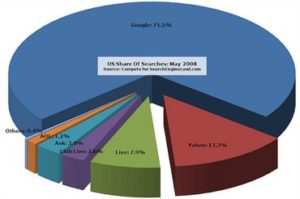
But perhaps more interesting was the finding that Google took in 85% of the paid search spend in the first quarter. (No wonder Yahoo! rushed into their arms after Microsoft blew them off). This points to a big inefficiency in PPC in general. If Google has 71% of the search market based on total number of searches, but 85% of the PPC budget, then substantially more people are spending substantially more dollars in Google than necessary.

Google’s Popularity Means You’re Overpaying

It’s not a mystery why paid search is up 52% and Google has 14% more spend share than eyeball share. In a down economy, marketers want to minimize waste, and Google PPC is the closest thing to a sure bet that’s easily available. (see previous post on digital marketing’s prominence in a recession). Marketers figure that if they have to retrench and focus on results and ROI, Google’s the place to go. But, if everyone is thinking that (and it appears they are), then the price for a click on Google PPC will continue to rise quickly to the point that profitability and ROI are impacted.

I suggest monitoring your average cost per click carefully to see if this trend is impacting you or your clients.

Don’t Dismiss Yahoo!

On a related note, this 85% Google share very much undervalues the importance of Yahoo! to many successful PPC programs. In many cases while working on client projects with Mighty Interactive, we saw Yahoo actually outperform Google. This is especially true for certain brands, as Yahoo’s users skew more female and less technical than do Google’s (and MSN’s users are even more female than Yahoo).

So, if the Google gold rush is pricing you out of the market, swim upstream and put some dollars in Yahoo and MSN where the clicks are cheap and your competition has fled. Similar Posts That You Might Enjoy

Jason Baer

How to calculate your PPC budget and success

Monday, February 18th, 2008

Q.

I’m interested in pay per click search engine advertising, but I don’t know how much it will cost. Help!

A.

Projecting costs for pay per click can be as mysterious as Britney Spears’ career plan.

Like success in Iraq, multiple factors determine your PPC budget and success level, and they are inter-related.

The single most critical decision in a PPC program is term selection. Only bid on terms that are extremely relevant to your business. This is not a time to be optimistic along the lines of “Well we only provide service in Phoenix, but we’d like to provide service in Indiana someday, so let’s just bid on all the Indiana search terms.” That will blow through your budget faster than Kobayashi eating hot dogs.

Use a program like Word Tracker or Google’s term selection tool to find search terms that are right for you. By way of example, let’s assume you want to focus on 100 search terms, with combined daily search volume of 400 per day. That works out to approximately 12,000 potential searches per month.

Multiple studies – including our own research – have shown that on average one-third of searchers will click on paid ads, with the balance clicking on natural search results. Remember that the paid ads are typically at the top of the page and in the right hand column, often with some sort of blue or gray background color behind them.

Using this data point, we can assume that the universe of potential PPC clicks for your search term is 3,960 per month (12,000 x 33%). Assuming you are going to launch your campaign on Google and Yahoo (with possible expansion later), you will reach 80% of all searchers, so your official click universe is 3168 per month (3960 x 80%).

But what percentage of those 3168 searchers will click on your ad? Your click rate will depend on how aggressive you bid and how well-written your ads are. It’s not easy to craft a great ad in 80 characters, and very small changes can have big impacts on your results. Use Google and Yahoo’s tools to test many versions of your ad.

Recognize that your results are intrinsically linked, to some degree, to the behavior of your competition. You’ll often find competitors “bidding blind” in search engine advertising, paying whatever it takes to stay number one in the results. This is like getting pulled over because the guy next to you is speeding, and it can be extremely frustrating to watch them spiral up the per click prices for all bidders.

In general, we use a rate of 9% to project the percentage of paid clicks a solid ad will attract if it typically falls in the top 3 bid positions. This then gives you approximately 285 clicks per month on your ad (3168 x 9%). Remember, this is 9% of the people that click on paid listings.

Yahoo! provides a seemingly accurate bid price range tool. Use this tool to determine average top bid prices for your search terms. Add 15% to account for Google’s higher average click fees. If the average price for top 3 bid positions for your search terms is $2, use $2.30 as your average. Multiply that by your estimated clicks (285) and Shazam! you have your estimated monthly expenditure for PPC: $655 (285 x $2.30).

If you poured yourself a scotch three paragraphs ago, and if in your opinion, this formula is far too similar to watching sausage being made, I’ve found an easy resource for you to determine your estimated budget. Just use this Mighty Interactive PPC Calculator. Plug in some numbers, and it will do the numerical heavy lifting for you automatically.

For you cynics, I’m frequently asked about competitors nefariously clicking on ads late into the evening, costing you thousands in fake clicks. While “click fraud” does occur online, the search engines log every click by time and computer (IP) address, and have sophisticated algorithms that diagnose rampant abuse. Can you cost your hated rival a few dollars here and there by clicking on their ad? Yes, and they can do the same to you. Unfortunately, that’s part of the search engine game, but the chances any serious budgetary damage can be inflicted is pretty slim.Similar Posts That You Might Enjoy

Jason Baer

Black Magic: What You Need to Know About the Dark Art of Search Engine Marketing

Sunday, August 1st, 2004

Thirty six percent of site visits come from a search engine or other Web link, according to Web measurement firm Web Side Story. Betting 36% of your site traffic on the outcome of an ongoing epic duel between geeks who work for search engine companies and the geeks who try to outsmart them seems akin to listing “monkey’s paw and other lucky talismans” as your primary marketing strategy.

Every one of the nearly 300 corporate clients we’ve worked with over the past 10 years has needed some manner of search engine help. You’d think search engine strategies would be as comfortable and satisfying as a good bowl of chili by now. But instead, search engine success remains mysterious and elusive, like Marilyn Manson or Cardinals’ playoff victories.

You see, there’s a lot of money to be made in the finding stuff business, and the search engine companies are eyeing each other warily like angry leprechauns sitting on their pots of gold. There’s already been consolidation in the industry, and the jockeying for survival is picking up speed. In just the past 60 days, Yahoo! has revitalized their search system, Disney announced they want to sell their Infoseek search engine (and hired Google to handle their searches) and Overture purchased Alta Vista (the market leader circa 1998).

The breakneck pace of change on the Internet has slowed down - except in the search engine world. So, while we wait for the search engine dust to settle, we still have to make sure our Web sites can be found on whichever ones are still standing at the moment.

The bad news is that to become a search engine expert is a noble, but somewhat unrealistic goal along the lines of astronaut or gourmet English chef. The good news is that you can dramatically improve your search engine results by focusing on a few key components of search engine success.


Word Up

Because of their pervasiveness and importance, search engines are the most competitive aspect of the Internet. Other people own Web sites, and they might be reading helpful columns written by Internet consultants, too.

So, to increase your chances at success, out smart the other guy by choosing to optimize realistic and viable keywords. You can’t be ranked number one for every word that’s remotely related to your business - there’s too much competition for those keywords.

Let’s say you are a homebuilder or developer, as are some of our clients. What might be theoretical good keywords (actually key phrases in many cases)? Here’s a list of possibilities, and the number of matches on Google:

New Homes 4,420,000
Arizona New Homes 782,000
Phoenix New Homes 431,000
Scottsdale New Homes 98,800
Scottsdale Luxury Homes 36,800

Specificity is the key to search engine success. Do more people type “new homes” into a search engine than type in “Scottsdale luxury homes”? Yes, but there are so many matches for a broad search like “new homes” that your chances of being in the top 20-30 listings are exceedingly poor.

Where do you start? Figure out what products or services you specifically offer, and list all the keywords and phrases associated with them. Then, review your current Web site statistics and determine what words and phrases visitors are using to find your site today. Also, send an email to 25 of your current customers and ask them to list the five phrases they would type into a search engine to find your business.

Take that knowledge, and combine it with keyword search frequency and competitive match information from an inexpensive product like wordtracker.com to hone a list of 10-50 words or phrases that both specifically apply to your business, and are viable for optimization. The more specific the term, the more likely the searcher will find exactly what they are seeking, increasing the change they will convert into a sale.


What’s the Density Kenneth?

Once you’ve determined your best possible keywords, the goal is to incorporate those words EXACTLY into your Web site copy as frequently as possible. Many search engines use keyword density as a major component of their ranking algorithm. That means that number of times your keyword appears on a page as a percentage of all words on the page can dramatically influence your rankings.

A density of 3-4% is ideal. Less than that, and competitive sites will have greater density, moving you down the search results list. Too much density will get you bounced out of the engine for keyword spamming - putting the same keyword on your page ad infinitum.

Writing that frequently includes your exact keywords can sound as forced as a Bill Clinton apology, so it might be a good idea to optimize for 10 keywords rather than 50 - unless you have a very large site.


Popularity Contest

Ultimately, ingredients of the witches brew that determines each search engine’s rankings (and they are all different) can be manipulated through careful keyword selection, density and other techniques that advanced search engine groupies can tackle. The search engine proprietors figured this out, and realizing that the secret sauce wasn’t that secret, added a new rule to the game - popularity and reputation.

The assumption is that popularity of a site translates into site relevancy, and relevant sites should be listed first in search results. Popularity is measured in two ways. First, by inbound links. How many sites link to the site in question, and how many sites link to the sites that link to the site in question? Second, how often is the search result for the site in question clicked on by users of the search engine.

Reputation is measured by what the text that links to your pages says about your company.

The notion was that this was a fair and equitable way to evaluate sites objectively, and more importantly for the Star Chamber of search engine owners, seemed to be a method that couldn’t be artificially manipulated. Wrong. A whole new sub industry has recently emerged whose sole business is to procure inbound links for Web sites. You want another 50 sites to link to yours to improve your search rankings for “cactus candy” or whatever is important to your business? Can do. $25 per link is the going rate.

To excel at search engine rankings, we advise that you consider professional assistance. Legitimate services begin at around $300 per month.

To improve your current results, take a look at your site traffic and how much (or little) of it comes from search engines, and where you’re currently ranked for keywords that are important to your business. Then, follow the steps above, and you should be moving up the charts like a new Brittany Spears single.Similar Posts That You Might Enjoy

Jason Baer