In some circles, social media marketers still get a bum wrap for not being able to prove how their work impacts the bottom line. Despite an abundance of overwhelming evidence to the contrary, many business leaders still view social media as a “nice to have” but not a necessity. “We see our competitors employing social [...]
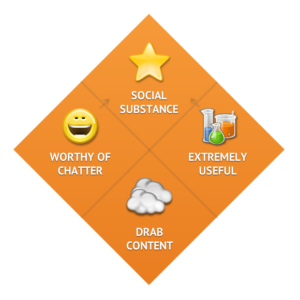
Creating Social Substance: Talkable & Useful Content
Creating outstanding content marketing programs requires social substance. Your content must be useful and worthy of chatter.
WEBININE: Boost Email Delivery Rates with SenderScore
Increase email delivery rates with SenderScore.org. This webinine (short webinar) provides instruction and email advice.
Abandonment Issues – What To Do with Content Archipelagos
If you viewed your content marketing operations from a 35,000 foot level, what would they look like? Would your organization’s content assets, social media networks and web/mobile properties all be aligned and grouped in a cohesive, self-supporting structure? Would they appear to feed audience traffic to one another? Would you have any assets that stand alone, away from the others in isolation?
If your answer to that last question is “yes,” you are not alone. With the best intentions, many brands concept, create and eventually forget about assets once utilized for content marketing purposes. There are countless mobile apps, videos, infographics, research summaries, podcasts and even networks that are like content archipelagos – untouched, inconsequential and alone.
WEBININE: How to Build an Email Sign-up Form That Works
In this webiNINE, our series of ~9-minute webinars for social media and online marketing practitioners, we review the email sign-up process for three sites in the travel and tourism industry. The initial sign-up form is a crucial component of a successful email marketing program. Find out what form elements help deliver a quality experience for the visitor.
Moneyball Principles for Content Marketing
By now you have likely seen, read or heard about the story of the Oakland A’s baseball teams of the early 2000s. Led by General Manager, Billy Beane, the club had limited resources with which to build a winning team, especially when compared to big budget competitors like the New York Yankees, Boston Red Sox, etc. As opposed to relying on old school player evaluation tactics, they hired analysts who used statistical models to identify batters who could score more runs and find pitchers who could get more outs. While the Moneyball story is framed within the game of baseball, it’s really about math. It showed that we can depend on numbers to help predict success. And while it was not perfect, this particular “numbers first” approach proved better than an expert’s best guess.
The 12 Key Messaging Strategies for Email Lifecycle Marketing
Guest post from Chris Sietsema, who teaches and trains small to medium-sized businesses and non-profits in the disciplines of search, social media, email marketing and online analytics. Chris owns Teach to Fish Digital, a one-man consultancy in beautiful Mesa, Arizona. He also created the infographics for The NOW Revolution. A common challenge for us is [...]