Posts Tagged ‘email promotion’

Mobile Opt-in Flies at US Airways

Thursday, November 20th, 2008

A recent study by ExactTarget and Ball State University showed that consumers 24 years old and younger prefer text messages to email. For consumers 25+, email still reigns supreme. Does that put text/mobile/SMS out of reach for most brands? Not at all. In fact, using mobile to drive email subscriptions is an emerging best practice.

Mobile opt-in is instant, exceptionally easy for the subscriber, and the brand gets both an email address AND a mobile number for use when text messaging is more prevalent in the U.S.

Mobile Opt-in Done Right

I should have joined US Airways’ points program long ago. I fly the airline often, but haven’t signed up for the program because I didn’t want to take the time to fill out a long, online form, etc.

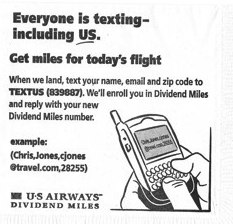
But, on a recent flight I glanced at my cocktail napkin to see this compelling and easy sign-up offer:

Other than the fact that US Airways was practically daring me to violate the in-flight ban on cell phone usage, I was enthralled. One text message with your name and email address, and you’re enrolled. Very slick.

Follow Up Good, but Unfocused

Almost immediately after signing up via text, I received a nifty email confirmation that included a digital membership card, and two offers for bonus mile via credit card offer. While the creative on the offers wasn’t spectacular, the use of transactional email to drive additional action is on the mark.

But then the next day, I received another email that mentioned something called TEXTUS (evidently the system that runs the mobile opt-in program), and asks for me to provide additional info to activate my account. I understand the need/desire for more info from me, but shouldn’t they have asked for that before I got my nifty digital membership card? I wasn’t offended, but I was confused. And that could have been easily avoided. And why was that sent a whole day later?

Then, once I did in fact log-in to provide additional information, I received another confirmation with another digital membership card, and related offers (more this time). Again not bad, but a bit puzzling.

Overall, a great program. Fills a need. Makes it easy. Confirmation and follow up is a little wacky, but extra effort for being an airline (not typically the most nimble marketers) and pulling off a mobile program.

I anticipate mobile opt-in will be big in 2009. The prevalence of SMS capable phones make it a natural for point of sale e-mail subscriptions for newsletters, special offers, and other programs.

Could you use mobile opt-in effectively? What’s your plan?

Similar Posts That You Might Enjoy

Welcome. If you liked that, there's plenty more. Please subscribe to my RSS feed. You can also find me on Twitter @jaybaer

Jason Baer

Red Robin’s Email Program Has a Broken Wing

Thursday, October 30th, 2008

By all accounts, Red Robin is very successful restaurant chain. With hundreds of locations nation-wide and well-deserved plaudits for their Unbridled Acts customer service program, Red Robin has it together. (try the Bonzai Burger, Bruschetta Chicken Burger, and the Tower of Onion Rings).

But the Red Robin customer loyalty messaging program is far less than it should be. In fact, it’s downright weird.

A trip to a Phoenix-area Red Robin recently found all tables covered with these coasters:

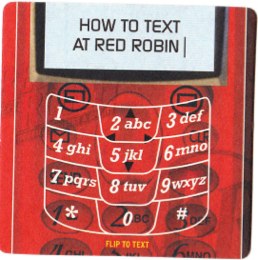
I thought “Cool! Red Robin is rolling out a mobile opt-in or SMS promotion program.”  I literally whipped out my iPhone and was ready to go, until I turned over the coaster:


Umm, what? “Red Robin Yummm”? I literally stared at the coaster for a couple minutes before I realized that this was NOT a national SMS program, but rather some sort of conversation piece. I still don’t fully understand it.

A meta joke about text messaging? A subtle suggestion that customers text their friends about Red Robin? The “95 of 237″ indication makes it even more mysterious. Are there 237 of these phony text message coasters? (first one I’ve seen, but I don’t go to Red Robin routinely)

What I completely can’t fathom is that they spent a ton of money on creating fake text messaging coasters. If you’re going to those lengths, why not just put in 1.5% more effort and create an ACTUAL program?

The Robin Has Landed

So when our meal is finished, the bill comes. I open the bill jacket to find that Red Robin has a guest survey (complete with a circle the bird head scale for illiterate patrons). Here’s how it looked in the bill jacket:

  I notice the red part at the bottom because the comment card is slightly too tall to fit in the bill jacket without the bottom folded over. I was thinking “did they not measure the bill jackets when they designed this card? typical agency…” 

But then I unfolded the card:

It turns out, you get a free gift for supplying your email address, and a FREE BURGER on your birthday.

I helped set up Cold Stone Creamery’s massively successful birthday club email program (which now has millions of members). A free anything on your birthday is a big deal. Why would Red Robin create a card that leads with the circle a bird head scale, and hides a very compelling call to action under a fold over that many people will NEVER see? 

Ridiculous. If you want to build a list, ask people to sign up. In this case it’s as if Red Robin feels they have to launch a birthday club, but are sort of embarrassed about it, so they hide it. Like people that keep their ill-behaved, slobbery dogs in a guest bedroom when they have company over to watch football. 

Red Robin has all the ingredients for a wildly successful, multi-modal messaging program. Brand loyalty. Budget. At least some executive support for a birthday club. But for a restaurant that bills themselves as “Master Mixologists” the combination of elements in this program could use some serious re-working. 

 Similar Posts That You Might Enjoy

Jason Baer

15 Email Statistics That Are Shaping The Future

Wednesday, October 22nd, 2008

I just finished an invigorating panel discussion at the Marketing Profs Digital Marketing Mixer. Moderated by Aaron Kahlow from Online Marketing Summit, the session was titled “What Your Customers Really Think of Your Email Program.” (click here for the presentation at Slideshare)

I was joined on the panel by Katrina Anderson of iPost, and Annie Kinnaird of Emma. Stephanie Miller of ReturnPath was the brains behind the format.

The idea was to wade through the ton of email data being published seemingly every day, and focus on the really juicy stuff - subscriber studies - that’s impacting how the email marketing industry is evolving.

Which of These Email Marketing Stats Scare You Most?

1. 21% of email recipients report email as Spam, even if they know it isn’t

2. 43% of email recipients click the Spam button based on the email “from” name or email address

3. 69% of email recipients report email as Spam based solely on the subject line

4. 35% of email recipients open email based on the subject line alone

5. IP addresses appearing on just one of the 12 major blacklists had email deliverability 25 points below those not listed on any blacklists

6. Email lists with 10% or more unknown users get only 44% of their email delivered by ISPs

7. 17% of Americans create a new email address every 6 months

8. 30% of subscribers change email addresses annually

9. If marketers optimized their emails for image blocking, ROI would increase 9+%

10. 84% of people 18-34 use an email preview pane

11. People who buy products marketed through email spend 138% more than people that do not receive email offers

12. 44% of email recipients made at least one purchase last year based on a promotional email

13. Subscribers below age 25 prefer SMS to email

14. 35% of business professionals check email on a mobile device

15. 80% of social network members have received unsolicited email or invites 

What Do You Think? Is the Future of Email 1:1 Communication? Leave a Comment

More illuminating posts about email marketing>> 

 Similar Posts That You Might Enjoy

Jason Baer

Amp Up Email Results with Honeymoon Segmentation

Tuesday, October 7th, 2008

Subscribers to your email list are most likely to open, click, forward to a friend, and buy in the first 30-60 days after joining the list.

This is the Honeymoon and you need to use it to boost your email results - especially in the 4th quarter holiday shopping season.

This chart from Marketing Sherpa shows the impact of recency on email results. This is a somewhat dated B2B chart, although I have no doubt whatsoever that the trend holds. If you have more recent data, please leave a comment below.

Creating a Honeymoon Segment

During the Honeymoon, subscribers are flush with excitement about your email program. Possibilities are boundless, as your whole messaging relationship lies in front of them, and surely that relationship will be filled with timely offers and insightful information.

While palms are sweaty, and giddiness abounds, you should create a specific and separate Honeymoon Segment for your email program. The Honeymoon segment is anyone who has joined your list in the past 30-60 days. Use 30 days if you plan to mail recipients 3+ times per month, and 60 days for 1-2 sends per month.

Treat Honeymooners entirely differently than you do your other subscribers. Mail more frequently, ask them to forward to a friend, use aggressive offers. Essentially, your objective is to maximize the value of the Honeymoon by capitalizing on the short-term excitement that new subscribers have about your program.

Because the Honeymoon will end. The excitement will fade in a flurry of email offers, and you’ll begin to quarrel about things that used to seem so trivial - like message frequency, bed making, and spending too much time on your fantasy football team.

Note that you can help stave off the end of the Honeymoon by moving as quickly as possible toward truly relevant, hyper-targeted messaging. This is the future of email, but it requires a real commitment to use segmentation to deliver timely and useful messages at all time.

Do This First

Two components of the Honeymoon strategy you absolutely must employ are thank you messages and testing. Send an immediate thank you message to all new subscribers. That thank you should include a meaningful offer (preferably with a time limit) and a request to forward to a friend. Your chances of generating revenue and viral behaviors from your subscribers diminishes with each email received, so try to make it happen in the first 5 minutes a subscriber joins your list.

Second, use rigorous testing to maximize the impact of the Honeymoon. The same way you’re engaged in constant testing of your main email program, you need to be testing your Honeymoon segment. From lines. Subject lines. Day of week. Time of day. Layouts. Offers.

Note that because your Honeymoon segment will of course be much smaller than your main program, it may take longer than usual to test. Watch your statistical validity, too.

Have you used the Honeymoon Segment? Do you think you can adopt it in time for the holidays?

Leave a comment with your ideas.
Similar Posts That You Might Enjoy

Jason Baer

Email Marketing - What Do You Want to Know?

Friday, August 22nd, 2008

I’m happy to announce that I’ve been elected to co-chair the Consumer Education Roundtable for the Email Experience Council. 

The EEC is the global professional association for email marketers, striving to enhance the image of email as a tactic while advocating its importance for business.

In partnership with the DMA (Direct Marketing Association), EEC also puts on an excellent (dare I say definitive) conference for email marketers called Email Evolution. The next edition is February 9 - 11 in Scottsdale, AZ. (Information here)
 

Help Me Help You

My EEC Consumer Education Roundtable is charged with building the definitive Web site or online application to help marketers understand email best practices, design, statistics, regulations, etc.

Currently, there are a lot of resources online about good email marketing, but they are spread all over the place and its hard to determine to whom to listen. This new EEC initiative will help solve that problem by aggregating “approved” email marketing information.

Even the EEC itself is perpetuating the current problem, as the online resources section links to a variety of white papers, blogs, stats, columns and other flotsam and jetsam. (I’ve been waiting for the day when I could use flotsam and jetsam in a blog post)
 

I Need Your Comments Please

Please help me get the new roundtable off to a rousing start. Please leave a comment (or hit me on Twitter @jaybaer) and tell me what you really want to know about email marketing.


I train agencies on digital and interactive marketing>>
Get my blog posts in your email>>

Similar Posts That You Might Enjoy

Jason Baer

When The Fonz Clicked Delete: Email has jumped the shark

Wednesday, June 20th, 2007

Like Lohan trips to rehab and Cardinals’ “this is our year” chants, most of us have had it up to here with email.  Spam has gone from annoying to ridiculous. I got an insane, indecipherable missive from a German derelict this week. 417 times. It looked like he slapped a sausage on the keyboard to form random word forms, and then fired out the email.

For marketers, it’s been too easy. Email requires little technical or budget pain compared to other marketing channels, and those advantages have resulted in marketers beating the golden goose to death with a huge “Send” button.

Getting great response rates from email is tougher than ever. Email volume is massive and the technical rules of the game have changed dramatically in the past 12 months.

Here’s what you need to know to be a successful email marketer, now that doing so has gotten substantially more difficult.

Mind Your Rep

Whether or not the major ISPs delivered your email to the inboxes of your subscribers was formerly determined by the content of your email. Viagra references were lumped together with more innocuous offenses like exclamation marks, use of “click here” and “free”, and unusual font colors into a naughty list that would get your email filtered.

That’s clearly a pretty blunt instrument with which to decide email validity. Consequently, many ISPs have now switched to delivering email wholly or at least in part based on the reputation of the sender. Mercifully, it has nothing to do with high school and that night on the roof.  Instead, reputation is determined by the percentage of your subscribers that mark your email as spam. You may have heard that people rarely click “unsubscribe.” That’s true. Instead, nearly all consumer ISPs (AOL, Earthlink, Cox, et al) have a “mark as spam” button prominently located. Instead of taking the time to unsubscribe, consumers click the spam button, and like Prom writ wrong, there goes your reputation.

Consequently, it is more critical than ever to not send email to anyone that hasn’t specifically requested it from you, and to only send content of value. Given the importance of reputation to the success of your email campaign, it’s better to have a small, quality list than to have a big list of dubious merit.

Your Trojan Horse Has Shipped

A proven method for increasing the frequency of your email communication without annoying your subscribers and putting your reputation at risk is to engage in transactional email.

Transactional messages are anything that gets sent out based on either a user action or relationship status change. Thank you for subscribing. Your order has shipped. Your order is delayed. Thank you for your bill payment. Your customer service request has been received.

All of these emails can be configured to include valuable promotional and informational content alongside the core transaction messaging. And it works. A study by MarketingSherpa found that consumers read transactional emails from trusted brands frequently or very often 75% of the time, compared to 55% for regular email communication.

Open Sesame

When it comes to measuring the success of your outstanding new transactional email program, give pause when using open rate as a metric. If you have Outlook (or Yahoo! mail and others) you may have noticed that images in emails don’t load unless you click “load images” in the message. Email open rates are tied directly to images. If an image (like your logo) loads in the recipient’s email program, the email has been “opened” and will be counted as such. This is true even if the email is only seen in the preview pane.

With images turned off on many browsers, however, open rates have plummeted. We have seen a decline of approximately 50% for every client over the past year.

Consider using click-through rate or total clicks as your main barometer for email success. Both are reliable and not influenced by technology or email software variations.

Also, because so many images are not loading, it is absolutely imperative that any graphics in your email are solely illustrative. You should never put an offer, headline, phone number, or any sort of important information in a graphic unless that same information is also prominently included in text.

The Name Is the Game

Everything you’ve just read is of course invalid unless you can convince people to subscribe to your email program.

As much as half of your Web site traffic may enter your site on a page other than the home page. Thus, you should include your email sign up on every page of the site. Incidentally, this is true for other key promotional elements on your site. Remember than any and every page of your site could be a visitor’s entry point and that page needs to be clear and persuasive.

While you’re at it, include the actual sign-up form on every page. Don’t make people click to another page to sign-up, we have found it to reduce response rates.

Lastly, make sure people know what they’re going to get from you. Again, it’s like high school. Set clear expectations at the beginning, and nobody will be disappointed. Add a link to a sample email newsletter above your sign-up form. Your response rate will increase, your spam complaints will decrease, or both.

Is email the bright and shiny new toy it once was? Sadly, no. But by following the evolving rules for email success, you can continue to outflank your competition and create valuable online relationships with your customers.Similar Posts That You Might Enjoy

Jason Baer

Making a List: Clicking it Twice

Thursday, July 1st, 2004

Consumers visit a limited number of Web sites each month. How can you make your site one of them?

In the American way of thinking, if some is good, more must be better. Anything useful or interesting gets proliferated until it reaches gluttonous proportions.

Cereal is good. But do we need nearly 100 varieties? How many movies based on comic book characters can be made in a three year period? A lot, evidently. And nowhere is this phenomenon more omnipresent than in reality TV. Real World begat Survivor which begat a death spiral of televised humiliations that explain why most of the world either laughs at or hates America. By the time you read this, you may have watched or Miss Dog America, an actual show on Fox (during sweeps, natch) with 50 fine bitches from around the country - plus D.C. - competing for top canine honors.

If there’s a dead horse, America will beat it.

The Internet is no exception. Being a primarily American creation, the Web lives by the same rules of excess applied to the rest of our culture. In 2002, there were approximately 35 million Web sites in existence. That’s one for every nine Americans.

According to Nielsen/NetRatings, the average U.S. home Internet user visited 49 different Web sites in December, 2002. Out of 35 million, each person went to just 49 sites. How’s that for a little competition?

What can you do to get your Web site a small share of the 12 hours the average home Internet user spends online each month? Here are four tips to keep them coming back.


Focus on Why, not What


At this point, most people assume that your company has a Web site. Consequently, while you should include your Web site address on everything associated with your company to maximize the effectiveness of this technique you need to do more than just slap on your URL.

Whenever time and space permit, explain why people should visit your site. It’s easy to ignore or overlook your Web site address alone, and it certainly doesn’t provide a compelling reason for someone to visit the site. For example, instead of tagging ads with www.arizonalottery.com the Arizona Lottery should add, “Sign up to have winning numbers delivered by email. Free. Visit www.arizonalottery.com”.

Web site promotion that offers specific reasons for doing so can draw discretionary visits that a URL by itself cannot.


Be Found


As people’s use of the Internet becomes more focused and task-oriented (the average number of sites viewed monthly was in the 70+ range as little as one year ago), users “search and surf” less. However, according to measurement firm WebSideStory, Inc., 36 percent of Web site visitors arrived at sites via a search engine or other Web link. This means that roughly one third of your potential audience will (or will not) find you using a search.

Search engine optimization is the classic “get what you pay for” business. If someone tells you they can get you listed in all the search engines for $99, run away. Sure, they can get you listed, but if you’re not in the top 30 results for a given search phrase, there°s no point in being there at all.

We work with search engine optimization companies daily, and in our experience, you should expect to pay a minimum of $250 a month if you are at all serious about driving traffic to your Web site.


Make it Easy to Return


The counterpoint to the 36 percent of Web site visitors who arrive via search engine or link is that a whopping 64 percent don’t. That means that two out of every three people who come to your Web site will do so by typing in your URL or using a bookmark (aka favorites).

Tackle these two important tasks immediately: First, if you are using an acronym as your Web address and you are not IBM, ATT, NAFTA, NBA, NFL, or some other equally recognizable collection of letters, stop doing so immediately. The old rule that your URL needs to be short is bunk. It needs to be easy to remember, and using an obscure acronym for your Web site address is by definition difficult to remember.

Ideally, your Web address should be whatever your receptionist says when he or she answers the phone.

Phoenix Children’s Hospital is a long-time client. For their first Web site (circa 1996) they used phxchildrens.com as their address, to focus on brevity. Now, however, their award-winning site uses phoenixchildrenshospital.com as its URL.

Second, remind people to add your site to their favorites. If you can make a bit of room on your home page add a small line reading, “Visit again. Add us to your favorites.” Just a little note so visitors who truly are interested in your site will take a second to put you in the all-important favorites list before they move on to one of the 48 other sites they°ll visit this month.


Push, don’t Pull


Unless your target audience is more familiar with Harry Potter than Harry Truman, the notion that they will “sur f”the Web and come back to your site on occasion to see what’s new has about as much credibility as Michael Jackson’s “only two surgeries” claim. Adults use Web sites primarily to access specific information, solve problems or research purchases. Period.

So, if you want them to come back, you not only need to give them the specific reason for doing so (see above) but ideally you must give them the vehicle, too. That means getting permission to communicate with them via email, usually a periodic email newsletter where you can give subscribers a compelling rationale to revisit your site.

Indeed, email is getting a bad rap due to misuse and overuse (which we prophesied in this column 18 months ago), but if you do it right, it’s still the most powerful way to get visitors to return. AZ-TV, the independent television station that boasts Pat McMahon and the Wallace & Ladmo revival among its programming, is a client. On days when their email newsletter is sent out, Web site traffic spikes 300%.

Just remember to never send an email that doesn’t have real informational value to the recipient. If you don’t have anything new and useful to say, be quiet.

The Internet is as big as Mike Tyson’s gigantic, hideous face tattoo. After all, there are 683 search results on Google just for “bizAZ.” Getting eyeballs to your Web site is one of the eternal challenges of the industry, but you don’t have to stage a dog beauty pageant to do it. Just implement a few of these tricks and they’ll be beating down your digital door.Similar Posts That You Might Enjoy

Jason Baer