Posts Tagged ‘recession proof marketing’

5 Reasons Why Digital Marketing Will Thrive in the Recession

Tuesday, September 30th, 2008

From Dot Bomb to Dot Boom

Let’s face it. The economy is taking on the distinctive, sickly pallor of a post Mardi Gras Keith Richards.

Generally, recessions hit the advertising business with the ferocity of a rabid wolverine, and the last one trimmed overall ad spending by 9% according to market researchers Veronis Suhler Stevenson. The wolverine in question mauled and devoured online advertising, which plummeted 27% over two years during the last recession.

This time it will be different. Not only will online marketing survive, it may actually thrive during the lean times, continuing its inexorable theft of ad spend from traditional media tactics. Online is far more mature and proven now, and there are five specific reasons why it will be the go-to tactic among increasingly budget-conscious marketers.

Money Talks

First, online is typically less expensive than many other marketing tactics, and a sizable and impactful online effort can be undertaken more quickly and cost-effectively than can an offline campaign.

Wiggle Room

Like an Elizabeth Taylor marriage, online doesn’t require much long-term commitment. PPC ads can go up and down on a day-to-day basis. Email can be sent (or not sent) based on financial considerations. Even banner ads can usually be negotiated with an advantageous cancellation clause of 72 hours or so. Try that with your local TV station or newspaper. Other than keeping your Web site up to date, the only core online tactics that require substantial ongoing effort are organic search optimization, and Web site analytics and testing.

More Juice for the Squeeze

With diminished outbound marketing budgets, companies will shift focus toward increasing revenue from current customers, either through more frequent purchases, or larger ones. Email marketing is the perfect vehicle for communicating with customers and incentivizing additional purchases. Customer lifecycle marketing (persuasively combining email with direct mail, voice mail and text messaging) will gain favor as companies strive to close a higher percentage of a reduced flow of leads.

Waste Not

There is meaningful financial waste associated with advertising to people who have no interest in your product or service. The superior targeting ability of online marketing will enable companies to focus their reduced marketing dollars solely on likely prospects. This will accelerate the trend toward use of behavioral targeting and retargeting in online ad placement.

Behavioral targeting mines a person’s Web page visits and search terms to serve relevant ads. If a prospect reads several pages on Yahoo! about Nissan Altimas and does a search on Yahoo! using a related term, an ad for Valley Nissan dealers can be served up just in time.

Retargeting (a nascent industry led by local company Fetchback) takes the concept one step further, enabling companies to advertise only to people who have visited their Web site previously without making a purchase. With average conversion rates hovering around 2%, this is an ideal way to reach the other 98% that have taken the time to visit your site but haven’t yet converted.

Additionally, search marketing will continue to expand since it is the only tactic (other than Yellow Pages) that puts the marketer in the middle of the consumer’s purchase psychology funnel. I expect heavier bidding on specific, “long tail” search terms that often correlate with greater intent to purchase.

Numbers Don’t Lie

Online marketing of all types offers superior measurability and trackability in comparison to traditional tactics. This is of course due to the Orwellian nature of the Web, where every mouse click is tracked, usually anonymously. While the availability of this data may give you the same creepy feeling you get when gazing upon Joan Rivers, it makes for effective marketing.

When implemented correctly, banner ads, organic search, paid search, blogs and social media, email, lifecycle marketing and all other online marketing tactics provide a user by user scoreboard that can be utilized to ascertain precise return on investment metrics for each campaign.

In this way, online marketing provides companies the ability to test a wide array of tactics, evaluate which generates the best response, and then adjust the marketing program accordingly.

The old saying is “I know half my marketing dollars are wasted. I just don’t know which half.” This problem is even more acute and painful in a down economy when advertising dollars are curtailed. The inherent cost, targeting, and tracking advantages of online marketing make it more likely to succeed (or at least able to minimize losses from a failed campaign). And when a wolverine is at your door, that’s the type of assurance you want from your marketing strategy.


How I help ad agencies & PR firms get better at digital marketing>>
Get my blog posts in your email>>

Sphere: Related Content

Welcome. If you like the content here, consider susbscribing to my RSS feed. You can also find me on Twitter @jaybaer

Jason Baer

The 10 Strengths of the Agency of the Future

Tuesday, September 16th, 2008

Web services giant Sapient recently fielded a national online digital marketing survey of more than 200 chief marketing officers (CMOs) and senior marketers responsible for managing digital budgets (among other things).

Survey respondents were asked about the top qualities they sought in their advertising and marketing agencies in the coming year.

Sapient’s Top 10 Wish List for Agencies of the Future…and My Comments

1. Greater knowledge of the digital space. With more than a third of marketers surveyed revealing that they are not confident that their current agency is well-positioned to take their brand through the unchartered waters of online digital marketing and interactive advertising, it’s clear that agencies need to have a greater knowledge of the digital space in order to thrive. In fact, nearly half (45 percent) of the respondents have switched agencies (or plan to switch in the next 12 months) for one with greater digital knowledge or have hired an additional digital specialist to handle their interactive campaigns.

This is another in a series of warnings from me that traditional agencies NEED to get uber-competent at digital marketing now. Clients are switching agencies based on digital marketing knowledge. See my post “Wake Up Agencies - Digital Shops = Trojan Horse” for more.

2. More use of “pull interactions.” When trying to engage consumers with their brand, 90 percent of respondents agree that it is becoming increasingly important that their agency uses ‘pull interactions’ such as social media and online communities rather than traditional ‘push’ campaigns.

No question this is true, and it will be even more acute in 2010 when Millennials (who prefer organic sources of information and recommendations) become a larger demographic cohort than Boomers or Gen X. 

3. Leverage virtual communities. An overwhelming 94 percent of respondents expressed interest in leveraging virtual communities (public and private) to understand more about their target audience.

This one is a little fuzzy for me. It sounds like market research using social networks. That can work, but if this list is in order, no way is this #3 for the future of agencies. On a related note, check out Rapleaf. They take a database (your client’s email list, for example) and cross-reference it against all the social networks so you can figure out if you should emphasize MySpace, Facebook, LinkedIn, or something else. Cool, and potentially massively useful. 

4. Agency executives using the technology they are recommending. Ninety-two percent of respondents said it was ‘somewhat’ or ‘very’ important that agency employees use the technologies that they are recommending. For example, it is important that agency executives regularly use Facebook, Flickr, wikis, blogs, etc. in their personal social media mix.

The fact that this even made the list is an indictment of the advertising profession. If you’re going to pitch a social media campaign to a major client, you might want to have a Twitter account (among other things). It’s like SEO firms that aren’t ranked anywhere on Google for their own services. The Emperor has no clothes.

5. Chief Digital Officers make agencies more appealing. Forty-three percent of marketers surveyed said that agencies with chief digital officers are more appealing than those without.

I agree that having somebody in charge of digital strategy in an agency can be beneficial (disclosure: I had this role at Off Madison Ave for nearly 3 years). However, that approach only works if the agency has many digital experts, and just needs someone to steer the ship. Too many small and mid-sized agencies far prey to the “guru syndrom” and hire one Internet guy to handle all digital marketing for their agency. Big mistake. If that guy leaves (and he will), you’re screwed. And, centralizing digital expertise gives the rest of your staff an excuse to not get better at digital marketing. Don’t do this. See my series of training workshops for agencies on how to not get your whole agency competent at digital marketing. 

6. Web 2.0 and social media savvy. Sixty three percent of marketers surveyed said that an agency’s Web 2.0 and social media capabilities are ‘important/very important’ when it comes to agency selection.

Yes. Related to a couple of the points above. However, it’s critical for agencies to have a social media strategy for their clients, not just a random collection of social media tactics. Building a wikipedia page is not a strategy.

7. Agencies that understand consumer behavior. Seventy-six percent of respondents deemed this as an ‘important/very important’ aspect of their agency’s online digital marketing and interactive advertising area of expertise.

Isn’t this what agencies are supposed to be doing now (never mind the future)? This will be a huge determinant on agency winners and losers in the future, because Google and others will take away agencies’ revenue streams that are procedural rather than strategy and creative-driven. See my post about Google looking to crush agencies for scary details. 

8. Demonstrate strategic thinking. Seventy-seven percent of marketers surveyed ranked strategy/brain trust capabilities at the top of their agency wish list.

Yes. See #7. Same thing in my book. 

9. Branding and creative capabilities. Sixty-seven percent of respondents ranked branding at the top of their agency wish list while seventy-six percent ranked creative capabilities as ‘important/very important.’

This one is definitely more future looking than some of the others. At present, especially for the mid market, digital marketing can sometimes be very successful without great branding. But that will change, and agencies MUST get their creative teams comfortable with digital. How do creative directors get away with “I don’t really understand online, so I have our junior art director do that stuff”? Would that work for radio? For outdoor? For magazine? Well guess what, Internet advertising is larger than all three of these media types (U.S. annual spend).

10. Ability to measure success. It’s no surprise that marketers want an agency that can report on where campaigns succeeded, fell short and where they should be fine-tuned. Sixty-five percent ranked analytics at the top of their agency wish list.

This is the secret weapon of digital marketing and what makes it superior to traditional in some ways. Agencies that aren’t using the inherent measurability of interactive marketing to their advantage are missing the boat. The reason digital marketing will thrive in the recession is its targeting and tracking components. 


What do you think? Are there other attributes the agency of the future must have? Jetsons-style flying car? Extreme Wii proficiency? Please leave a comment with your ideas.

Perhaps you’d like to receive these blog posts via email?


Sphere: Related Content

Jason Baer

Internet Advertising to Grow 20% in 2008

Wednesday, August 13th, 2008

A new report from Bernstein Research says online advertising in the U.S. will grow by 20% in 2008, despite weakness in travel, auto, and financials.

Top categories for online advertising spend include:

  • Finance, insurance, real estate - 29.6% of overall spend
  • Media and entertainment - 25.2%
  • Retail - 13.8%
  • Other - 12.9%
  • Auto - 8.6%
Despite big cuts in auto marketing in broadcast and print, online ads for automakers were actually up 3.8% in the first quarter. (see my blog post about auto advertising online, and why it works)

According to Bernstein’s forecast, even a significant worsening in overall economic conditions wouldn’t deter Internet advertising growth much. In a full-blown recession scenario, they predict online ads would still grow by 17%. (See my blog post on “Why Digital Marketing Will Thrive in a Recession” for more on this topic).

The Question for Agencies…

This research begs an obvious question for agencies? Are there other elements of your business that are likely to grow by 20% this year? If not, is it time to ramp up your digital capabilities?

Any agency readers of Convince & Convert care to comment about their digital progress in 2008?

How I help ad agencies & PR firms get better at digital marketing>>
Get my blog posts in your email>>
 

Sphere: Related Content

Jason Baer

Media Buyers Say Internet Advertising Will Grow in Next 6 Months

Monday, July 7th, 2008

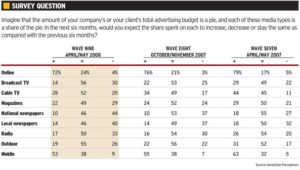
Market Research firm Advertising Perceptions released a new survey of 1,811 media buyers showing that a whopping 72% of them believe Internet advertising spend will increase in the second half of 2008.

This is a shocking finding, considering that no other medium (other than mobile) was expected to grow by more than 28% of the respondents.

The outlook for newspapers and radio was especially pessimistic, with more than a third of respondents projecting overall spend to drop for those media in the next 6 months.

While we’re big supporters of mobile here at C&C, 55% of media buyers suggesting that mobile spend will increase was also a suprise. As a somewhat experimental tactic, we’d expect mobile to be set aside temporarily in this down economy. However, the measurability of mobile (which is also a terrific database acquisition tactic) could be fueling the optimism about it.

Without question, the measurability of Internet advertising and search marketing is what’s driving the move of ad dollars from traditional tactics like newspaper toward digital marketing. This move is going to be even more acute in a recession, as digital’s cost-effectiveness, speed of deployment, and targeting capabilities make it a “safe” media bet for most companies and agencies.

It will be very interesting to see if this movement of ad dollars toward digital results in markedly higher CPMs for banner ads by year end. We’re already seeing increases in PPC costs due to the “over-popularity” of Google.

Sphere: Related Content

Jason Baer

Google’s Popularity is Costing You Money

Monday, June 30th, 2008

Paid search management vendor Covario said today that PPC spending was up 52% in Q1 2008 versus 2007.

52% is a big leap for an already red-hot digital marketing tactic.

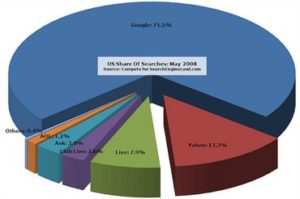
But perhaps more interesting was the finding that Google took in 85% of the paid search spend in the first quarter. (No wonder Yahoo! rushed into their arms after Microsoft blew them off). This points to a big inefficiency in PPC in general. If Google has 71% of the search market based on total number of searches, but 85% of the PPC budget, then substantially more people are spending substantially more dollars in Google than necessary.

Google’s Popularity Means You’re Overpaying

It’s not a mystery why paid search is up 52% and Google has 14% more spend share than eyeball share. In a down economy, marketers want to minimize waste, and Google PPC is the closest thing to a sure bet that’s easily available. (see previous post on digital marketing’s prominence in a recession). Marketers figure that if they have to retrench and focus on results and ROI, Google’s the place to go. But, if everyone is thinking that (and it appears they are), then the price for a click on Google PPC will continue to rise quickly to the point that profitability and ROI are impacted.

I suggest monitoring your average cost per click carefully to see if this trend is impacting you or your clients.

Don’t Dismiss Yahoo!

On a related note, this 85% Google share very much undervalues the importance of Yahoo! to many successful PPC programs. In many cases while working on client projects with Mighty Interactive, we saw Yahoo actually outperform Google. This is especially true for certain brands, as Yahoo’s users skew more female and less technical than do Google’s (and MSN’s users are even more female than Yahoo).

So, if the Google gold rush is pricing you out of the market, swim upstream and put some dollars in Yahoo and MSN where the clicks are cheap and your competition has fled.

Sphere: Related Content

Jason Baer