Measuring Facebook Fan Engagement Beyond the Like

Matt Simpson Measuring Facebook Fan Engagement Beyond the LikeGuest post from Matt Simpson, interactive marketing director for Bulbstorm. Bulbstorm executes campaigns for brands seeking to create passionate bonds with consumers.

Not long ago, the ultimate measure of a successful Facebook promotion was fan growth. That was sooooo 2010.

Fan growth is simply not enough. Disagree? Throw out a sweepstakes app, dangle a free iPad, and buy some cheap Facebook ads. You can easily buy fans, but to what end?

It’s time we adjust our aim – and retrain our stakeholders’ focus – beyond that initial click of the like button and toward real engagement. Here are two ways we measure Facebook promotion success in the post-like world.

Depth of engagement

Boasting of fan count is like bragging about the size of your email list. A big list is nice, but how effectively are you using it?

At Bulbstorm, we’ve defined a metric we call brand engagements. It’s a tally of any and all thoughtful interactions consumers have with your brand on Facebook. Engagements range from liking or commenting in the news feed to interacting with content within a promotion application.

promo engagement funnel e1307158795466 Measuring Facebook Fan Engagement Beyond the LikeBrand engagements often form the bottom of the conversion funnel of Bulbstorm promotions. Some of our clients also want to drive to a campaign-specific objective like coupon distribution, email list growth, or user-generated content collection, as shown in the funnel graphic.

One recent promotion soliciting the submission and rating of user content drove 309,133 brand engagements in five weeks. That’s serious interaction!

That averaged out to 61,827 engagements per week – not bad considering the brand averaged 6,808 weekly engagements in the weeks leading up to the promotion. Here’s the data:
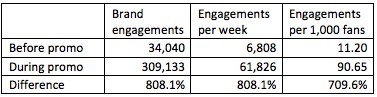
brand engagements Measuring Facebook Fan Engagement Beyond the Like

Of course, not all engagements are created equal. Consumers invest more of their passion into submitting a piece of user-generated content than into liking your fan page’s status. But a consistent approach to aggregating brand engagements enables you to compare campaigns and track depth of engagement over time.

Breadth of engagement

There are so many reasons individual Facebook users might miss your brand on a given day. Maybe they were playing Farmville. Maybe they didn’t log in. Maybe your content sucks – and suffers the wrath of Facebook EdgeRank or the user’s hide option.

That’s why one of our favorite pieces of data available through Facebook Insights is active users. This metric lets us see how many unique users viewed or engaged with a brand in the last week or month (either on a fan page on in the user’s news feed). This metric does not include users engaged with a promotions app, but your developer should be able to provide that number from App Insights.

Divide weekly or monthly active users (WAU or MAU) by fan count to get a rough gauge of engaged vs. non-engaged fans for the period.
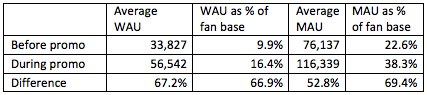
active users Measuring Facebook Fan Engagement Beyond the LikeNot surprisingly, WAU and MAU increase dramatically during a promotion. After all, a promotion gives you a compelling reason to ask for engagement. For example, one of our CPG clients experienced the following jump in engagement during a recent promotion.

Beyond the like

Is engagement the end all be all? No. Ultimately, we’re all looking to sell products or services at a healthy margin.

However, the metrics outlined above are indicators of a passionate bond between brands and consumers than fan count … at least until Facebook gives us a “love” button.

It’s time we wean ourselves – and our stakeholders – off of like campaigns driven by meaningless iPad giveaways. It’s time we evolve past validating our Facebook promotions by fan growth alone. How are you measuring engagement beyond the like button?

(Bulbstorm is a Convince & Convert client)
pf button both Measuring Facebook Fan Engagement Beyond the Like
Genesis Theme Framework

Convince & Convert Runs on the Genesis Framework

The Genesis Framework, which powers this site, offers a huge selection of amazing designs which can change the way your site looks. They are easy to customize and include layout options as well as custom widgets, so get Genesis now!

Order The NOW Revolution

Social media and technology have changed business forever.

Buy Now
Post comment as twitter logo facebook logo
Sort: Newest | Oldest
rickyyean 7 pts

ScribeDevil thanks for breaking down your campaign. That's some massive jump in engagement and would love to learn more about what the promo entailed. Obviously you stated out with a very engaged user base already and most of us still have a long way to go before we can get there, but can always learn more about designing good promos!

jehuthehunt 5 pts

I really like the idea of measuring engagement (at least in part) through the active user/total fanbase calculation. I do have one question however: does anyone know how Facebook measures active user interactions? For instance, if my page has 1,000 monthly user interactions, are those 1,000 different/unique fans? Or possibly 500 fans interacting with the page twice in a couple of different ways?

ScribeDevil 7 pts

jehuthehunt Monthly active users should be unique for the month. So, 1,000 MAU is 1,000 different users. Some of those 1,000 engaged once and some engaged multiple times. Hope this helps!!

jehuthehunt 5 pts

ScribeDevil jehuthehunt terrific! thanks so much for clearing that up.

jehuthehunt 5 pts

ScribeDevil One more question as a follow-up: based on this calculation, what sort of percentage range should a healthy page have? 50%? 60%? I'm assuming that the higher percentage, the better...I'm just wondering about establishing some sort of benchmark to help set expectations.

ScribeDevil 7 pts

jehuthehunt Great question! Unfortunately, we cannot compare ourselves to other similarly-sized brands in our industry (because MAU data is not public). Until Facebook decides to distribute industry-by-industry standards, we'll have to be satisfied using MAU percentages to track our own improvement over time.

JasonPeck 11 pts

Great stuff here! Another we look at in determining fan engagement is the average number of interactions (likes, comments, fan posts, etc) per day on a brand's Facebook page. Ideally, (if we and our clients are doing a good job) this increases over time and will jump up during promotions. We also like to look at how this correlates with weekly and monthly active users as well as seeing if there's any correlation between this and referral traffic to the client's website from Facebook (and purchases as a result of this traffic).

LHInsights 13 pts

ScribeDevil thoughtful. I have seen brands that boast of million fans and 100 likes on a post or comments. if one looks into the comments they are no where related to the content actually . so i guess its time to move ahead of likes as u have specified clearly.

mlogan 5 pts

Jay, one other dimension worth considering is quality of engagement. I've seen a couple of promotions for clients where the promotion attracted plenty of comments, but a large percentage of comments were complaints. In general, sentiment analysis is quite unreliable in the social monitoring tools I've seen, so it's definitely a challenge, but a purely quantitative approach to engagement misses the boat, IMO.

ScribeDevil 7 pts

mlogan LoL! Excellent point. We cannot be slaves to data. Kudos to anyone with the cajones to pat themselves on the backs after dressing up complaints as comments! That's juking of the stats worthy of The Wire. :)

DirectResponse.net 11 pts

Doing too many promotions can definitely hurt a brand. People become interested in more about what shiny new toy they can win. Rather than becoming more connected with the brand itself.

Anybody can write a review for a chance to win an iPad. That doesn't help measure brand loyalty. It just means they REALLY want an iPad.

ScribeDevil 7 pts

DirectResponse.net I wholeheartedly second this motion. Unless you do marketing for Apple, do NOT give away an iPad. We encourage clients to offer prizes with high perceived value and strong brand alignment. Check out this grainy video of me discussing this very topic: http://www.youtube.com/watch?v=bMuMF929S6k

hilary_lee 5 pts

We've been trying to encourage engagement by asking questions (fill in the blank), holding giveaways (where fans have to comment), or specifically asking for a post "like." How often would you recommend a brand making posts per day on Facebook specifically asking for some sort engagement action? How many is too many? Also, what are your opinions on EdgeRank Checker? How closely should I follow my score?

ScribeDevil 7 pts

hilary_lee Fairytale Brownies, representing! I like it. I think the answer to any questions around "how often" or "how many" is to test. The newsletters and blogs we all read are great for outlining philosophies and best practices. Then it's up to us as marketers to apply those philosophies and best practices in our environment through disciplined testing. As for EdgeRank, I'd follow it as closely as your bandwidth and other priorities allow. More data is always good, until it overwhelms us. :)

Tikydo 6 pts

I agree that what is important is to have facebook users still be interested in the brand's page or offer after becoming fans. Why do you take into consideration the ads impressions in the promotion engagement funnel?

ScribeDevil 7 pts

Tikydo We think it's important to account for all elements of a campaign in our reporting. Advertising has been an important element of nearly every successful enterprise-level Facebook promotion of which we're aware.

danperezfilms 122 pts

Now if only somebody could prove that "engagement" leads to increased sales/revenue, then we'd really be on to something, yes?

ScribeDevil 7 pts

danperezfilms Hear, hear! It's our responsibility as marketers to work with our clients (internal or external) to build systems that track to a sale.

DaveGallant 16 pts

danperezfilms I second this, as this has become a recurring question by many. I have read several articles on the importance of measuring engagement, as well as preaching it myself, yet have seen little to no posts on how that "engagement" directly leads to increased sales/revenue.

Kudos to you ScribeDevil for devising a way to measure. Yet the reality is using that Facebook promotion for fan growth still produces those metrics that can be shown from beginning to end.

AngelaHausman 5 pts

I like your approach to measuring engagement, but maybe a weighting system would improve it's performance. As you say not all engagement is created equal. So, weigh user generated content more than a like and you've increased the accuracy of your measure. An increase in engagement over time is nice, but if you're running some campaign, it may be a huge increase in Likes accounts for most of the change. And we know most users who fan a company never go back to the company's fanpage so does an increase in Likes have much value.

Angela Hausman, PhD

http://hausmanmarketresearch.org

ScribeDevil 7 pts

AngelaHausman I agree. A weighted approach would add valuable insights. They key is to be consistent in measurement. If you're comparing campaign X vs. campaign Y, make sure both were measured on the same scale (weighted or aggregated). One thing I like about the aggregated approach is that it's a very easy concept for those outside our industry to grasp. Too much weighting and scoring can sometimes look like snake oil.

nrobins1 8 pts

What if Monthly & Weekly Active Users are double the fan base? This is good, but what's holding the non-fans back?

ScribeDevil 7 pts

nrobins1 It's great that your fans are so active! I'm not sure I understand the part about non-fans though. Care to clarify? :)

nrobins1 8 pts

basically when monthly active users exceed the actual amount of people who "like" your Facebook Page, there are a whole bunch of people that aren't taking an action to "like" the page. Am I missing something? ScribeDevil

ScribeDevil 7 pts

nrobins1 ScribeDevil Your assessment seems logical to me. I can envision a scenario in which a page with relatively few fans receives a lot of visitors (driving page views) but does not convert those visitors into fans. If you're running ads (or otherwise promoting your page), I'd recommend taking a look at your welcome tab and ensuring you're communicating the benefits of opting-in via like.

Conversation from Twitter

sghazzi
sghazzi

hussdajani omardxb gr8 piece

m_sosh
m_sosh

Thanks for the RT! socialntwknanny

socialntwknanny
socialntwknanny

m_sosh You're welcome—thank you for the great article. :)

sparkloft
sparkloft

rydermedia Thanks for your retweet!

jaybaer
jaybaer

@theresaoverby @sparkloft Thanks guys. Credit goes to scribedevil for the guest post.

sparkloft
sparkloft

jaybaer theresaoverby scribedevil Great post! http://budurl.com/45jp

madamsaz
madamsaz

bulbstorm looking forward to lunch!