
Does social media breed inequality?
Because our behaviors on the social Web leave a noticeable fingerprint, smart companies can modify the way they engage and interact with us, based on our social graph, purchase history, etc. Would the VP of Customer Satisfaction of Southwest Airlines have called Kevin Smith at home (after he was kicked off a plane for being too portly), if Kevin Smith did NOT have 1.6 million followers on Twitter?
The reality is, there’s never been a level playing field. Fly more miles, get priority seating on an airline. Eat 10 sandwiches, get the 11th free. But now, social media is enabling companies to make influencer outreach a foundational marketing tactic.
In Search of Mass Influencers
In a fascinating new Forrester Research study about online peer influence, Augie Ray and Josh Bernoff determine that consumers generated more than 500 billion online impressions about products and services in 2009. But more than 80% of those impressions, from “I love Sweet Leaf Tea” to “I’d rather die than sleep in this hotel” are created by just 16% of the U.S. population.
Labeled “Mass Influencers” this army of 29 million opinionated chatterboxes may very well be the key to your social media success. Sure, “listening” is the most oft-cited path to social success, but if the “Mass Influencers” aren’t talking about your company, you could have Dumbo ears, and it won’t make a bit of difference.
Finding Your Influencers
As noted in the study, the notion of true 1:1 marketing via social media is a bit of a fallacy. It’s really only possible in a reactive sense via social CRM, where individual complaints or questions can indeed be handled.
Instead, why not focus your social media efforts on trying to locate and engage with the Mass Influencers within your customer base? Here’s 6 ways to find the gossips in your midst:
1. Segment by Age
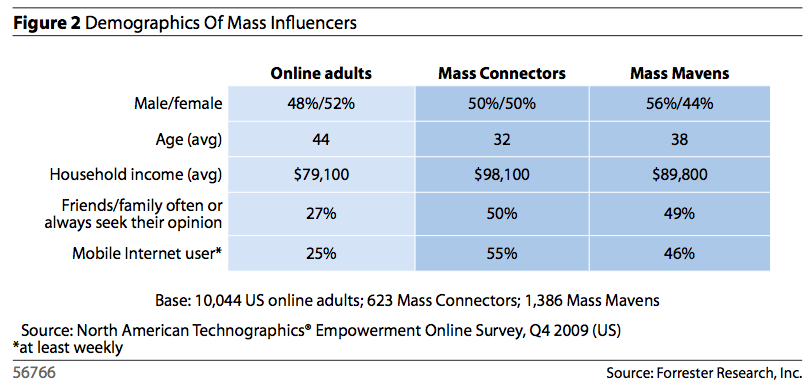
The average age of Mass Influencers are between 32 and 38 years old (younger than the average online American, at 44). If you have age in your database, isolate customers that are approximately 25-44 years of age – old enough to have developed influence among their peers, but young enough to be facile with emerging ways of sharing those insights.
2. Segment by Income
Possibly because they can afford to experience (and thus compare) more things, Mass Influencers average household income ranges from $89,000 to $98,000, higher than the U.S. online average of $79,000. If you have income in your database, isolate customers in the upper middle tier (for most companies).
3. Look to Facebook
Somewhat surprising (at least to me) was the finding in the Forrester study that 62% of influential impressions from Mass Influencers took place on Facebook, with Twitter just 10%. Consequently, look to your Facebook fans, or use of the new Facebook “like” feature as a marker for Mass Influence. (It would be interesting to see if your Facebook Insights shows an age distribution concentration for your Facebook fans in the 25-44 range).
Also, perhaps your potential Mass Influencers aren’t already fans of yours on Facebook. Take your email lists, and use Flowtown to determine who within your customer base has a Facebook account. That’s a good starter list for Mass Influencers.
4. Look to Yelp and Forums
When you get beyond social networks, the heaviest concentration of influential impressions is on ratings and reviews sites (32%), followed by discussion boards/forums at 29%. Don’t assume that the person that gave you one star on a Yelp review is some sort of carnival freak outlier. It’s entirely possible she is a Mass Influencer. Same with the message board trolls, who are all too easy to overlook in favor of bloggers and Twitterers. Someone in your company should be assigned to monitor and respond to ALL reviews and forum posts, positive or negative.
5. Isolate Mobile Users
The same way that a wallet chain indicate the owner loves Kings of Leon, mobile Internet use is a definitive marker for Mass Influentials. Twenty five percent of the U.S. online population access the Internet from a mobile device. Among influentials? Fifty percent! The next time you send an email, I would absolutely run a report showing opens and clicks by mobile device. Also, although manual, you could pay attention to with what software your fans are posting to your Facebook fan page. Mobile device usage indicates potential influencer status.
Let’s break this down. Imagine you are a business that has a customer database that includes age, income, email address (and probably several other fields). Let’s also assume that you have a Facebook fan page. Take your customer database and build this type of influence scoring spreadsheet (This is not Forrester stuff, I put this together – don’t blame them):
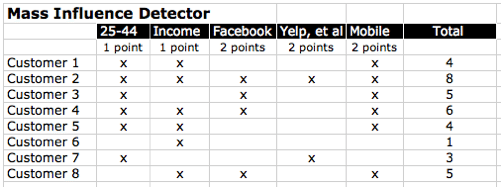
Note that I gave the behavior-based markers double-weighting. With this scoresheet, I would look at any score at 5 or above as a serious indication of Mass Influencer status. I would then create a group in my database solely populated by those influencers, and I would create a whole series of outreach and engagement campaigns to trigger positive brand chatter among them.
What would you do?



Interesting post, Jay.
I suppose that people like big mouths have always had more influence, one way or another. After college, I worked in customer relations for a large electronics' company. My manager told us at the time (and this is 1994, mind you) that the average angry customer told 61 people about his/her experiences.
What do you think that number is now with tweets and comments for all of the world to see?
The Science of Inequality – Finding Your Influential Customers: Does social media breed inequality?Because our beh… http://bit.ly/9AK0HX
RT @jaybaer: The Science of Inequality – Finding Your Influential Customers: Does social media breed ine… http://bit.ly/9RcCXz #marketing
The Science of Inequality – Finding Your Influential Customers: Does social media breed inequality?Because our beh… http://bit.ly/clux45
The Science of Inequality – Finding Your Influential Customers http://bit.ly/clux45
The Science of Inequality – Finding Your Influential Customers: Does social media breed inequality?Because our beh… http://bit.ly/clux45
RT @jaybaer The Science of Inequality – Finding Your Influential Customers http://bit.ly/cCjlW2 #SMM
New @jaybaer The Science of Inequality – Finding Your Influential Customers http://bit.ly/clux45
RT @jaybaer The Science of Inequality – Finding Your Influential Customers http://bit.ly/cCjlW2 #SMM
C&C Blog Post – The Science of Inequality – Finding Your Influential Customers http://bit.ly/dcYshf RT Please
The Science of Inequality – Finding Your Influential Customers http://bit.ly/clux45 #ConvinceandConvert
Jay Baer Blog: The Science of Inequality – Finding Your Influential Customers http://bit.ly/drscxy Full http://bit.ly/adeX31
The Science of Inequality – Finding Your Influential Customers http://bit.ly/9ewPQP
The Science of Inequality – Finding Your Influential Customers http://ow.ly/17ctTH
The Science of Inequality – Finding Your Influential Customers http://bit.ly/b24VDH Social-Media.alltop
The Science of Inequality – Finding Your Influential Customers http://bit.ly/cKy4wc #news #socialmedia
RT @jaybaer: The Science of Inequality – Finding Your Influential Customers http://bit.ly/9ewPQP
RT @nancyrubin The Science of Inequality – Finding Your Influential Customers http://bit.ly/9ewPQP by @jaybaer
The Science of Inequality – Finding Your Influential Customers http://ow.ly/1E428
RT @blurMarketing: The Science of Inequality – Finding Your Influential Customers http://ow.ly/1E428
Interesting assessment of the Forrester research, and nicely put into an actionable chart to make it “doable” if a client has some of these data points available. It is nice to see approaches that go beyond the oft misguided “number of followers” thinking.
The overall concept of trying to “calculate” (not guess) who the mass influencers are using your available data points and weighting factors, and then planning outreach specifically to them, is helpful. Thanks Jay.
The Science of Inequality – Finding Your Influential Customers #in http://viigo.im/3kj7
The Science of Inequality – Finding Your Influential Customers (via @jaybaer) http://bit.ly/d9tcgh #smm #marketing #influence
The Science of Inequality – Finding Your Influential Customers http://bit.ly/9KM7R6
The Science of Inequality http://om.ly/imyA @jaybaer on how to identify influential customers..
More than 80% of impressions are created by just 16% of the U.S. population: http://bit.ly/bWIFNn (via @prsarahevans)
Great stuff. We have also found asking appropriate questions and product usage details help identify these folks.
Really important link about digital WOM: RT @jaybaer: The Science of Inequality – Finding Your Influential Customers http://bit.ly/9ewPQP
Who are your influencers? 80% of consumers content about products and services created by just 16% of the population – http://bit.ly/aSHQ0a