The Social Impact of Friendships and Lies

  • February 9th, 2010 | Written By: Jay Baer
  • | View Comments

Do you trust me?

Social media relies on the premise that we’ll believe what people tell us more readily than if we were told the same thing by a nameless, faceless company. That’s why brands go to great lengths to humanize themselves on the social Web.

But, a new study by Edelman (whose digital arm features social media and ebusiness genius David Armano) claims that bond is eroding.

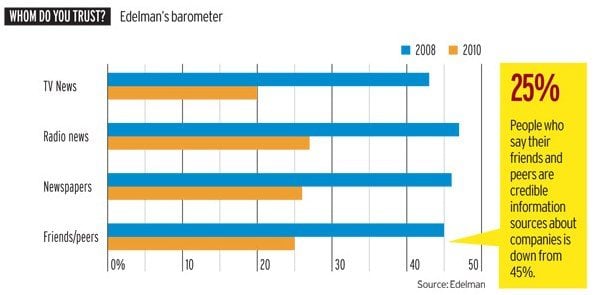
A survey of 4,875 adults (500 U.S.) world-wide shows that just 25% of respondents said their friends and peers are credible sources of information about companies – a decline of 20% since a similar analysis in 2008.
Social Media  Consumers Trust Their Friends Less Advertising Age News The Social Impact of Friendships and Lies

AdAge tried to make hay out of these findings with the provocative headline: “In the Age of Friending, Consumers Trust Their Friends Less.

With Friends Like These, Who Needs Friends?

On the surface, it makes sense. The pervasive time crunch that blankets us all has forced us to curtail face-to-face relationships in exchange for digital interaction. And in most cases, we’re willing converts, with Facebook’s ease-of-use and Twitter’s immediacy replacing letter writing and meeting up for lunch. As a result, we have both more and fewer friends than ever.

The real shift is in how we define friendship. That’s the research study I’d like to see. There are dozens – maybe even hundreds – of people that I “know” via social media, and consider to be friends. Yet, in almost every case I have no idea if these people even have siblings.

So, given that we’ve cast a much wider net for our “friends” thanks to the social Web, is it any wonder that some of those new fish will be less than sushi grade? Furthermore, our newfound addiction to status updating gives each of our “friends” that many more opportunities to ratify or countermand our own choices and proclivities, building or eroding trustworthiness in real-time.

In the old days of three dimensional friendship, you might discover some unsavory elements of a friend after spending two or three afternoons or evenings together, in different situations, with various combinations of mutual acquaintances. Now, you can discover if someone’s a dolt in 140 characters or less. It’s like truth serum with a keyboard. I’ve now hit double digits on the number of people I have unfriended due to their apparent round-the-clock playing of pointless mafia, farming, or aquarium games on Facebook.

So sure we have less faith in our “friends” than we used to. But, unlike AdAge, I certainly don’t see that as a shortcoming of social media, because the same study showed (as pointed out by the always awesome Shiv Singh) that our trust in EVERYTHING has gone down.

Lying By the Seat of Our Pants

Reexamine the chart above. Trust in TV news? Down 20%+. Trust in radio news? Down 20%. Trust in newspapers? Down 20%. What’s interesting and depressing is that our trust in everything measured in this study has diminished by almost exactly the same rate. That’s not an indictment of social media and its relationship-building, it’s an indictment of veracity.

And really, is that a surprise either? In the last year, I’ve been lied to at various times by the President, Congress, my family, clients, Tiger Woods, Toyota, the Catholic Church, the local school board, and at least one Olson twin (but I can’t remember which). What this Edelman research demonstrates is that we’ve become a bunch of cynics, and who could blame us?

That’s why it’s more important than ever for companies (in social media or otherwise) to embrace the truth. It used to be that scandalous lies got talked about. Now, authenticity and acknowledgement of shortcomings is an incredibly effective marketing and communications approach (see Dominos, as I wrote about here).

In the land of the liars, the truth-teller is king.
View Comments to “The Social Impact of Friendships and Lies”

  1. Twitter Comment


    Étude très intéressante sur le degré de croyance selon les medias lorsque l’on parle d’une entreprise [link to post]

    Posted using Chat Catcher

  2. Twitter Comment


    Étude très intéressante sur le degré de croyance selon les medias lorsque l'on parle d'une entreprise [link to post]

    Posted using Chat Catcher

  3. Twitter Comment


    Trust in all media down 20%, not just social trust [link to post] post by @jaybaer

    Posted using Chat Catcher

  4. great observation Jay. I think now is an opportunity for people and companies to embrace a level of transparency and honesty that hasn't been seen in long time. The values of accountability and truthfulness will set you apart from the masses. Of course I wonder how much patience many will have, considering the effort involved in building trust?

  5. I'm not sure if the research tells us anything we didn't already know, Jason. In real life, we trust a chosen few, while we consider the opinion of others. The others may “break through” into the trusted circle by action and consistency; but until then we only trust the opinion of those that have earned our trust. Why would this be any different online?

    I think it's more a matter of trusting less people as opposed to less trust in people overall. There's a difference.

    Cheers :)

  6. Narciso17 says:

    Appreciate your two cents on this, Jason – it's a good reminder that just b/c something looks and walks like a duck doesn't necessarily mean that it's a duck indeed. There's a lot of folks out there claiming to be this and that or just simply puffing up their expertise with the help of smoke and mirrors. You can see alot of this in the 'green living' industry – folks call it greenwashing. Thsi is kinda like that since you really have to vet the REAL folks and the posers. And like Danny Brown noted (@DannyBrown), you've just gotta be that much more selective on who your 'real friends' are.

    Narciso Tovar
    Big Noise Communications
    @Narciso17

  7. I always wondered what would happen if Mashable put out a headline like: “New Apple/Google 4G Super Smart Mobile is Coming!” … and then the subsequent article explained to the actual readers that there is no such thing, and this was simply a test to see how many people actually read the articles before sending them to the people who are supposed to trust them as content aggregators and creators.
    How many times would this 'article' be re-tweeted? Between the pre-set bots, and the humanoids who decide to act like 'bots RT anything if the right blog (or blogger) curates it … I unfortunately think the #'s would be huge.

    It has become so easy to share, that 'trust' is THE main component of influencers. Not their #'s and reach, but are they trusted.

    Interesting post Jason.

    Clinton

  8. Dan Ariely, a behavioral economist and resident smart-guy at MIT had this to say about why we would mislead others on a very popular ted.com speech.

    http://www.ted.com/index.php/talks/dan_ariely_o...

  9. Ike Pigott says:

    Brilliant, Jay. the sushi line says it all. Well, almost.

    The Ambient Web connects me to people that I have a relationship with, or once did. Not all of those people will be relevant in helping me answer my questions about a product.

    I feel that once we dive down into the polling and the methodology, we'll find that the definition of “friend” for the purposes of these surveys will have contexts different enough to render the comparisons (and thus the “trend”) meaningless.

  10. kahuna7 says:

    Jay, I don't normally comment on your posts (which I should) but I find myself redistributing your posts to my sphere of influence quite often because of how great your content has been now for about the last year. I don't know if you took the red pill or what, but whatever has spurred your last 12-16 months of phenomenal article writing and blog posting, PLEASE KEEP IT UP. Heart felt thank you for enlightment.

  11. I think the concepts of friend, fan and trust have to be redefined. There are people online that I regularly engage with, and although they may be “friends” they are certainly not FRIENDS. Trust gets played with all the time also. Some companies (such as Domino's which I also wrote about here: http://bit.ly/aGoOkB ) have gotten better at acting like they are all of those buzz words like transparent, human, conversational, engaging, etc. You know, kind of like “We are really not a transparent company, but we play one on YouTube.” I think it may be time for new words to be invented to differentiate “friend” vs. friend and “trust” vs. trust.

  12. Twitter Comment


    Trust in all media down 20%, not just social trust [link to post] post by @jaybaer

    Posted using Chat Catcher

  13. Twitter Comment


    RT @fruchter The Social Impact of Friendships and Lies [link to post]

    Posted using Chat Catcher

  14. Tend to agree with Danny on this one. I don't trust all of my friends with everything, but heck, I love them dearly.

  15. I heard about this yesterday I think… This just shows that what most people consider 'friends' these days (thanks to all the loose definition via social networks) is much greater and when they friend all these people they're getting hit with more spam and advertising… I think that's driving the trust down.
    I still see no dip in word-of-mouth referrals for my services…

    … update: now that I read the whole thing I notice you mentioned the same thing lol… good we see eye to eye… and mmm… sushi

  16. Jay,

    “What’s interesting and depressing is that our trust in everything measured in this study has diminished by almost exactly the same rate”

    I agree with your suggestion that we just trust everything less (even ourselves?) and so it's not that we trust our friends any less relative to other sources, just that our benchmark for trust has changed.

  17. suzyoge says:

    I'd like to see a category added here, “Experts”. I think many people look to trusted online resources for expertise.

    Thanks to social media, friends are often exposed as being liars or at least untrustworthy. This is especially true when you know the person offline too and can see the gap between reality and what they post online. For “Online Experts” the illusion can stay in tact. At least for now, until the next survey comes out;-)

  18. Twitter Comment


    RT @fruchter The Social Impact of Friendships and Lies [link to post]

    Posted using Chat Catcher

  19. Twitter Comment


    RT @brett: The Social Impact of Friendships and Lies – [link to post] (via @jaybaer @socialmedia2day)

    Posted using Chat Catcher

  20. Twitter Comment


    RT @brett: The Social Impact of Friendships and Lies – [link to post] (via @jaybaer @socialmedia2day)

    Posted using Chat Catcher

  21. Twitter Comment


    The Social Impact of Friendships and Lies [link to post] by @jaybaer excellent piece

    Posted using Chat Catcher

  22. Jay

    Great stats for sure. Do you think that the lying plays more of a role than the recessed economy and the promise that it will get better and the economy will be strong again (as more and more people lose their jobs and houses). I think that when it really starts to hit home (yourself, friend and family) that people start to lose trust ans when we lose trust it runs the gamete. I would be curious to track this data and see what happens when times are good to see if there is a upward shift.

    Thanks so much for posting these stats. I love stats!

  23. Twitter Comment


    The Social Impact of Friendships and Lies [link to post] by @jaybaer excellent piece

    Posted using Chat Catcher

  24. That's a good point. It's not that because of social media, trust has gone down. It's that sometime during the last few years, we've started to consider lying acceptable and that's been done at the cost of decreased trust.

    I now trust a few of my friends more than ever, but I don't confuse my friends with my Facebook friends.

  25. The Social Impact of Friendship and Lies http://bit.ly/bOrem0 "In the land of liars the truth-teller is king"

  26. Enjoyed this. Maybe trust inversely related to size of network? RT @jaybaer: The Social Impact of Friendships and Lies http://bit.ly/bnJ7rq

  27. RT @CMM_PR Social media, trust, and the future of friendship – http://om.ly/fEsg – Great post. (Via @jaybaer) #pr #socialmedia

  28. Alex Hall says:

    Interesting read: The Social Impact of Friendships and Lies – http://is.gd/89uRq #socialmedia

  29. RT @jaybaer The Social Impact of Friendships and Lies http://bit.ly/bnJ7rq

  30. mikeeisele says:

    News has been replaced by propaganda, so we all crave authenticity. How many brands or people do you know who are truly authentic?

  31. The Social Impact of Friendships and Lies http://ow.ly/15XQ4

  32. bteaster says:

    good article about trust from Jay Baer. read the comments as well Social Impact of Friendships and Lies http://bit.ly/deP0a9)

  33. RT @tweetmeme The Social Impact of Friendships and Lies http://bit.ly/bJiQBj

  34. The Social Impact of Friendships and Lies http://j.mp/aEfZ10

  35. RT @maddiegrant: The Social Impact of Friendships and Lies http://j.mp/aEfZ10

  36. The Social Impact of Friendships and Lies http://bit.ly/cBkwXJ

  37. I love this post Jay, but keep in mind what Edelman said just a year ago…ok, maybe two years ago. People actually trust employees.

    You describe faceless organizations. On of the keys to success we are seeing is that companies stop being faceless and start freeing their humans they gain a ton of credibility. Edelman said that “employees are 5 times more credible than CEO bloggers”

    And it makes sense right? Who better to help me buy a flat screen TV than the employee who sees 100 customers a week? Understands not only the products, but has seen enough customer scenarios to help guide the right match.

    No matter what the company, you generally hire smart people who like their jobs, like the customers and want to add value to their relationships. Free Them!

    http://blogging.compendiumblog.com/blog/bloggin...

  38. RE: @jaybaer I love this post Jay, but keep in mind what Edelman said just a year ago…ok, maybe two years ago. Peo… http://disq.us/c984o

  39. Pam Alvord says:

    Are your friends and friends-of-friends truly qualified to provide an opinion on the topic? In many cases, comments are made an opinions are formed not from first-hand (or even second-hand) experience, but simply the previous post. Read more at http://bit.ly/cW9tfl

    kilgannonsays@wordpress.com
    @kilgannonsays

  40. STUDY: The Social Impact of Friendships and Lies — http://ow.ly/1870F

  41. chuckfranks says:

    First I don't trust the survey. Less that 5K participants, all college educated, high income, and getting news from 3 media sources a day. Secondly I don't trust the source. A company who sells it's self as someone you should hire to help you with trust.

    I think this is hype. Are there trends to be looked at sure. Are all the distinctions people are making valid, who are “friends” excellent points made by many.

    Surveys need to be duplicated to show a trend. All I saw at their site is a lot of marketing about their survey and how it impacts you and “OMG” hire us to help you keep from loosing everyone's trust.

    I'm not drinking the juice yet.

  42. Len Cook says:

    Intended for business, but worth a PERSONAL read for sure! The Social Impact of Friendships and Lies – http://bit.ly/bnHRTE (via @jaybaer)

  43. Interesting – The Social Impact of Friendships and Lies http://bit.ly/cyQbWm

  44. People are becoming bigger septics. Check out how much the trust levels have declined over the past 2 years – http://bit.ly/dqRegM

  45. People are becoming bigger septics. Check out how much the trust levels have declined over the past 2 years – http://bit.ly/dqRegM

  46. Mauricio Lemus says:

    Jay, you're absolutely right about people becoming ever more skeptical round the world. It's scary to think that you can't trust anybody or anything, especially governments. I think this situation is very damaging for society, for skepticism derives in total apathy and once this sets in, the bad guys can do their thing more freely.

  47. Our level of trust is down, and social media is not helping the cause. http://bit.ly/liesandsocialmedia

  48. Jay: Completely agree w/ your points on the study not indicating that information from friends and peers had become any less valuable.

    In fact, I remember reading this ad age article when it came out in January and there were a few major flaws in Ad Age’s description of the 2008 vs 2010 survey results:

    1) The 2008 study polled global respondents on the question “How credible do you think the following are in providing information on a company”. The 2010 survey polled only US respondents (who tend to be considerably more cynical).

    2) Even if they were comparing two similar groups geographically, the numbers are still completely distorted – ironically, eroding the credibility of Ad Age as an information source – but the “25%” they highlight is derived by comparing a group of 25-35 yr olds in 2008 to a group of 35-64 year olds in 2010. When comparing the group of 25-35 year olds in 2008 to 2010 – the % change is only 16% – not 25%.

  49. John Kosic says:

    RT @jaybaer: The Social Impact of Friendships and Lies http://om.ly/sCAy

  50. RT @jaybaer: The Social Impact of Friendships and Lies http://om.ly/sCAy

Leave a Reply

You can use these tags: <a href="" title=""> <abbr title=""> <acronym title=""> <b> <blockquote cite=""> <cite> <code> <del datetime=""> <em> <i> <q cite=""> <strike> <strong>

blog comments powered by Disqus