Posts Tagged ‘marketing tactics’

Mobile Opt-in Flies at US Airways

Thursday, November 20th, 2008

A recent study by ExactTarget and Ball State University showed that consumers 24 years old and younger prefer text messages to email. For consumers 25+, email still reigns supreme. Does that put text/mobile/SMS out of reach for most brands? Not at all. In fact, using mobile to drive email subscriptions is an emerging best practice.

Mobile opt-in is instant, exceptionally easy for the subscriber, and the brand gets both an email address AND a mobile number for use when text messaging is more prevalent in the U.S.

Mobile Opt-in Done Right

I should have joined US Airways’ points program long ago. I fly the airline often, but haven’t signed up for the program because I didn’t want to take the time to fill out a long, online form, etc.

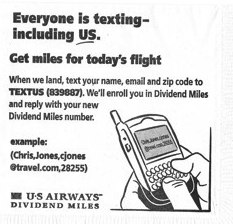
But, on a recent flight I glanced at my cocktail napkin to see this compelling and easy sign-up offer:

Other than the fact that US Airways was practically daring me to violate the in-flight ban on cell phone usage, I was enthralled. One text message with your name and email address, and you’re enrolled. Very slick.

Follow Up Good, but Unfocused

Almost immediately after signing up via text, I received a nifty email confirmation that included a digital membership card, and two offers for bonus mile via credit card offer. While the creative on the offers wasn’t spectacular, the use of transactional email to drive additional action is on the mark.

But then the next day, I received another email that mentioned something called TEXTUS (evidently the system that runs the mobile opt-in program), and asks for me to provide additional info to activate my account. I understand the need/desire for more info from me, but shouldn’t they have asked for that before I got my nifty digital membership card? I wasn’t offended, but I was confused. And that could have been easily avoided. And why was that sent a whole day later?

Then, once I did in fact log-in to provide additional information, I received another confirmation with another digital membership card, and related offers (more this time). Again not bad, but a bit puzzling.

Overall, a great program. Fills a need. Makes it easy. Confirmation and follow up is a little wacky, but extra effort for being an airline (not typically the most nimble marketers) and pulling off a mobile program.

I anticipate mobile opt-in will be big in 2009. The prevalence of SMS capable phones make it a natural for point of sale e-mail subscriptions for newsletters, special offers, and other programs.

Could you use mobile opt-in effectively? What’s your plan?

Sphere: Related Content

Welcome. If you like the content here, consider susbscribing to my RSS feed. You can also find me on Twitter @jaybaer

Jason Baer

Scott Monty - The Twitter 20 Twinterview about Social Media at Ford

Friday, October 24th, 2008

Live from Marketing Profs Digital Mixer

Photo by Doug HaslamScott Monty, the head of social media for Ford, participated in a Twitter 20 interview on October 23 and answered a wide range of questions about social media at big companies, and his ideas for the future of conversation marketing.

Scott and myself and 248 other lucky folks were in Scottsdale for the Marketing Profs Digital Marketing Mixer.

Scott Monty Interview Transcript

1. @jaybaer: How do you describe your role at Ford?

  • @scottmonty Strategist, evangelist and advisor within the the entire organization. My job, ultimately, is akin to a conductor of an orchestra.

2. @jaybaer: This is a new role within Ford? How did they handle social media before you arrived?

  • @scottmonty It’s a new role; previous SM work was handled by Social Media Group, our agency of record. Their CEO @maggiefox is my #1 advisor.

3. @jaybaer: A lot of talk at this #mpdm conference about setting social media objectives. Do you have one for Ford, or several?

  • @scottmonty We’re creating a global corporate social media strategy to guide us in everything we do. All depts, audiences, regions = complex!

4. @jaybaer: Auto is a many layered business. How do dealers view your work? Are they aware? Can and do they do their own social media?

  • @scottmonty Dealers are at every level; some barely understand email, others want to use social media. They’re busy, but SM could boost CRM

5. @jaybaer: Interesting point about CRM. Do you feel social media is more an acquisition tactic or retention and brand loyalty tactic?

  • @scottmonty Depends on how you want to use it. I’m more of a purist - I value creating awareness, changing perceptions, building relationships

6. @jaybaer: Ford is of course a large company. How does that help or hinder your social media efforts? It sounds like they’ve given you a lot of rope

  • @scottmonty To hang myself with? ;-) Good news: I’m the sole appointed expert. Bad news: I’m only one person and I’m in constant demand.

7. @jaybaer: The company has a lot of agencies and other marketing programs. Do you actively coordinate the social media efforts with them?

  • @scottmonty Yes. I sought out the Digital Marketing team early on and have connected with their agencies. International efforts are up next.

8. @jaybaer: You were at Crayon, a social media strategy firm previously. Differences in the in-house and out-of-house SM process?

  • @scottmonty It’s much more complex internally than I had assumed as an external consultant. IT, legal, and general corporate politics abound.

9. @jaybaer: What social media programs/plans are you rolling out for Ford that have you excited (other than free Ford Flex rides at #mpdm)?

10. @jaybaer: In terms of your Twitter strategy, is it de-centralized? Several people, several accounts? How do you staff it?

  • Our Twitter accounts will be distributed across departments, and in some cases will have teams on each account. We’ll ID who they R

11. @jaybaer: There’s talk about companies cutting SM budgets because it’s “experimental”. How do you balance SM and today’s auto climate?

  • @scottmonty We’re committed to social media and building relationships - can’t go dark on that. Borrow against media budgets 4 low-cost SM programs

12. @jaybaer: Some say (including here at #mpdm) “Sure he can do it, he’s at Ford. I’m a small biz, I don’t even know the 1st step.” What is step 1?

  • @scottmonty Step 1 is to find where your customers are online, and become part of that community. Listen, listen, listen. Then jump in.

13. @jaybaer: In today’s #mpdm luncheon @garyvee talked a lot about passion. Why are you passionate about social media?

  • @scottmonty I’ve seen it as the future of marketing & communications for some time. And it’s all about talking with people, which I enjoy.

14. @jaybaer: I agree that SM is the future of marketing, but when will that future arrive? Still people not online, much less Soc Media.

  • @scottmonty My best guess is some time within the next 3 years. I’d watch what happens in the newspaper industry as an indicator.

15. @jaybaer: Are you more of a Ford Flex guy or a 2010 Mustang guy? What else do you have coming out?

  • @scottmonty I’ve enjoyed driving the Flex over the last 2 days, but I’m waiting for my Mustang to be delivered. We’ve got 2 new hybrids in 2009

16. @jaybaer: Your travel schedule is onerous. Is that helping or hurting your social media outreach efforts? Wi-Fi in the new Mustang!

  • @scottmonty Now that would be dangerous! Ford & I both view my conference speaking gigs as a chance to tell Ford’s story & connect with people.

17. @jaybaer: You apparently have a Sherlock Holmes blog?http://bakerstreetblog.com Can you elaborate on that please?

  • @scottmonty Another passion. I’m a member of the Baker Street Irregulars, the 75 year-old literary society. I merged my SM passion with that.

18. @jaybaer: It’s Elementary. You also have a co-blog with@cc_chapman on diners and dives (@diners). Recommended diners or go-to items?

  • @scottmonty Diners are like politics - everyone has their preference, and all diners are local. I like the old Worcester diner car types.

19. @jaybaer: I imagine it’s been a bit of a whirlwind since you started at Ford (3+ months). What’s been most gratifying to-date?

  • 1) The excitement of my arrival at Ford; 2) Seeing the faces of bloggers as they’ve had access to super-secret areas at events.

20. @jaybaer: The rules are still being written. What bugs you? If you could outlaw one component of social media, what would it be?

  • @scottmonty Tough question. I suppose the general level of snarkiness & excoriation that happens on some sites. But that’s just human nature.
Sphere: Related Content

Jason Baer

NHL Misses Net in New Campaign - Where’s Social Media?

Wednesday, October 1st, 2008

The National Hockey League has rolled out a series of compelling TV spots featuring some of the game’s biggest stars.

And while the new commercials - with a theme of “Is This The Year?” will run nationally on Canadian broadcast and U.S. cable television, like so many campaigns, it’s being forced to go it alone.

How About Some Synergy?

Instead of launching an integrated effort, it appears that this is a TV-only exercise (created in-house by the NHL with creative consulting from Y&R).

- A search for “NHL” on Google finds no mention of the campaign in either paid or organic listing.

- The official NHL Facebook page doesn’t mention the campaign, and doesn’t link to the ads.

- The spots are not on YouTube (although they are on the NHL.com site).

- The ads are not specifically touted even on the Web sites of the featured players’ teams.

A Huge Social Media Opportunity

If there’s one sports league that could and should capitalize on social media marketing, it’s the NHL. It’s downright cultish, and very few people are ambivalent toward it. So many easy social media programs could be launched.

Contests to make your own “Is This The Year?” commercial. Contests to describe why this is indeed the year for your team. Guest blog posts from the players in the commercials. Uploading the spots to YouTube, including a “Making Of” video that shows how the innovative commercials were produced. Linking the spots from players’ Facebook pages.

And in the digital marketing realm, campaign elements might include: buying banner ads that include the commercials using rich media, video ads on Hulu.com and other sites, buying PPC ads that link to the spots, and having each team email links to the commercials to their season ticket holders.

The geo-targeted possibilities are enormous, because the NHL actually cut 2 local versions (featuring local stars) for every team in the league, and these spots will roll out soon after the national effort launches.

It’s amazing that the NHL would create what appears to be something like 70 TV commercials, and not back them up with anything in the digital marketing or social media marketing universe except for putting them on their own site.

Do you agree, or am I being too hard on the ice gang? Other examples of missed social media opportunities?


I’m on Twitter @jaybaer
Subscribe to Convince & Convert via email


Sphere: Related Content

Jason Baer

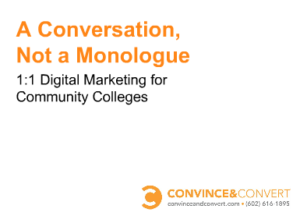
A Conversation, Not a Monologue - Digital Marketing for Colleges

Friday, September 26th, 2008

I just finished giving a speech at the western region meeting of the National Council for Marketing & Public Relations in Sedona, Arizona. 

NCMPR is the association of community and technical college marketers. A really interesting group that needs to harness social media and work with prospective students on an individual, relevant, highly personal basis. 

While this presentation was specifically for NCMPR, there is a lot of material that will be valuable to anyone looking to launch and maintain a social media and digital marketing program for a mid-sized business or organization. 

Key points in this presentation:

- Media outlets have exploded, causing audience fragmentation

- You have to communicate to audiences individually, because they don’t herd together like the old days

- Using the power of audience segmentation

- Digital marketing is critical in this new hyper-targeted marketing world, because online users identify themselves through their search queries and site usage

- Ways to find prospective community college students (Twitter, Facebook, Blog search, Flickr)

- Web site is the key to translating awareness of your college (or any brand) to action

- Web content needs to be transparent, real, and multi-modal

- Lead acquisition is critical for colleges. Give users multiple call to action options. 

- Secrets to good form design

- Web site testing and optimization basics

- Lead nurturing via personalized follow up and triggered communications


Comments are very much appreciated. Enjoy. 


Sphere: Related Content

Jason Baer

3 Reasons David Lee Roth is a Bad Internet Marketer

Monday, September 22nd, 2008

I am of a vintage that was shaped by Van Halen’s album (actually a cassette for me) 1984. With Jump, Panama, and Hot for Teacher (a video that joins “Hungry Like the Wolf” in my early teen pantheon), this was a truly epic record - highlighted by David Lee Roth’s bad boy caterwauling. 


And then, he screwed it up. Went solo. Recorded novelty hits like Just a Gigolo and California Girls, which were only slightly more legit than Weird Al Yankovic shlock. 

From 1985 until the inevitable bittersweet reunion tour in 2007, both Roth and his former band mates suffered, never recapturing their former glory (despite the yeoman efforts of Sammy Hagar). 

Internet Marketing is Not a Solo Act

Ultimately, it was proven that David Lee Roth was better as part of a group, than he was a solo artist. And the same is true of your Internet marketing efforts.

Many (and perhaps even most) agencies I talk to are trying to add digital marketing services to their capabilities by hiring their own David Lee Roth. A guru. A turtle-necked Web geek that can do it all. Don’t make that mistake.

Here are 3 reasons why the one man show routine doesn’t work.

1. It’s Unknowable

Digital marketing is a paradigm and a platform, not a job function. You can’t hire somebody who does “digital marketing” the same way you hire a copywriter or an account executive, or an art director. The field of Internet marketing is now far too broad and the nuances too numerous for one person to be able to cover all the bases on a practitioner level.

There is no way I could actually execute on the full array of tactics the way I did in 1995-2002 when the variety of tactics was semi-graspable.

The biggest mistake agencies (and clients) make is believing that the same guru that is designing and/or programming Web sites on your behalf can also handle the marketing of those Web sites. They cannot. The two skill sets are almost opposites.

Web design is a project-based, creative, inward-facing, technology-driven process. Internet marketing is an ongoing, methodical, outward-facing, relationship and message-driven process. Other than a little initial search optimization on recently completed sites, Web designers are not doing Internet marketing.

2. Knowledge in a Silo Cannot Expand

I very much believe that eventually we won’t have digital marketing departments or even digital marketing agencies. As digital (Web, mobile, digital outdoor, etc.) becomes fully integrated into the lives of a majority of the developed world, “digital marketing” will be a component of every campaign.

This convergence is already happening. Public relations and search engine optimization are blending. The growing use of video advertising online. Direct mail campaigns that use personal URLs that lead to individualized landing pages - are those “traditional” tactics, or “digital” tactics?

Eventually, digital won’t be given the special treatment the way it is today. You wouldn’t have a “radio department” and eventually you won’t have a “digital department” either.

If digital will be a part of everything, isn’t it imperative that everyone in your agency (or in-house marketing department) understand digital marketing to some degree?

If you have a guru, it gives EVERY other member of your team a built-in excuse (that you provided) to not have to get up to speed on digital marketing.

3. Asking for Trouble

If you hire a guru to handle all of your digital marketing and centralize that understanding, it creates an operational bottleneck in your organization. It’s not even a hub and spoke model. It’s just hub. Every brainstorm that requires digital thinking requires the guru. Every client meeting. Every pitch. When the guru is sick, the digital effort is grounded.

Plus, how many accounts can the guru work on competently?

It’s an extremely inefficient way to manage your personnel.

Further, since the guru gets to work on all the big accounts (because all the big accounts will want digital marketing), the guru develops quite a resume. Consequently, the guru will be endlessly recruited (perhaps even by your own clients). Eventually, the guru will leave for another opportunity that doesn’t require the ball juggling of an agency, and may include free lunch, stock options, and a big office.

Trust me. The guru will leave.

And then what? When the sum total of your organization’s digital marketing expertise walks out the door, how do you keep providing services to current clients, much less attract new ones? Typically, agencies faced with this scenario try to find Guru 2.0 which of course just perpetuates the problem.

Don’t Be Seduced by the Guru

I know fully embracing and integrating digital marketing is hard. If it wasn’t, I wouldn’t have started a consulting company to assist. The pull of hiring one person to make the pain go away is strong. But don’t fall for it.

Make a plan to distribute responsibility for digital marketing tactics to multiple members of your team. One person handles SEO. One person handles Email. One person handles online media buying. Clearly, once you have a concentration of clients that need digital marketing services from you, you may want to add staff to work on tactical execution. But until then, remember one critical fact:

Internet Marketing is Complicated, But It’s Not Hard

If your staff is bright enough to work for you, they’re bright enough to figure out part of the digital marketing arsenal.

Do you agree? What are your cautionary tales or success stories about Internet marketing gurus? I’d love to hear your comments. Let’s discuss.

Sphere: Related Content

Jason Baer

The Official Toothpaste of Social Media

Friday, September 5th, 2008

Will the Crest Weekly Toothpaste Launch Work?

Minty Fresh Blogger MouthsIn a sign that the guys who control ad budgets are getting the value of interactive advertising faster than the agencies that place it, P&G announced recently that they are introducing their new Crest Weekly toothpaste almost entirely through the blogosphere.

Samples of Crest Weekly were sent to prominent bloggers (as well as 600,000 Moms) in an effort to trigger an underground viral effect. P&G marketing honchos say that Crest Weekly is an unconventional product. You use it weekly to augment your regular brushing - it has more grit in it to give you that “just back from the dentist, but not numbed or broke” feeling. Thus, it is difficult to explain on TV.

While that makes sense, I suspect the famous data hounds at P&G are also cooking up a little test to see if social media can really carry the water for a launch.

It appears - at least for now - that it cannot, but results are inconclusive.

Ironic Lack of Word of Mouth for Oral Care Product

My search for blog posts, Tweets and other signposts indicating that bloggers indeed used Crest Weekly and wrote about it turned up fairly low volume - although Ariana Huffington’s smile looks a little brighter these days.

I found 10 separate blog posts, on well-targeted sites (beauty, women’s, shopping). I also found just one Tweet (from one of the bloggers promoting her post).
Crest in Show
My favorite among them was Tia Williams’ “Crest In Show” post that artfully wove in her background as the daughter of a dentist. Nice!

P&G has not said how many bloggers were given samples, but they did disclose that they began arriving in early August. The product launches in stores next week (mid-September).

The Cavities in the Crest Weekly Launch

There are two fundamental problems with the Crest Weekly approach.

1. They actually sent the product out too early. Blogging is a NOW thing, not a “we’re working on the December issue in August” thing. Sending out samples 6 weeks before the product launches when one use of the product will clearly communicate the benefits to the blogger is too long of a lead time.

It will be very interesting to see if blog posts about Crest Weekly intensify next week when the product launches. I suspect some bloggers are holding their posts until closer to launch. If you find some new ones on Google Blog Search or Technorati, please let me know.

2. The tactic overwhelmed the strategy. The notion that a major consumer goods manufacturer would launch a product via social media is so novel (for now) that the buzz around it became about the marketing approach rather than about the toothpaste. In fact, there are actually more blog posts (including one more once I click Publish) about the social media launch then about Crest Weekly and its magical teeth scouring properties.

Hopefully, P&G won’t interpret this to-date tepid response from the blogosphere as a sign that social media won’t work, and will instead adjust its tactical plan next time around for greater success.

In a related story, Kellogg announced today that the ROI on their digital marketing for Special K cereal (blogs, ads, microsite) is superior to the ROI for traditional advertising. While this isn’t shocking to yours truly - a well-targeted and well-executed digital program will almost always beat traditional in a pure ROI fight - for a company like Kellogg to put that information in print (Ad Week) is a quite the watershed.

Have you launched a product or brand using heavy social media? Did P&G do the Crest Weekly program right, or wrong? Please tell us your story in the comments.


My training and consulting workshops on social media, SEO, email and more>>
Get my blog posts in your email>>

Sphere: Related Content

Jason Baer

Agencies Need to be Testing Landing Pages

Monday, July 21st, 2008

Average length of stay on a Web site is approximately 2 minutes and 30 seconds overall. Approximate length of stay by visitors coming from search is about 10 seconds. Why the difference? Search users are less likely to know your company and its attributes in advance, and they know there are several other options available to them simply by clicking “back”. In short, search engine users have the attention span of a 4 year-old after three s’mores and a cup of grape Kool-Aid. 

Most marketers engaged in even semi-serious pay per click programs have determined that creating specific “landing pages” to sync with particular search terms can help combat the flighty nature of search users. If a user searches for “mustard” on Google and clicks on your ad, you don’t take them to your home page, you take them to a page that’s all about mustard. You don’t even mention ketchup. Why confuse the user with information that doesn’t specifically address their needs?

This ability to determine the specific interests of the consumer (via their search phrase) and give them marketing messages that match is perhaps the most powerful capability of the Web as a whole. It’s as if consumers are walking around with thought bubbles over their heads describing what they want to buy. 

Not to be ignored is the important fact that Google (and I presume Yahoo!) are now including the content (and download speed) of landing pages as components in the “quality score” that determines where your PPC ad appears in search results. Meaning, if the page that lies behind your Google ad is not uber-relevant to the query, your ad will be penalized for it. This makes creating great landing pages a necessity, not a luxury. 

For agencies, the creation of landing pages is a critically important service that is not often being offered to clients with the appropriate voracity. If the client is thinking about a Web site redesign, but isn’t ready or doesn’t have the budget, creating a series of outstanding landing pages can help the agency prove its Web design mettle. Further, if a variety of messaging and/or design approaches are being considered for the new Web site, testing the efficacy of those approaches on landing pages is a smart move. 

Because they lie directly in the consumers’ research and purchase funnel, landing pages provide extraordinarily useful data that can be extrapolated for use in other online and offline marketing programs. Offer testing, photo testing, price point testing. All of these can be accomplished with landing pages with relative ease.

In fact, a rigorous and ongoing program that tests new landing page components (including multi-variate testing) can have tremendous bottom-line impact for clients, and makes the agency a hero. A multi-variate test that we conducted at Mighty Interactive for a student loan company generated a 40%+ increase in leads - resulting in a financial gain of hundreds of thousands of dollars for the client. 

When testing landing pages (and really any digital marketing element), remember that small changes can make a big difference. Background colors, font, spacing, photos, headlines and more can all impact whether a consumer will buy now or buy never. Don’t overlook button labels, either. Your action button is the last thing the consumer reads before determining whether to take action. Labeling it “submit” or something equally uninspired is missing a tremendous opportunity to set the hook at a critical time. 

If you have a landing page testing success story, let’s hear about it. 


Sphere: Related Content

Jason Baer

UPDATE: GoDaddy and the .Me Domain Disaster

Thursday, July 17th, 2008

UPDATE:

Well, the .me registration was a complete and utter fiasco. Speaking from personal experience, and reporting from Mashable (soon to be joined by a lot of other reporting, I predict) - this was one of the worst examples of customer experience in my 15 years online. 

It took one full hour to check out. After having to reload every step in their byzantine shopping cart at least 3 times, I finally was able to pay. 

Then, 2 hours later (after already charging my credit card of course) I get an email saying that the domain they sold me was in fact not available. That’s like a guy from Safeway coming over to your house and taking back the sweet corn you bought in the morning because somebody else had apparently bought it too. I’ve received “out of stock” emails from e-commerce companies after checkout (which is also annoying - how about tying your online inventory to your offline inventory?), but to have that happen with a purely virtual item like a domain name is unfathomable.

Insert Conspiracy Theory

There were reports in recent months that GoDaddy was registering domains that people researched on their site (you see if a name is available, if it is and you don’t register it immediately, SURPRISE it’s taken the next day). Also, they were squatting on domains in the renewal grace period and dramatically increasing the renewal prices.

Based on that anti-customer behavior (if true), I wouldn’t be at all shocked if GoDaddy was selling .me domains, and then reviewing checkouts to find ones with aftermarket value, and keeping them for themselves. 

GoDaddy needs to spend less money on TV commercials, and a lot more on servers and a Chief Customer Experience Officer. Seems to me like their long-term plan is to achieve true market dominance (they are pretty close already) and then really start turning the screws on customers. Nice.

__________________________________________________________________________________

Tomorrow - July 17 - marks the first open registration period for the new top level domain (TLD) .me

Intended for use in personal branding, no doubt many other creative ideas for .me addresses are being hatched, perhaps similar to del.icio.us 

For PR firms and publicists, covering the .me base for clients that have existing or emerging personal brands (especially speakers and authors) is a must. 

.me domains are $19.98/year on a two-year minimum and are available most readily from GoDaddy. Domains go on sale at 8am on July 17. Use code BTPS7 and you should receive 20% off your purchase. 

More information is available from GoDaddy here.

We do not recommend moving your Web site content over to your .me address unless you have consulted a search marketing specialist, as doing so could severely curtail your inbound links and search rankings.

Sphere: Related Content

Jason Baer

Is Digital Marketing Killing Magazine Ads?

Sunday, July 13th, 2008

A report last week by the Publishers Information Bureau found that advertising pages in the nation’s magazines declined by 7.4% compared to the first half of 2007

With the stock market down by about 20%, and house prices down at least that much in some parts of the country, a 7% dip in magazine ads may seem less frightening than the prospect that Angelina Jolie will somehow end up being mother to all of the world’s children. 

However, there are two inexorable trends in marketing right now and neither bode well for magazines mid or long-term. The economy will rebound at some point, but even when that happens, will magazines recoup their share of the advertising pie? In general, I think not. 

First, marketing is increasingly about measurability, and on that front magazines score no better than any other “traditional advertising” tactic like TV, radio, or newspaper. I would put magazines ahead of outdoor on that scale, because at least they have audited circulation. But how does the savvy marketing director (or agency media buyer) determine the financial impact and ROI of magazine? Short of tracking URLs and phone numbers (which basically pass the measurement buck off to another medium), it’s pretty difficult to isolate the effect of a magazine buy - which is why digital marketing is growing and everything else is stagnating in this down economy

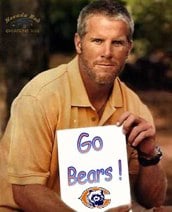
The second issue for magazines is speed. The lead times required by monthly magazines for advertising and editorial are positively anachronistic. Consumer magazines are working on their October issues right now. Seriously? By October, Brett Favre could be playing quarterback for the Bears, and all of California could be on fire. In these uncertain times, committing to expensive magazine ads 90 days in advance seems like a leap of faith that fewer advertisers are willing to make. 

And speaking of speed, magazines without an especially sharp editorial focus and solid reporting are going to have a tough time in a culture where information is conveyed in 160-character bites RIGHT NOW. Interestingly, some of the magazines showing the biggest decline in ad pages this year are those who cover topics that are perhaps covered better online by sites and blogs.

Blender (-23.5%). See www.pitchforkmedia.com, last.fm

Business Week (-14.8%) See www.thestreet.com, www.cnbc.com, www.businessweek.com

PC Magazine (-35.8%) See www.gizmodo.com, www.cnet.com

Newsweek (-22.4%) Time (-21.1%) and U.S. News (-30.3%) See www.huffingtonpost.com, www.nytimes.com, and Twitter, where thousands of people are discussing current events as they happen, not a week later. 

Interestingly, one area of magazine-ville that showed consistent gains was food publications. With gas and food prices soaring, Americans are eating out less and trying to craft delicious meals at home. I’m not sure this trend is going to do anything about the obesity problem, however, as Cooking with Paul Deen ad pages were up 31%. That lady is physically incapable of executing recipes without at least one pound of sour cream. 


Sphere: Related Content

Jason Baer

A New Weapon for Agencies in the Fight Against Digital Marketing Specialists

Monday, July 7th, 2008

Convince & Convert launches consultancy to help agencies figure out a digital marketing game plan

(July 8, 2008 — Flagstaff, Ariz.)
Thousands of advertising and public relations firms find themselves under siege as new tactics and digital specialty agencies chip away at their client base.

What’s an agency to do? Outsource digital marketing? Hire an in-house expert? Merge with a digital marketing agency? Ignore the Web and hope it goes away?

Convince & Convert, a new digital marketing consultancy, has launched to answer those questions – and more. The firm is believed to be America’s first devoted solely to helping agencies get better (and more profitable) at digital marketing. Convince & Convert improves agencies’ in-house expertise in email marketing, search marketing, Web strategy, Internet advertising, social media, and mobile marketing.

The company specializes in Digital Marketing Audit and Actions, an intensive, 2-day analysis and examination of an agency’s digital capabilities, with a detailed roadmap for improvements. The firm also works with agencies on an ongoing basis to increase in-house digital marketing expertise and profits.

The firm is led by Jason Baer, a 15-year Internet veteran who has worked with dozens of agencies and hundreds of major companies including: Nike, Fujitsu, Pulte Homes, Cold Stone Creamery, and RJ Reynolds. He founded the award-winning digital marketing firm Mighty Interactive, which he sold to integrated Tempe, AZ agency Off Madison Ave in 2005. He remains a senior consultant to Off Madison Ave.

Notes

•    To provide a true competitive advantage to its clients, Convince & Convert will work with only one agency in each U.S. market.

•    Digital marketing is expected to double in the next 4 years, according to eMarketer, yet many advertising and PR agencies continue to struggle with integrating digital marketing tactics and executing them competently and profitably for their clients. A recent Forrester Research report says agencies “…must build new interactive competencies quickly in order to succeed.”

•    Convince and Convert maintains an active blog on digital marketing issues for agencies

Tags

digital marketing, digital marketing consultants, ad agency consultants, interactive marketing consultants, internet business consultants, PR firm consultants, social media consultants, ad agency roundtable

Links

Convince & Convert digital marketing blog

Convince & Convert digital marketing consultants services and fees

Jason Baer Biography

Are You Digital Ready? Quiz for Agencies

Quotes

(attributable to Jason Baer, President Convince & Convert)

Advertising and PR firms have been having their lunch eaten for years by digital-only shops, and I’ve done some of that eating. Agencies must act now to dramatically improve their digital capabilities or their core business will begin to erode.

Ultimately, there shouldn’t be a “digital” group within an agency. Every marketing tactic should have a digital component. That’s what Convince & Convert does - shows agencies how to integrate and profit from interactive marketing.

Attributable to Forrester Research Report “Agencies Must Build Digital Skills to Survive) April, 2008

Traditional advertising agencies face significant technical difficulties. Clients are shifting business to digital shops, and consumers have turned away from media channels that built the agency industry and toward emerging Internet media. Ad agencies must build new interactive competencies quickly in order to succeed. How? They must build digital skills with a three-tiered approach of establishing digital commitment at the executive level, retraining existing staffers, and building a pipeline of future talent.

Multimedia

convince and convert logo

Get Convince & Convert Logo

Jason Baer Headshot

Get Jason Baer Headshot

Get Jason Baer Bio (PDF)

Jason Baer
Convince & Convert
(602) 616.1895
jason@convinceandconvert.com
Twitter: @jaybaer

Sphere: Related Content

Jason Baer