Posts Tagged ‘media mix’

NHL Misses Net in New Campaign - Where’s Social Media?

Wednesday, October 1st, 2008

The National Hockey League has rolled out a series of compelling TV spots featuring some of the game’s biggest stars.

And while the new commercials - with a theme of “Is This The Year?” will run nationally on Canadian broadcast and U.S. cable television, like so many campaigns, it’s being forced to go it alone.

How About Some Synergy?

Instead of launching an integrated effort, it appears that this is a TV-only exercise (created in-house by the NHL with creative consulting from Y&R).

- A search for “NHL” on Google finds no mention of the campaign in either paid or organic listing.

- The official NHL Facebook page doesn’t mention the campaign, and doesn’t link to the ads.

- The spots are not on YouTube (although they are on the NHL.com site).

- The ads are not specifically touted even on the Web sites of the featured players’ teams.

A Huge Social Media Opportunity

If there’s one sports league that could and should capitalize on social media marketing, it’s the NHL. It’s downright cultish, and very few people are ambivalent toward it. So many easy social media programs could be launched.

Contests to make your own “Is This The Year?” commercial. Contests to describe why this is indeed the year for your team. Guest blog posts from the players in the commercials. Uploading the spots to YouTube, including a “Making Of” video that shows how the innovative commercials were produced. Linking the spots from players’ Facebook pages.

And in the digital marketing realm, campaign elements might include: buying banner ads that include the commercials using rich media, video ads on Hulu.com and other sites, buying PPC ads that link to the spots, and having each team email links to the commercials to their season ticket holders.

The geo-targeted possibilities are enormous, because the NHL actually cut 2 local versions (featuring local stars) for every team in the league, and these spots will roll out soon after the national effort launches.

It’s amazing that the NHL would create what appears to be something like 70 TV commercials, and not back them up with anything in the digital marketing or social media marketing universe except for putting them on their own site.

Do you agree, or am I being too hard on the ice gang? Other examples of missed social media opportunities?


I’m on Twitter @jaybaer
Subscribe to Convince & Convert via email


Sphere: Related Content

Welcome. If you like the content here, consider susbscribing to my RSS feed. You can also find me on Twitter @jaybaer

Jason Baer

5 Reasons Why Digital Marketing Will Thrive in the Recession

Tuesday, September 30th, 2008

From Dot Bomb to Dot Boom

Let’s face it. The economy is taking on the distinctive, sickly pallor of a post Mardi Gras Keith Richards.

Generally, recessions hit the advertising business with the ferocity of a rabid wolverine, and the last one trimmed overall ad spending by 9% according to market researchers Veronis Suhler Stevenson. The wolverine in question mauled and devoured online advertising, which plummeted 27% over two years during the last recession.

This time it will be different. Not only will online marketing survive, it may actually thrive during the lean times, continuing its inexorable theft of ad spend from traditional media tactics. Online is far more mature and proven now, and there are five specific reasons why it will be the go-to tactic among increasingly budget-conscious marketers.

Money Talks

First, online is typically less expensive than many other marketing tactics, and a sizable and impactful online effort can be undertaken more quickly and cost-effectively than can an offline campaign.

Wiggle Room

Like an Elizabeth Taylor marriage, online doesn’t require much long-term commitment. PPC ads can go up and down on a day-to-day basis. Email can be sent (or not sent) based on financial considerations. Even banner ads can usually be negotiated with an advantageous cancellation clause of 72 hours or so. Try that with your local TV station or newspaper. Other than keeping your Web site up to date, the only core online tactics that require substantial ongoing effort are organic search optimization, and Web site analytics and testing.

More Juice for the Squeeze

With diminished outbound marketing budgets, companies will shift focus toward increasing revenue from current customers, either through more frequent purchases, or larger ones. Email marketing is the perfect vehicle for communicating with customers and incentivizing additional purchases. Customer lifecycle marketing (persuasively combining email with direct mail, voice mail and text messaging) will gain favor as companies strive to close a higher percentage of a reduced flow of leads.

Waste Not

There is meaningful financial waste associated with advertising to people who have no interest in your product or service. The superior targeting ability of online marketing will enable companies to focus their reduced marketing dollars solely on likely prospects. This will accelerate the trend toward use of behavioral targeting and retargeting in online ad placement.

Behavioral targeting mines a person’s Web page visits and search terms to serve relevant ads. If a prospect reads several pages on Yahoo! about Nissan Altimas and does a search on Yahoo! using a related term, an ad for Valley Nissan dealers can be served up just in time.

Retargeting (a nascent industry led by local company Fetchback) takes the concept one step further, enabling companies to advertise only to people who have visited their Web site previously without making a purchase. With average conversion rates hovering around 2%, this is an ideal way to reach the other 98% that have taken the time to visit your site but haven’t yet converted.

Additionally, search marketing will continue to expand since it is the only tactic (other than Yellow Pages) that puts the marketer in the middle of the consumer’s purchase psychology funnel. I expect heavier bidding on specific, “long tail” search terms that often correlate with greater intent to purchase.

Numbers Don’t Lie

Online marketing of all types offers superior measurability and trackability in comparison to traditional tactics. This is of course due to the Orwellian nature of the Web, where every mouse click is tracked, usually anonymously. While the availability of this data may give you the same creepy feeling you get when gazing upon Joan Rivers, it makes for effective marketing.

When implemented correctly, banner ads, organic search, paid search, blogs and social media, email, lifecycle marketing and all other online marketing tactics provide a user by user scoreboard that can be utilized to ascertain precise return on investment metrics for each campaign.

In this way, online marketing provides companies the ability to test a wide array of tactics, evaluate which generates the best response, and then adjust the marketing program accordingly.

The old saying is “I know half my marketing dollars are wasted. I just don’t know which half.” This problem is even more acute and painful in a down economy when advertising dollars are curtailed. The inherent cost, targeting, and tracking advantages of online marketing make it more likely to succeed (or at least able to minimize losses from a failed campaign). And when a wolverine is at your door, that’s the type of assurance you want from your marketing strategy.


How I help ad agencies & PR firms get better at digital marketing>>
Get my blog posts in your email>>

Sphere: Related Content

Jason Baer

The Alarming Truth About Digital Marketing’s Imperfections

Monday, September 8th, 2008

A One Legged Stool

My Job, Pre InternetThere’s no question the Internet has been good to me. The last two jobs I had before getting involved in Internet marketing in 1994 were spokesman for the Arizona Department of Juvenile Corrections (prison tours), and marketing director for Waste Management (landfill tours). I prefer this gig as it is smell and horror-free.

I’ve been doing the Internet thing long enough, however, that my hype detector is finely honed (when I hear the words “designer dog” my nose runs). And lately, the more I read about this new online boom, the more Kleenex I grab.

No question, online marketing has many enticing characteristics like trackability, ease of implementation, and targeting (all of which I’ve chronicled in these pages). But I’ve witnessed more than a handful of conversations recently where clients and even agencies have pondered “maybe we should only do online?”

The Internet Isn’t Magic

That chalk mark on the ground? That’s the line between enthusiasm and crazy, and you just crossed it. People are being lured into an illusory sense that just because it’s digital, it defies the laws of marketing. That just because a trial campaign was boffo, a 400% increase in budget should yield a commensurate increase in results.

There are a few, highly targeted businesses – especially those that operate only online – that can succeed with a purely digital marketing approach. But for most real world companies, online-only (or even online dominant) marketing will not succeed.

The Difference Between Demand Creation, and Demand Fulfillment

Why? Because at its very core, digital marketing fulfills demand much better than it creates it. The digital tactics that work best (email to current customers, search marketing, highly targeted banners, social media) work because they reach an audience that is either already aware of your company, or susceptible to your charms based on their needs and lifestyle.

At any moment in time, there are a finite number of prospective customers that are aware of your service, interested in your service, and online. Thus, there is a ceiling on the effectiveness and size of any winning digital campaign. Approximately 100 people will search today for “RV rentals.” And not much can be done online to increase that number. You can do everything possible to maximize your exposure to those 100 searchers, but that’s the size of the potential customer pool via search at present.

To grow the pool of people who are clearly interested in RV rentals (as evidenced by their search query), you have to use the much maligned and uncool world of traditional marketing. By using print, broadcast, direct mail, event sponsorship, and public relations you can grow the awareness and demand for your product or service, and PRESTO that demand will show up online.

Learn From Cupcakes

For example, an examination of historical search volume for “cupcakes” shows a consistent, slightly increasing number of daily searches from 2004 through 2006. Beginning in 2007, when the media began running frequent stories about the new gourmet cupcake trend (no doubt prodded by professional PR practitioners), search volume for “cupcakes” spiked, with a 300% increase.

….While you’re here, sign up to get my blog posts in your email

1+1=3

At Off Madison Ave, (where I handle strategic planning) we often engage in a tactic called “Media Isolation” to measure this effect and produce efficient media plans. Try it for yourself.

Take a two to four week period and run only PPC and SEO. No other outbound efforts. Then, keep the search campaign up, and add offline tactics. Reexamine results of the search program. Then, take down the traditional campaign, and continue running the search campaign.

What you’ll find in essentially every case is that the initial online campaign produces results that increase by 50-100% when traditional media is added. But most interestingly, the search campaign continues to perform better than it did initially, even when traditional media ceases. Why? Because the traditional program increased demand, and then the online tactics fulfill that demand.

This concept that offline marketing improves online marketing is powerful, but it can sometimes take a while to prove, when you consider that search latency (the time lag between when a consumer first searches for you and when they buy) can be as long as 90 days. Look at your reports in three and six month increments, not just monthly intervals, to help identify these relationships and trends.

From a marketing strategy standpoint, maximizing the effectiveness of your online efforts is a great first step, as the available data and feedback immediacy produce ROI faster than other tactics. But if you want to seriously grow your customer base, you have to put down the black turtleneck and Red Bull and employ a true mix of marketing approaches that work together to increase the number of people that care enough about your product to bother looking for it.

What do you think? Am I being too hard on Internet marketing? Leave a comment

More posts about using a true media mix>>

My digital marketing training workshops for agencies>>

Get my blog posts in your email>>

Sphere: Related Content

Jason Baer

Internet Advertising to Grow 20% in 2008

Wednesday, August 13th, 2008

A new report from Bernstein Research says online advertising in the U.S. will grow by 20% in 2008, despite weakness in travel, auto, and financials.

Top categories for online advertising spend include:

  • Finance, insurance, real estate - 29.6% of overall spend
  • Media and entertainment - 25.2%
  • Retail - 13.8%
  • Other - 12.9%
  • Auto - 8.6%
Despite big cuts in auto marketing in broadcast and print, online ads for automakers were actually up 3.8% in the first quarter. (see my blog post about auto advertising online, and why it works)

According to Bernstein’s forecast, even a significant worsening in overall economic conditions wouldn’t deter Internet advertising growth much. In a full-blown recession scenario, they predict online ads would still grow by 17%. (See my blog post on “Why Digital Marketing Will Thrive in a Recession” for more on this topic).

The Question for Agencies…

This research begs an obvious question for agencies? Are there other elements of your business that are likely to grow by 20% this year? If not, is it time to ramp up your digital capabilities?

Any agency readers of Convince & Convert care to comment about their digital progress in 2008?

How I help ad agencies & PR firms get better at digital marketing>>
Get my blog posts in your email>>
 

Sphere: Related Content

Jason Baer

3 New Features for Google’s Ad Planner

Tuesday, August 5th, 2008

Google announced on Friday via one of their blogs that they have added 3 new features to Ad Planner. 

(note: for more about Ad Planner, and Google’s long-term plan to totally change the ad agency business, read this post from Convince & Convert’s greatest hits)

Impressive that Google has made pretty significant upgrades to Ad Planner only a month after launch, and the new features make it an even more useful tool for ad agency Internet advertising buyers.

  • They’ve added more detail on sites, including a lot of stickiness metrics like time spent, total views, and average visits per visitor. This really helps understanding the potential engagement level of sie visitors.
  • If you already have sites that you know you need to include in your plan (either they’re must buys, or you’re already running them, etc.) you can just type them in, rather than having to search for them in the Ad Planner interface. 
  • Visual indicator that the site is in the plan. This is a helpful step, as it displays an icon next to sites you’ve already included so that you don’t add the same site multiple times. Nice usability touch.
If you haven’t tried Ad Planner yet, you can request an account here

I’ll review Ad Planner in-depth in a future edition of the Convince & Convert Agency Advantage Tools

Have you tried Ad Planner? Leave a comment and let me know what you think. 

How I help ad agencies & PR firms get better at digital marketing>>
Get my blog posts in your email>>
Sphere: Related Content

Jason Baer

Automakers Increase Internet Ads - Why It Will Work

Wednesday, July 30th, 2008

AdAge reports that GM has moved approximately 25% of its total media budget online over the past three years. That’s 25% of a $2 billion+ annual media spend.

A current focus for GM’s online initiatives is the new Used Car Ambush program, a microsite and online campaign intended to convince used car shoppers to purchase certified GM used vehicles, rather than those sold by private parties.
GM Used Car Ambush Web Site

The site is perhaps a bit too polished to pull off its desired “organic” vibe, and it requires a serious download commitment from the user. But, this type of online-only content and accompanying campaign demonstrates that car makers are trying to use the Web to make their overall media spend more efficient in these tough economic times.

Targeted Ads Are More Efficient

From an online advertising standpoint, moving dollars online (at the expense of TV) is a no-brainer for automotive and other highly considered purchases. Here are just a few of the way you could target your advertising online to reach only consumers with a demonstrated interest in making a vehicle purchase in the near future:

- Manufacturer Web site
- Dealer Web sites
- Paid search
- Organic search
- Behaviorally targeted banner ads
- Ads on auto aggregator sites like cars.com
- Ads on blogs and social networking sites devoted to vehicle research and reviews (However, we do not recommend ads on social networks. Here’s 3 reasons why:)

Conversely, here are the ways to isolate TV viewers so that you are only reaching folks that are currently in the market for a vehicle:

- Using demographics and psychographics and hoping for the best

Furthermore, reaching out to prospective buyers online enables automakers to presumably collect data from Web site visitors, allowing for ongoing, targeted follow up via email, postal mail, etc.

Broadcast Is Not a Research Medium

Of course it’s true that the Web doesn’t reach everybody. As Dan Gorrell from Autostrategem mentioned in the AdAge account of GM’s spend, 34% of U.S. new vehicle buyers do not use the Internet to shop for an auto. He states that this makes GM’s online strategy a “double-edged sword.”

This makes zero sense to me. First, if 66% of the country IS using the Web to research new vehicle purchases, that’s a colossal market segment. Second, I very much doubt that the other 34% are instead using television to research vehicles. How would that work exactly? You watch “24″ hoping commercials for cars you like appear at the breaks?

Comparing Internet and TV as opportunities for consumer pre-purchase research is like comparing apples and chihuahuas.
Apples - Internet Advertising

chihuahua - Internet advertising

Broadcast Creates Demand. Online Fulfills It

Let’s don’t go crazy, however. There’s no question whatsoever that online advertising doesn’t have the reach or power to go it alone for a broad category like automotive. You need TV to generate initial interest and awareness (unless it’s just an under the radar program like Used Car Ambush). Once that awareness takes root via broadcast, the online components of the campaign pick up steam in a hurry.

I’ve seen this happen many times, and it’s an easy phenomenon to measure (and agencies should try it). Measure search volume for your key terms. Then run a broadcast campaign (alone) for a couple of weeks. Then remeasure your search volume. You’ll find it goes up considerably. The same thing happens with banner ad campaigns. Click through rate always goes up after the market has been “softened” by broadcast.

Automakers looking to market more efficiently should reduce their TV spend and use it in short bursts at the beginning of campaigns to introduce new models and programs, and then follow up with aggressive Internet advertising programs that are much more targeted and cost effective.

Do you agree? Leave a comment.

Sphere: Related Content

Jason Baer

3 Reasons Why Social Networks Are Bad Ad Buys

Friday, July 25th, 2008

A recent article by Michael Estrin in iMediaConnection asks whether social media has lost its luster from an advertising standpoint.

Traffic and usage of the major social networks continues to soar, with traffic to Facebook and Linked In up considerably in the past 30 days. In fact, LinkedIn which is considered to be the least social of the social networks but the most popular among more seasoned business users, is up 187% year-over-year.

However, based on Estrin’s article, online media buyers are increasingly shunning social networks even though their audiences are huge and impressions are plentiful.

Pack Mentality, or Performance Issue?

For some media buyers, this poo-pooing of social media ad buys could be a herd effect. “people are saying social media isn’t a good buy, so I’m not buying it.” For other online media types - including yours truly - there’s another fact at work….

Historically, Ads on Social Networking Portals Don’t Work

I have personally supervised the purchase of many ads on MySpace and Facebook, and the performance of those ads has been consistently terrible when compared to the same ads targeting the same people running on different sites. I believe there are 3 reasons why this is true.

#1 - Proprietary Formats

Have you really looked at a social network page lately from an advertiser standpoint? It’s just an absolute mess. Facebook encourages users to cram as many applications and widgets as possible onto their profile pages, making for significant tunnel vision. Who can even notice the banner, when you’re being invited to play “Can you Name This Candy Bar” by a long-lost high school flame?

Not to mention the fact that the Facebook “banner” format is not really a banner at all, but a text-heavy, seemingly contextual ad that purports to serve up relevant offers based on your profile data. However, I seem to get an ad for liposuction every third visit, which while debatably necessary, doesn’t endure me to Facebook (nor to my Wii Fit which give me the “you’re obese” message when I log on - I love being ridiculed by my gaming system).

So, considering you can’t do anything remotely creative within the Facebook ad area, is it any wonder that the ads don’t pull? Why can’t Facebook use IAB standard ad formats like everyone else?

#2 Too Much Clutter

The second issue is the inability to determine if an ad is actually an ad. This is the biggest problem with MySpace, which has page layout regulations approximately equal to Chinese air quality standards. Lax, at best.

As the screen shot below for Paris Hilton Zombie demonstrates, the folks at University of Phoenix are not likely to be getting a lot of solid eyeballs on their banner, which even if it sprayed acid out of the computer monitor would be less arresting than the rest of the page.

#3 Lack of Relevancy

The success of the social networks in attracting huge audiences that pile up the page views actually hurts the sites from an advertising perspective. To even remotely fill their massive inventory, these sites are accepting run-of-site, low CPM deals as long as the advertiser meets a minimum overall spend ($10k+ in most instances).

As a result, the ads you see on these sites (especially MySpace) are frequently mismatched with their viewers. Considering heavy social network users view 30+ pages per visit, it takes about 2 visits to realize that most of the ads on the site are not targeted, nor relevant, therefore why bother paying them any attention? Imagine if every Super Bowl commercial was for discount embalming services. By halftime, you’d be ready to tune out.

While this trend is perhaps most egregious on these sites due to their millions of page views per hour, the explosion of ad inventory online is an industry-wide problem. I don’t blame sites for trying to monetize their content, even if it’s at $1 per thousand impressions, but the subsequent lack of ad relevancy trains users that banner ads usually don’t have anything interesting to say, and that hurts all advertisers.

The media buyers that are still buying social network ads are contributing to the problem by not implementing impression or frequency caps. I saw the same University of Phoenix ad about 9 times in a row on MySpace. That’s not an efficient or smart media purchase.

If you’ve got examples of good (or bad) social network advertising, leave a comment.

Sphere: Related Content

Jason Baer

Is Digital Marketing Killing Magazine Ads?

Sunday, July 13th, 2008

A report last week by the Publishers Information Bureau found that advertising pages in the nation’s magazines declined by 7.4% compared to the first half of 2007

With the stock market down by about 20%, and house prices down at least that much in some parts of the country, a 7% dip in magazine ads may seem less frightening than the prospect that Angelina Jolie will somehow end up being mother to all of the world’s children. 

However, there are two inexorable trends in marketing right now and neither bode well for magazines mid or long-term. The economy will rebound at some point, but even when that happens, will magazines recoup their share of the advertising pie? In general, I think not. 

First, marketing is increasingly about measurability, and on that front magazines score no better than any other “traditional advertising” tactic like TV, radio, or newspaper. I would put magazines ahead of outdoor on that scale, because at least they have audited circulation. But how does the savvy marketing director (or agency media buyer) determine the financial impact and ROI of magazine? Short of tracking URLs and phone numbers (which basically pass the measurement buck off to another medium), it’s pretty difficult to isolate the effect of a magazine buy - which is why digital marketing is growing and everything else is stagnating in this down economy

The second issue for magazines is speed. The lead times required by monthly magazines for advertising and editorial are positively anachronistic. Consumer magazines are working on their October issues right now. Seriously? By October, Brett Favre could be playing quarterback for the Bears, and all of California could be on fire. In these uncertain times, committing to expensive magazine ads 90 days in advance seems like a leap of faith that fewer advertisers are willing to make. 

And speaking of speed, magazines without an especially sharp editorial focus and solid reporting are going to have a tough time in a culture where information is conveyed in 160-character bites RIGHT NOW. Interestingly, some of the magazines showing the biggest decline in ad pages this year are those who cover topics that are perhaps covered better online by sites and blogs.

Blender (-23.5%). See www.pitchforkmedia.com, last.fm

Business Week (-14.8%) See www.thestreet.com, www.cnbc.com, www.businessweek.com

PC Magazine (-35.8%) See www.gizmodo.com, www.cnet.com

Newsweek (-22.4%) Time (-21.1%) and U.S. News (-30.3%) See www.huffingtonpost.com, www.nytimes.com, and Twitter, where thousands of people are discussing current events as they happen, not a week later. 

Interestingly, one area of magazine-ville that showed consistent gains was food publications. With gas and food prices soaring, Americans are eating out less and trying to craft delicious meals at home. I’m not sure this trend is going to do anything about the obesity problem, however, as Cooking with Paul Deen ad pages were up 31%. That lady is physically incapable of executing recipes without at least one pound of sour cream. 


Sphere: Related Content

Jason Baer

Media Buyers Say Internet Advertising Will Grow in Next 6 Months

Monday, July 7th, 2008

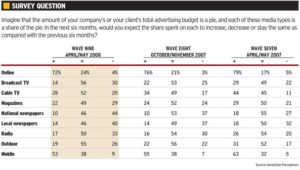
Market Research firm Advertising Perceptions released a new survey of 1,811 media buyers showing that a whopping 72% of them believe Internet advertising spend will increase in the second half of 2008.

This is a shocking finding, considering that no other medium (other than mobile) was expected to grow by more than 28% of the respondents.

The outlook for newspapers and radio was especially pessimistic, with more than a third of respondents projecting overall spend to drop for those media in the next 6 months.

While we’re big supporters of mobile here at C&C, 55% of media buyers suggesting that mobile spend will increase was also a suprise. As a somewhat experimental tactic, we’d expect mobile to be set aside temporarily in this down economy. However, the measurability of mobile (which is also a terrific database acquisition tactic) could be fueling the optimism about it.

Without question, the measurability of Internet advertising and search marketing is what’s driving the move of ad dollars from traditional tactics like newspaper toward digital marketing. This move is going to be even more acute in a recession, as digital’s cost-effectiveness, speed of deployment, and targeting capabilities make it a “safe” media bet for most companies and agencies.

It will be very interesting to see if this movement of ad dollars toward digital results in markedly higher CPMs for banner ads by year end. We’re already seeing increases in PPC costs due to the “over-popularity” of Google.

Sphere: Related Content

Jason Baer

What’s Your Word Worth? Measuring Word of Mouth Online

Monday, June 30th, 2008

Fascinating article in BrandWeek today about putting a value on word of mouth marketing.

BzzAgent, a word of mouth marketing agency (how’s that for a good gig if you can get it), says they figure an online conversation about a brand is worth 50 cents.

It’s admirable that somebody is trying to put a value on word of mouth and social media marketing, because today it looks a lot like that Smoke Monster on Lost, or SEO pricing circa 1999. But, I’m not sure that 50 cents is a metric that makes sense. Interesting, however, is the fact that a much more rigorous study conducted by ChatThreads Group found a 51 cent average value (based on estimated number of product units sold).

Note: Here is a nice slide deck from Digital Influence Group on measuring social media, via SlideShare

The biggest problem I have with this type of math is that it is so inherently tied to all other facets of an integrated marketing plan. Word of mouth isn’t like search marketing, where you need something, you look for it, and you find it. Via search, I’ve found a company or product I didn’t otherwise know countless times. With word of mouth, it seems more likely that a product or service will be mentioned and I’ll already know it, it’s just a reminder. Thus, it’s not a “new mention” but a “reminder mention” and that’s worth less to me as a marketer.

Further, the biggest fallacy is assuming that all digital word of mouth mentions are equivalent. A prominent post on Trip Advisor or Yelp may get a lot more eyeballs than a similar comment on a small, localized travel site. In that way, digital word of mouth is the same as network TV, radio, or print. The number of people paying attention dramatically impacts the worth of the medium.

(incidentally, Internet advertising whether banners or pay per click is the one exception. You buy as many impressions or click as you want, and the overall size of the site’s audience is somewhat immaterial - one of the reasons I love Internet advertising).

For now, while I applaud the notion of putting a value on conversations online, I’ll stay away from recommending valuations or valuation methods until it shakes out a bit more. I suggest you do the same.

Sphere: Related Content

Jason Baer